A CRO strategy is a plan for improving your website’s conversion rate through research and testing. Matched to where your business actually is right now. Not where some consultant thinks you should be. Where you are today.
Most businesses skip this entirely. They read a blog post about what CRO is, get excited, test a random button color, see no results, and decide CRO doesn’t work for them. That’s not a strategy. That’s a coin flip with extra steps.
The approach that actually works looks more like a fitness plan. You wouldn’t walk into a gym on day one and deadlift 300 pounds. You’d start with what you can handle, build habits, and increase the weight over time. CRO works the same way. What you should focus on in month one looks nothing like what you should focus on in year two.
The CRO audit checklist gives you a structured starting point for research. This conversion rate optimization guide gives you a phased CRO strategy framework, organized by business maturity. With real numbers, realistic timelines, and none of the “just test more” advice that sounds helpful but isn’t. If you’re ready for a step-by-step template for building your initial conversion optimization plan, we have a companion guide for that.
What a CRO strategy actually is (and why most companies skip it)
A conversion rate optimization strategy is the plan. Tactics are the individual things you test. Process is how you run each test. Most people mash these together. Like confusing a recipe with a grocery list and a kitchen timer.
A strategy answers: “Given our traffic, our goals, and our current skills, what should we work on first?” Tactics answer: “What specific change should we try on this page?” Process answers: “How do we actually run and measure the test?”
This post covers strategy. For tactics, check out proven CRO tactics. To understand the step-by-step CRO process for running each test from hypothesis to analysis, we have a dedicated guide. And for a broader look at what digital CRO covers across websites, apps, email, and more, start there.
Here’s why most businesses skip the strategy part: it feels slow. You’ve got a landing page that isn’t converting. You want to fix it now. So you jump straight into landing page optimization without a plan, change the headline, swap the hero image, add a testimonial, and launch everything at once. Two weeks later, conversions went up 3%. Or down 2%. You have no idea what worked.
That’s not just a you problem. 47% of CRO programs have no clear goals at all. Nearly half the companies doing this work can’t tell you what success looks like. No wonder so many give up.
Where your business sits today: the CRO maturity check
Speero (a research and consulting firm focused on experimentation) breaks companies into five maturity levels. We’ve simplified their framework into something you can use in two minutes.
Answer these five questions honestly:
- Do you track conversion rates for your key pages? (not just overall site traffic)
- Have you ever run a structured A/B test? (not just “we changed the page and hoped”)
- Do you have a list of test ideas ranked by potential impact?
- Do you review test results at least monthly?
- Do you share what you learned from tests across your team?
0-1 “yes” answers: You’re at the starting line. Begin with Phase 1, or check out our CRO guide for beginners for a structured starting point. 2-3 “yes” answers: You’ve got the basics. Jump to Phase 2. 4-5 “yes” answers: You’re ahead of most companies. Start at Phase 3 or 4.
For context: only 10% of companies reach the most mature testing level. But the trajectory is positive. 54% of companies now sit at strategic or transformative maturity, up from 35% in 2021. The industry is growing up. And there’s a reason: businesses with mature testing programs are 69% more likely to grow significantly.
That’s a “should I take this seriously?” number. Yes. You should.
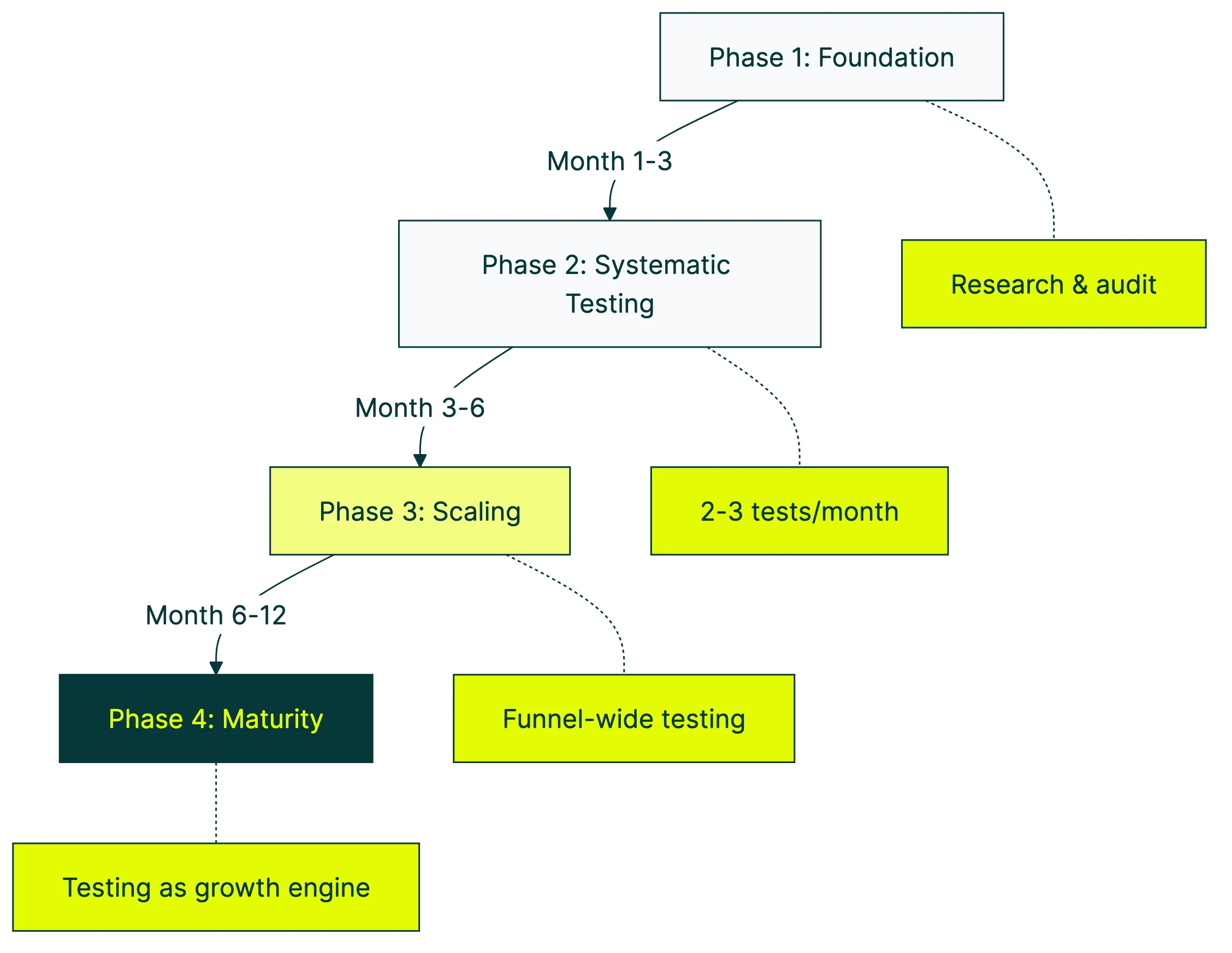
Here’s what each phase looks like at a glance:
| Phase | Timeline | Focus | Test velocity |
|---|---|---|---|
| 1. Foundation | Month 1-3 | Research, audit, tool setup | 0-2 tests total |
| 2. Systematic testing | Month 3-6 | Build a testing habit | 2-3 tests/month |
| 3. Scaling | Month 6-12 | Funnel-wide testing | 4-8 tests/month |
| 4. Maturity | Year 2+ | Testing as a growth engine | 16+ tests/month |
Phase 1: foundation (month 1-3): research before you test
CXL (one of the most respected voices in conversion research) has a principle called ResearchXL. 80% of CRO is research, 20% is testing. Most companies flip this. They jump straight into testing without knowing what’s wrong. Like taking medicine before getting a diagnosis.
Focus on these first:
Look at your data. Open your analytics. Find the pages that get the most traffic but have the lowest conversion rates. Those are your biggest opportunities. If your pricing page gets 5,000 visits a month but only 1% click “start trial,” that’s where the money is. Not your blog sidebar.
Run a conversion audit. Walk through your own website as if you’ve never seen it. Try to buy something. Try to sign up. Note every moment of confusion, friction, or “wait, what do I click?” That list is gold. For a detailed approach, use our conversion audit framework.
Set up your tools. You need analytics (you probably already have GA4, and here’s how to track your ecommerce conversion rate in GA4 if you haven’t yet) and a testing tool. Keep it simple. You don’t need five platforms and a data warehouse. You need something that lets you change a headline and see which version gets more clicks. Kirro lets you set up your first test in about three minutes, no developer needed. Check out our roundup of CRO tools if you want to compare options.
Build your first test list. Write down 5-10 ideas based on what your audit found. Not assumptions. Not “I think the button should be green.” Actual observations like “the signup form asks for a phone number and nobody fills it out.” Rank them by which ones you think could make the biggest difference. In the industry, people call this a “test backlog.” It’s just a prioritized list. If you’re optimizing B2B conversion rates, start with demo request and pricing pages.
Set realistic expectations. You might run zero to two tests in this phase. That’s normal. These conversion rate optimization tips sound unsexy compared to “run 10 tests this week,” but they work. Rushing to test without research wastes your traffic. Think of every visitor who sees a poorly conceived test as a missed opportunity.
Our take: Most “getting started with CRO” guides tell you to run a test on day one. That sounds exciting. It’s also how you burn through three months of good traffic learning nothing useful. Do the boring research first. It pays off faster than you’d think.
Phase 2: systematic testing (month 3-6): build the habit
You’ve done your research. You know which pages need help and you’ve got a list of ideas to try. Now it’s time to build a testing habit.
The median company runs about 3 tests per month. That number comes from Optimizely’s analysis of 127,000 experiments. It’s one of the largest datasets on testing behavior available. For a small team just getting started, 1-2 per month is realistic. And perfectly fine.
The uncomfortable part from that same dataset: only 12% of tests produce a clear winner. Roughly 1 in 8. The other 88% either show no difference or the original actually beats the new version.
That’s how this works. If you knew which changes would win before testing, you wouldn’t need to test. The 12% win rate is normal, even for companies with massive CRO teams. If someone tells you every test they run is a winner, they’re either lying or not measuring correctly. For proof, check out these real-world CRO case studies with methodology ratings for each one.
How to pick which tests to run first. Use a simple scoring method. For each idea on your list, rate three things on a scale of 1-5. How big could the impact be? How confident are you it’ll work? How easy is it to set up? Multiply the scores together. Start with the highest number. CRO people call this “ICE scoring” (Impact, Confidence, Ease), but the name doesn’t matter. The ranking does.
Where to start testing. Headlines, calls to action (the buttons and links you want people to click), and page layout. These are your highest-impact, lowest-effort starting points. A headline test takes minutes to set up. Kirro’s visual editor lets you change text, images, or buttons and start testing right away. No waiting for a developer to make time. Explore different types of CRO tests to see what fits your situation.
How to split your time. Roughly 40% research, 40% building and running tests, 20% analyzing results. If you’re spending all your time running tests and never looking at what you learned, you’re on a treadmill. Moving but not going anywhere.
One more number worth knowing: tests that make bigger, more meaningful changes (rearranging a whole page section, not just changing a font) are 25% more likely to produce a winner. Small tweaks are easy to run but rarely move the needle. Don’t be afraid to test something bold.
Our take: The 12% win rate is actually great news. It means you don’t need to be a genius to run a successful CRO program. You need to be consistent. Run enough well-researched tests and the wins add up. It’s compound interest for your website.
Phase 3: scaling (month 6-12): from occasional tests to always-on
By now you’ve run a dozen or more tests. You’ve learned what your audience responds to. You know which pages matter most. Time to shift from testing individual elements to testing across your whole conversion funnel. That’s the path visitors take from landing on your site to becoming a customer. If you haven’t already, map your conversion funnel so you can see every stage and identify which transitions lose the most people. Then use our conversion funnel optimization guide to systematically improve each stage.
Test velocity targets. Aim for 4-8 tests per month, depending on your traffic. Here’s a realistic breakdown:
- 10,000-50,000 weekly visitors: You can run 2-3 tests at the same time on different pages
- 50,000-200,000 weekly visitors: 3-5 tests running at once is doable
- Under 10,000 weekly visitors: Stick to 1 test at a time. You need enough people seeing each version to get reliable results.
Matching your test velocity to your traffic level is a core conversion rate optimization technique. Traffic is the constraint nobody talks about. Every CRO guide says “run more tests.” Helpful. Like telling someone with $50 to diversify their stock portfolio. You can only run as many tests as your traffic allows. Going beyond that gives you unreliable results, which is worse than no results at all.
Connect CRO to business goals. Up until now, you’ve probably been measuring page-level numbers: “this version got 15% more clicks.” That’s useful. But the real question is: did those extra clicks turn into revenue? Start connecting your test results to the metrics your boss (or your own bank account) actually cares about.
If measuring A/B test conversion rates across your funnel feels complicated, it doesn’t have to be. Track the end-of-funnel action (purchase, signup, demo request) alongside the page-level metric. Sometimes a page change that increases clicks actually decreases final conversions. Better to know that now.
Build a learning library. Document every test result. Wins, losses, and draws. Write down what you tested, what you expected, and what actually happened. 58% of companies lack any kind of knowledge system for test insights. That means more than half are relearning the same lessons over and over.
Your learning library doesn’t need to be fancy. A spreadsheet works. The point is that when someone asks “have we ever tested pricing page layout?” the answer isn’t “I think maybe, two years ago? Ask Dave. Wait, Dave left.”
Think about how CRO and SEO work together at this stage too. Some tests that improve conversions can hurt your search rankings if you’re not careful. Knowing the overlap saves you from winning one battle and losing another.
Phase 4: maturity (year 2+): CRO as a growth engine
The top 10% of testing programs run 16 or more tests per month. That’s not the goal for everyone, and honestly, it doesn’t need to be. The goal is making experimentation the default way you answer business questions.
Booking.com runs over 1,000 tests at the same time, every single day. You don’t need that scale. But the principle behind it is worth stealing: don’t debate whether a change will work. Test it. Let the data answer.
At this level, CRO stops being about individual pages. The most important of all conversion rate optimization strategies: test entire customer journeys, including personalization for your website and AI-driven optimization. Email → landing page → signup flow → onboarding. Each piece affects the others. Mobile teams take this even further with app CRO strategies that span from store listing to paywall. A better email subject line means more people land on your page. A better page means more signups. A better onboarding means fewer people cancel. The whole chain matters.
Connect testing to customer lifetime value. Not just “did they convert?” but “did they stick around?” A popup that offers 50% off might boost signups by 30%. But if those discount-seekers cancel after a month, you’ve actually lost money. The mature CRO teams measure long-term value, not just the initial click.
One number puts all of this in perspective. Companies spend just $1 on CRO for every $92 they spend on acquiring customers. Ninety-two dollars getting people to your site. One dollar figuring out if the site actually works when they get there. Even a small rebalance toward testing pays off.
If you’re building toward this level, consider investing in CRO training for your team, building a formal CRO program with shared ownership, or choosing to partner with a CRO agency that can scale testing velocity faster than an internal hire.
The metrics that prove your CRO strategy is working
Most teams only measure conversions. That’s like grading a school only on test scores and ignoring whether students are learning. You need two sets of numbers.
Conversion metrics (is the website getting better?):
- Conversion rate by page, not just overall site average
- Revenue per visitor (how much money each visitor generates on average)
- Bounce rate by traffic source (how many visitors leave without doing anything, split by where they came from)
Program health metrics (the metrics to help you analyze conversion rate optimization progress over time):
- Test velocity: how many tests you run per month
- Win rate: what percentage of tests show a clear winner
- Average improvement per winning test
- Time from idea to live test
62% of companies don’t measure program health at all. They know their conversion rate went up 0.5% last quarter. But they can’t tell you if their testing program is getting faster or smarter. That’s flying blind.
And watch out for vanity metrics. The Optimizely 127k experiments report found that 3 of the 5 most commonly tracked metrics have the lowest correlation with actual business impact. If a metric makes you feel good but doesn’t connect to revenue, question whether it belongs on your dashboard.
Good measurement habits are the conversion rate optimization best practices that separate growing programs from stalled ones. For the full breakdown of which metrics matter and which ones just look pretty in a report, read our CRO metrics guide.
CRO marketing strategy mistakes that stall progress
Testing without research. The “throw spaghetti at the wall” approach. You run 10 tests based on gut feelings and none of them win. Not because CRO doesn’t work, but because the hypotheses were bad. Research first. Always. Look at your analytics, watch session recordings, read customer support tickets. Then form your test ideas.
Expecting every test to win. Now you know: 12% is normal. If you’re judging your CRO program by a single test result, you’re doing the equivalent of flipping a coin once and calling yourself a psychic. The value is in the pattern, not the individual flip.
Only testing tiny tweaks. Button color. Font size. Image swap. These feel safe. They’re also rarely meaningful. Tests that make significant changes to user experience are 25% more successful than minor cosmetic tweaks. If you’re going to invest the traffic, make the test count.
Quitting after one bad result. “We tried CRO. It didn’t work.” This is like going to the gym once, not losing 10 pounds, and deciding exercise is a scam. One inconclusive test tells you almost nothing. A pattern of 10 tests tells you a lot.
Ignoring what customers actually say. Surveys, support tickets, session recordings, chat logs. These are the raw materials for better test ideas. The best CRO teams use qualitative data (what people say and do) to generate hypotheses. Then quantitative data (the test results) to validate them. Numbers alone won’t tell you why people behave the way they do.
Not writing down what you learn. You ran a great test six months ago. What was the result? What did you change based on it? If nobody remembers, you’ll run the same test again. Or worse, make the same mistake. Write it down. A simple doc beats a perfect memory every time.
For testing-specific pitfalls, see our guide on common A/B testing mistakes.
FAQ
What is a CRO strategy?
A CRO strategy is a structured plan for improving your website’s conversion rate through research-backed testing. Instead of making random changes and hoping something works, a strategy tells you what to test and in what order. The key difference from random testing: a strategy adapts to your business’s current maturity level, traffic, and resources.
How do I create a CRO strategy from scratch?
Start with a conversion audit to find where visitors are dropping off. Set baseline metrics so you know your starting point. Build a prioritized list of test ideas based on data, not hunches. Then work through the phases: foundation (month 1-3), systematic testing (month 3-6), and scaling (month 6+). If you want a step-by-step template for the plan itself, check out our conversion optimization plan template.
What’s the difference between CRO strategy and CRO tactics?
Strategy is the plan: what to prioritize, in what order, and why. Tactics are the individual actions: testing a headline, simplifying a form, adding a trust badge. A strategy without tactics doesn’t improve anything. Tactics without a strategy waste time on random changes that might not matter. For a list of proven CRO tactics, see our separate guide.
How long does it take for a CRO strategy to show results?
Individual tests can show results in 2-4 weeks. But the real power of CRO takes 3-6 months to kick in. The compounding effect, where each test builds on what you learned from the last one, needs time to develop. Speero recommends 3-month strategic periods as the minimum planning window. If someone promises results in a week, they’re selling you something.
How many A/B tests should I run per month?
The median company runs 3 tests per month. For small teams starting out, 1-2 per month is realistic and fine. Your traffic volume sets the ceiling: sites with 10,000-50,000 weekly visitors can typically run 2-3 tests at the same time. Quality matters more than quantity. One well-researched test beats five random ones every time. Try running your first test to see how the process feels before committing to a schedule.
What are the best conversion rate optimization techniques for small businesses?
Start with your highest-traffic, lowest-converting page. Test the headline first (it’s usually the biggest lever). Then test your call to action: the text, the placement, the color. Move to page layout and form simplification after that. These conversion optimization techniques give you the highest return with the least effort. For a full breakdown of techniques by business type, see our CRO recommendations guide and explore how to increase your conversion rate step by step. If you want a hands-on walkthrough, our guide on how to optimize conversion rate step by step covers the full sequence from audit to implementation. If you sell products online, our ecommerce CRO strategy guide covers what to prioritize for online stores. If you’re a local or service-area business, our local business CRO strategy guide covers what to prioritize when your customers are in your area.

Randy Wattilete
CRO expert and founder with nearly a decade running conversion experiments for companies from early-stage startups to global brands. Built programs for Nestlé, felyx, and Storytel. Founder of Kirro (A/B testing).
View all author posts