A CRO agency is a team you hire to figure out why people leave your website without buying. They run conversion rate optimization tests until the numbers go up. Good ones run structured tests. Bad ones redesign your homepage and call it “optimization.”
The tricky part is telling them apart. Most agency roundups online are written by agencies ranking themselves first. This one isn’t. We don’t sell CRO services. So we can be honest about what to look for, what to avoid, and when you shouldn’t hire one at all.
What a CRO agency actually does
A CRO agency’s job is four steps. Research what’s broken, come up with fixes, test those fixes on real visitors, and measure what happened. Then repeat.
The good ones treat it like a science project. The bad ones treat it like a creative brief.
The difference that matters? A real CRO agency runs A/B tests where half your visitors see version A and half see version B. They wait until enough people have visited to draw a reliable conclusion. Then they tell you which version won and why.
A bad CRO agency redesigns your checkout page based on “best practices” and launches it. Then they send you a report showing revenue went up 12%. What they don’t mention: it was December. Revenue always goes up in December.
73% of CRO programs don’t deliver measurable results, according to Econsultancy research. Most agencies don’t run enough tests. They don’t wait for reliable data. And they don’t have a real process.
Our take: The number one question to ask any CRO agency is “walk me through your process.” If they can’t describe a repeatable system in plain language, keep looking.
Types of CRO agencies (by specialization)
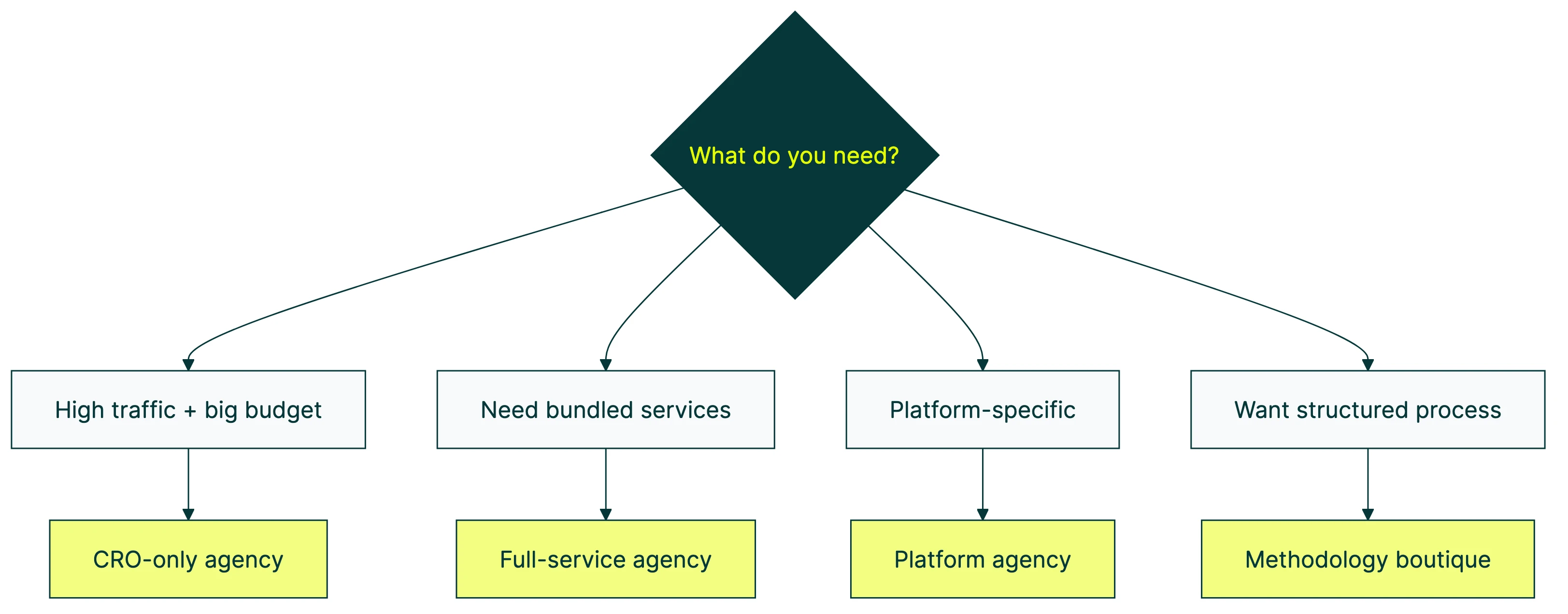
Dedicated CRO-only agencies do nothing but conversion rate optimization. Companies like Conversion, Conversion Rate Experts, and Speero eat, sleep, and breathe testing. Their teams are researchers, data people, and testing specialists.
If your site gets serious traffic and you want serious results, this is the category.
Full-service shops like KlientBoost or NP Digital offer CRO as one of many services. You get CRO bundled with paid ads, SEO, or design. The upside: one vendor, one invoice.
The downside: CRO is rarely their strongest skill. It’s the side dish, not the main course.
Then there are platform-specific agencies that focus on one type of website. Shopify CRO, SaaS landing pages, or B2B conversion optimization. They know the quirks of your platform inside out.
If you’re running a Shopify store, an agency that’s tested 200 Shopify checkouts will beat a generalist who’s tested 5.
Methodology-driven boutiques lead with a specific approach. Some use ResearchXL (a step-by-step research process that decides what to test). Others follow a Kaizen approach (small continuous improvements instead of big redesigns).
The “methodology” is just their system for deciding what to test and in what order. If they can explain it clearly, that’s a good sign.
Wondering whether you need an agency or a single expert? See our guide on hiring a CRO consultant for the solo-expert route, or browse the full CRO services landscape. If your main need is testing specifically, our A/B testing agency guide breaks down costs and when the math works.
| Type | Best for | Typical cost | Watch out for |
|---|---|---|---|
| CRO-only agency | High-traffic sites wanting dedicated focus | $10K-30K/mo | Can be overkill for smaller sites |
| Full-service agency | Teams wanting CRO bundled with other marketing | $5K-15K/mo | CRO may not be their specialty |
| Platform-specific | Shopify, SaaS, or ecommerce stores | $3K-15K/mo | Limited if you outgrow the platform |
| Methodology boutique | Companies wanting a structured process | $5K-20K/mo | Approach may not fit every business |
The best Shopify CRO agencies
Shopify’s page-building system (called Liquid templates) limits what you can change on certain pages. The checkout is especially locked down unless you’re on Shopify Plus. App conflicts can break tests.
A generalist agency will spend your first two months learning this. A Shopify specialist already knows.
Here are agencies with real Shopify CRO track records:
- SplitBase focuses on DTC (direct-to-consumer) brands doing $1M+ in revenue. Known for deep customer research before testing.
- Blend Commerce works with mid-market Shopify stores. Strong on product page and collection page testing.
- Charle Agency is a UK-based Shopify Plus partner. Heavy on checkout and post-purchase testing.
- CRO Media specializes in conversion testing for Shopify merchants. Ecommerce only.
- Convertibles works across ecommerce platforms but has published detailed Shopify cost breakdowns.
For context: average Shopify conversion rates sit between 1.4% and 2.0% depending on your product category. Shopify’s own data shows Shop Pay lifts checkout conversions by about 50% compared to guest checkout. If you haven’t turned that on yet, do it before calling any agency. For a full breakdown of what to fix yourself first, see our guide to Shopify conversion optimization.
How much CRO agencies charge (real numbers)
Nobody in this industry talks about pricing clearly. So here are the real ranges, pulled from Invesp’s pricing data, Convertibles’ cost analysis, and our own research across agency websites:
Monthly retainers (the most common model):
- Entry-level: $2,000-5,000/mo. Usually 2-4 tests per month with basic research.
- Mid-tier: $5,000-15,000/mo. Deeper research, 4-8 tests per month, dedicated team.
- Top-tier: $10,000-30,000+/mo. Full CRO program with research, testing, personalization, and strategy.
Other pricing models:
- Hourly consulting: $80-200 for a qualified specialist, $200-500 through an agency
- One-time CRO audit: $500-4,500 depending on scope
- Performance-based: 10-30% of extra revenue (rare, but more common with Shopify and direct-to-consumer brands)
The costs nobody mentions: Testing tools run $200-1,500 per month. Each test needs 10-30 hours of developer time to build and QA. Those aren’t usually included in the retainer.
Now the math. If you’re paying $7,500/mo for an agency, that’s $90,000 a year. Your site needs to generate at least $90,000 in extra revenue just to break even.
If you’re an ecommerce store doing $500K/year, a 20% conversion lift (which is excellent) would add $100K. That barely clears the agency fee.
If you’re doing $2M/year, the same lift adds $400K. Now the agency pays for itself many times over.
Our take: If the break-even math doesn’t work out in your favor, start with DIY testing. Kirro costs EUR 99/mo. That’s less than a single hour of most agency consultants’ time. Build a testing habit first, then bring in the pros when the math makes sense.
When you should NOT hire a CRO agency
You don’t have enough visitors. A/B testing needs real traffic to reach reliable conclusions. Most agencies need 5,000-30,000 monthly sessions on the pages being tested.
Below that, tests take months to finish and the results aren’t trustworthy. It’s like asking four people if your shirt looks good. Technically feedback. Not exactly reliable.
You haven’t found the right product or offer yet. Improving conversion on a product nobody wants is throwing money at the wrong problem. If visitors land on your page and leave because the offer doesn’t interest them, no headline will fix that. Fix the offer first.
You have no data setup. If you don’t have analytics, heatmaps, or session recordings in place, start there. An agency without data is a mechanic without a diagnostic tool. They’ll guess. You’ll pay.
Check out CRO tools and CRO software to get the basics running yourself.
You need results in 30 days. CRO compounds over time. The first month is research. The second month is the first tests.
Real results show up around month 3-4. The big wins typically come in month 6-12. If your CEO wants a conversion lift by next quarter, an agency will say no. Or say yes and disappoint you.
Your primary problem is traffic, not conversion. If you’re getting 500 visitors a month, improving your conversion rate from 2% to 4% means 10 extra conversions. That’s nice, but it won’t change your business. Get more visitors first. Then test.
If any of these sound like you, consider starting with CRO recommendations you can act on yourself. Or try running your own A/B tests at a fraction of the cost. You don’t need an agency to test a headline change.
How to evaluate a CRO agency before signing
This is the part most agency roundups skip. They’ll list 15 agencies and say “look for a data-driven approach.” Helpful, right? About as useful as “buy low, sell high.”
Here are the actual questions to ask. Write them down. Bring them to the meeting.
1. “Walk me through your process”
A good agency has a named methodology or at least a clear system. Research first, then prioritize, then test, then analyze. Conversion Rate Experts published their methodology openly. That’s confidence.
If an agency can’t describe their process in plain language, they don’t have one.
2. “How many tests do you run per month?”
Econsultancy research found that companies with large sales increases run about 6.5 tests per month. Companies with declining sales? About 2.4 tests per month.
More tests = more chances to find a win. A good agency runs 4-8 tests per month on your account.
3. “How do you handle tests that lose?”
This is the revealing one. 61% of A/B tests produce no significant winner. That’s normal.
A mature agency treats a losing test as data. An immature agency treats it as failure and pivots to something flashy.
Ask what they learned from their last three losing tests. The answer tells you everything about their culture.
4. “What testing tool do you use, and why?”
You want a specific answer. “We use VWO because it handles our clients’ traffic levels well and integrates with their analytics” is a great answer. “We use industry-standard tools” is a non-answer.
The tool choice also affects your costs. Some tools charge per visitor, which can add up fast.
5. “Show me a case study with real numbers”
Not “we increased conversions by 30%.” That means nothing without context. You want sample sizes, test duration, and how confident they are in the result.
If their case studies read like marketing brochures instead of CRO metrics reports, that’s a red flag.
6. “Who works on my account?”
You’re hiring a team, not a brand name. Ask who specifically will do your research, build your tests, and analyze results.
A dedicated team is better than a shared pool. Some agencies sell the A-team in the pitch and give you the junior squad after signing.
7. “Will I learn from this?”
Knowledge transfer matters, especially if you’re spending $10K+/mo. A good agency makes you smarter over time. A bad one makes you dependent.
Ask how they share what they’ve learned. Will you understand your CRO strategy better after 6 months than before?
Red flags to watch for: Promises of specific lift percentages before they’ve seen your data. No minimum traffic requirements mentioned. Case studies without statistical details. A sales process that’s all energy and no methodology.
The best CRO agencies to consider in 2026
Every other roundup ranks agencies 1 through 15, usually with the author’s own agency at #1. (Looking at you, Invesp.) We’re organizing by business type instead. The right agency depends on what you’re selling, not on a generic “top 10” list.
For ecommerce stores:
- Invesp is one of the oldest CRO agencies around. Strong on ecommerce, particularly with larger catalogs. They publish their pricing, which is refreshingly honest.
- Conversion Fanatics focuses exclusively on ecommerce. They require 30,000 monthly page views and $1M+ in annual sales. If you qualify, they’re serious operators.
- SplitBase specializes in direct-to-consumer brands and has published case studies with real statistical rigor.
For SaaS companies:
- Speero (formerly CXL Agency) brings deep research methodology. They’re the academic approach done right.
- The Good focuses on removing friction from digital experiences. Strong track record with SaaS signup flows.
- Conversion Rate Experts works with both SaaS and ecommerce. They helped companies like Google, Apple, and Amazon improve conversions. Their published case studies include real data.
For enterprise:
- Conversion is a UK-based agency that works almost exclusively with large organizations. Deep focus on behavioral research.
- Power Digital offers CRO alongside a broader digital marketing suite. Good fit if you want one agency handling multiple channels.
For UK businesses specifically: If you’re based in the UK, our CRO agencies in the UK buyer’s guide covers London and Manchester picks with real GBP pricing.
For small businesses and startups: Most agencies on this list require $1M+ in annual revenue or 10K+ monthly visitors. If that’s not you yet, starting with an agency will burn budget without results.
Start with CRO tools you can run yourself. Set up your first A/B test with Kirro for EUR 99/mo and build a testing habit. If you’re a local or service-area business, our guide to CRO services for local businesses covers what to focus on before considering an agency.
When your traffic and revenue justify agency costs, you’ll know exactly what to look for. You’ll already speak the language.
CRO agency vs. in-house vs. DIY
This isn’t a “one size fits all” answer. Here’s a decision framework based on real numbers from Convertibles’ cost analysis and Convert.com’s research on agency economics:
| Path | Year 1 cost | Best for | You’ll need |
|---|---|---|---|
| Agency | $120,000-180,000 | $50K+/mo ad spend, no in-house talent, need to move fast | 30-45 day onboarding window |
| In-house hire | $300,000-510,000 | Long-term commitment, enough work for a full-time role | Budget for salary + tools + training |
| DIY with tools | $1,200-3,000/yr | Small businesses, startups, under 10K monthly sessions | Kirro or similar tool, willingness to learn |
That in-house number looks high because it includes salary, benefits, tools, training, and the cost of hiring mistakes. An agency is cheaper in year one. By year 2-3, in-house becomes more cost-effective if you have enough testing volume.
The option nobody talks about: the hybrid model. Pay an agency for a one-time audit ($1,500-4,500). They tell you what’s wrong and what to test first.
Then run those tests yourself with a tool like Kirro. You get expert diagnosis without the monthly retainer.
In our experience, most small businesses do best starting with DIY testing. You learn what moves the needle for your specific site. When you’re running out of ideas or time, that’s when an agency earns its fee.
FAQ
What does a CRO agency do?
They research why visitors leave your site without buying, test changes to fix those problems, and measure results. Think of them as “website doctors” who diagnose and treat conversion problems.
A good agency follows a systematic process: research, prioritize, test, analyze, repeat. For a broader look at what CRO means, see our beginner’s guide.
How much does a CRO agency cost?
Monthly retainers range from $2,000 to $30,000+. Most established agencies charge $5,000-15,000 per month with a 6-month minimum.
But the real cost includes testing tools ($200-1,500/mo), developer time (10-30 hours per test), and your team’s time for reviews and approvals. Budget 30-50% on top of the quoted retainer for the full picture.
What are the biggest CRO mistakes?
Hiring an agency before you have enough traffic (you need 5,000+ monthly sessions for reliable testing). Expecting results in 30 days (good CRO compounds over 6-12 months). And not asking about methodology during the sales process.
SiteTuners research found that switching agencies costs an average of $143,000 with 8.7 months wasted. Get the first hire right.
How do I choose a CRO agency?
Ask about their testing methodology, how many tests they run monthly, and how they handle tests that don’t win. Request case studies with real numbers: sample sizes, confidence levels, test duration.
If they promise a specific conversion lift before seeing your data, that’s a red flag. See our full vetting framework above.
Can I do CRO without an agency?
Yes. Tools like Kirro let you run A/B tests yourself without CRO expertise. Many businesses start with DIY testing and only bring in an agency when they’ve outgrown what they can do alone.
The key is starting with high-impact tests (headlines, calls to action, hero sections) rather than testing everything at once. For ideas on what to test, check our CRO strategy guide and CRO SEO integration tips.

Randy Wattilete
CRO expert and founder with nearly a decade running conversion experiments for companies from early-stage startups to global brands. Built programs for Nestlé, felyx, and Storytel. Founder of Kirro (A/B testing).
View all author posts