Your website gets traffic. Some visitors buy, sign up, or fill out a form. Most don’t.
Conversion rate optimization is the practice of figuring out why they don’t. Then fixing it.
Here’s the formula: (conversions / total visitors) x 100 = your conversion rate. If 1,000 people visit and 30 buy, that’s 3%.
CRO is how you turn that 3% into 4%. Not by guessing. Not by copying what some other company did. By testing changes with real visitors and keeping what works.
The average business spends $92 acquiring a customer for every $1 it spends on converting them. That ratio is backwards. CRO fixes it.
Table of contents
What does CRO stand for?
Conversion is whatever action matters to your business. A purchase. A signup. A demo request. A phone call. You define it.
Conversion rate is the percentage of visitors who take that action. It tells you how well your website turns visitors into customers.
Optimization is the work of improving that percentage. Not once, but continuously.
You’ll also hear “conversion optimization” or “website optimization.” Same thing, fewer words. CRO is the acronym that stuck. (If you landed here wondering what CRO means across different industries, we cover the full disambiguation there.)
A “conversion” isn’t always a sale. For a SaaS company, it might be a free trial signup. For a media site, a newsletter subscription. For a B2B company, a demo request.
You define the conversion. Then you optimize for it. The conversion funnel framework shows how different conversion types map to different stages of the buyer journey.
Why CRO matters for your business
Think about it this way. You doubled your traffic last year. That cost money, time, and effort. Now imagine you’d doubled your conversion rate instead. Same result. Fraction of the cost.
And conversion improvements compound. A 10% lift this month stacks on top of last month’s 8% lift. Over a year, small gains add up to numbers that look like a typo in your analytics.
Companies with growing sales run 6.45 tests per month. Companies with declining sales run 2.42. Volume of testing correlates directly with business growth. Not because every test wins. Because the learning compounds.
The hard part isn’t knowing CRO works. It’s making it stick. According to the Speero Experimentation Maturity Report, 63% of companies say their culture encourages testing. But only 47% feel their testing efforts actually get recognized.
Only 1 in 10 companies ever reach the level where testing drives real business decisions (researchers call this “transformative” maturity).
The gap between wanting to test and actually building a testing habit is where most businesses stall. Tracking the right CRO metrics helps close that gap.
Our take: CRO isn’t a project with an end date. It’s a habit. Companies that treat it like a one-off redesign get one-off results. Companies that test every month get compounding ones.
How to increase website conversion rate
That ratio comes from Peep Laja, founder of CXL. His point: running random tests is a waste of traffic. The research phase is where the real value lives.
A solid CRO process looks like this:
-
Find the problem. Look at your analytics. Where do visitors drop off? Which pages have high traffic but low conversions? Run a CRO audit to pinpoint the weak spots. You can find your conversion rate in GA4 in about two minutes.
-
Research why. Heatmaps, session recordings, user surveys. Don’t assume you know why visitors leave. Ask them. Watch them.
-
Form a hypothesis. In plain language: “I think changing X will improve Y because of Z.” That “because” matters. It’s the difference between testing with intent and just shuffling buttons around.
-
Test it. Run an A/B test. Show half your visitors the original, half the new version. There are different types of CRO tests depending on what you’re changing.
-
Measure. Did the change work? By how much? Is the result reliable, or just noise?
-
Implement or iterate. Winners go live. Losers teach you something. Both outcomes are useful.

Most articles skip this part: the majority of tests don’t produce a winner. Kohavi and Thomke found that only 10-20% of A/B tests at Google and Bing produce positive results. A meta-analysis of 20,000 experiments on Optimizely found roughly the same: about 10% hit a clear win.
That’s not a failure rate. That’s how learning works. The ROI comes from compounding wins over time, not hitting a jackpot on every test.
That’s exactly why research matters so much. Put the research in first, and your win rate goes up. Skip the research, and you’re playing slots.
And only 0.2% of all websites use any A/B testing tool at all. Even among the top 10,000 highest-traffic sites, only 32% run tests. The bar for getting ahead of your competitors is absurdly low. Just starting puts you ahead of most.
Some testing tools use math that works with smaller amounts of traffic (called Bayesian statistics). Instead of waiting weeks for a definitive answer, you see a plain percentage: “Version B has a 94% chance of being better.” Faster decisions, less guesswork.
Our take: If you’re running tests without research, you’re playing slots. Do the research. Understand why visitors aren’t converting. Then test a fix. That order matters.
What CRO looks like in practice
Start with your headline. It’s the first thing visitors read. Often the last thing, too.
HubSpot tested 330,000 calls-to-action over 6 months and found that personalized CTAs convert 202% better than generic ones. Testing headlines is the single biggest change most businesses can make.
Then look at page speed. Portent analyzed 5.6 million sessions across 20 websites. Pages that load in 1 second convert 3x more than pages that take 5 seconds. Every second you shave off matters.
Mobile is the big one. Mobile devices account for 59.6% of web traffic globally. But mobile conversion rates average 2.0% versus 3.9% on desktop. That gap? Pure CRO opportunity.
Carts and forms are where you’ll find the most money on the floor. Baymard Institute’s meta-analysis of 50 studies puts the average cart abandonment rate at 70.22%. In the US and EU alone, better checkout design could recover $260 billion in lost sales.
Don’t underestimate social proof either. Baymard found that 95% of online shoppers rely on reviews before purchasing. Reviews, testimonials, customer logos. We covered 15 patterns that work in our social proof examples post.
And forms? Every extra field costs you conversions. Every vague button label (“Submit”) costs you conversions. “Get my free quote” outperforms “Submit” almost every time. It tells visitors what they’re getting, not what they’re doing.
If you want a structured approach to improving these areas, our how to increase your conversion rate guide walks through each one.
Our take: Everyone starts with the sexy stuff. New page design. Fancy animations. A complete rebrand. In practice, the biggest wins come from the boring things. Faster load times. Clearer headlines. One fewer form field. Start boring.
How to increase conversion rate for ecommerce
Ecommerce CRO has its own set of problems. Product pages need to do the selling that a shop assistant would do in person. Checkout flows need to reduce friction to nearly zero. And mobile shoppers are less patient than desktop ones.
The data is pretty clear.
Baymard Institute’s UX research found that 18% of shoppers abandon because of checkout usability problems. Not price. Not shipping. The checkout itself was too annoying to finish.
They also found that 56% of shoppers explore product images before anything else, but only 25% of ecommerce sites provide enough images.
Average conversion rates vary wildly by category. Dynamic Yield’s benchmark data breaks it down:
- Food and beverage: 6.11%
- Multi-brand retail: 4.90%
- Beauty and skincare: 4.55%
- Fashion and apparel: 3.01%
- Home and furniture: 1.24%
- Luxury goods: 1.19%
If you’re selling luxury watches and comparing yourself to a grocery delivery site, you’ll feel terrible for no reason. Context matters.
The biggest ecommerce CRO levers:
- Simplify checkout. Fewer fields. Guest checkout option. Progress indicators so shoppers know how many steps are left. Every unnecessary click between “Add to cart” and “Order confirmed” is a chance to lose someone.
- Invest in product photography. If 56% of shoppers look at images first, and three-quarters of sites show too few, this is low-hanging fruit. Show the product from multiple angles, in context, with zoom.
- Enable mobile payment. Apple Pay, Google Pay, Shop Pay. One-tap checkout removes the biggest mobile friction: typing credit card numbers on a small screen.
- Add trust signals near the buy button. Money-back guarantee. Secure checkout badge. Customer review count. These work because they answer the question the shopper is asking right before they pay: “Can I trust this site?”
For a full walkthrough, see our ecommerce CRO checklist. If you’re on Shopify specifically, we have a Shopify conversion optimization guide with platform-specific tips. For checkout optimization and product page optimization, we have separate deep-dives.
Our take: Most ecommerce sites lose more customers at checkout than anywhere else. Before you redesign your product pages, fix your checkout flow. It’s almost always the bigger win.
CRO by industry: what changes and what stays the same
A “good” conversion rate depends entirely on what you’re selling and who you’re selling to.
Ecommerce. Global average: 1.6% as of Q3 2025 (Statista). US: 1.8%. UK: 2.1%. These are lower than older benchmarks because they include all traffic, including window shoppers on mobile. A well-optimized store targets 3-5%.
SaaS. Free trial to paid conversion averages 18.2% for opt-in trials. Freemium models see about 2.6% upgrade rates (First Page Sage). Rule of thumb: 15% trial-to-paid is baseline, 25% is good, 30%+ is excellent.
B2B. Visitor-to-lead rates typically land between 2-5%. The challenge is longer sales cycles and multiple decision-makers.
Form optimization matters more here because every lead has higher value. More on this in our B2B conversion rate optimization guide.
Retail (physical stores). In-store conversion rates run 20-40%. Online runs 1.6-3%. The gap seems enormous, but the comparison is misleading.
People walking into a store already have high intent. They drove there. They parked. Online visitors include everyone who clicked a link out of mild curiosity from their couch. Same principles apply to both. Just different starting points.
Mobile. Desktop converts at 3.9%. Mobile at 2.0%. But mobile drives 75% of traffic and only 57% of sales. Mobile-optimized sites see 62% higher conversion than sites that aren’t.
The gap is shrinking, but slowly. For mobile apps, the funnel looks different: app store to install to activation. See our app conversion rate optimization guide.
Service businesses. Lead generation sites for service businesses convert at around 9% (Adobe benchmark data). The workflow is simpler: form fill or phone call versus a multi-step checkout. Higher conversion rates, but fewer conversion events.
For a broader look at what “good” means for your business, check good conversion rate benchmarks.
CRO vs other marketing strategies
| Strategy | What it does | How CRO fits |
|---|---|---|
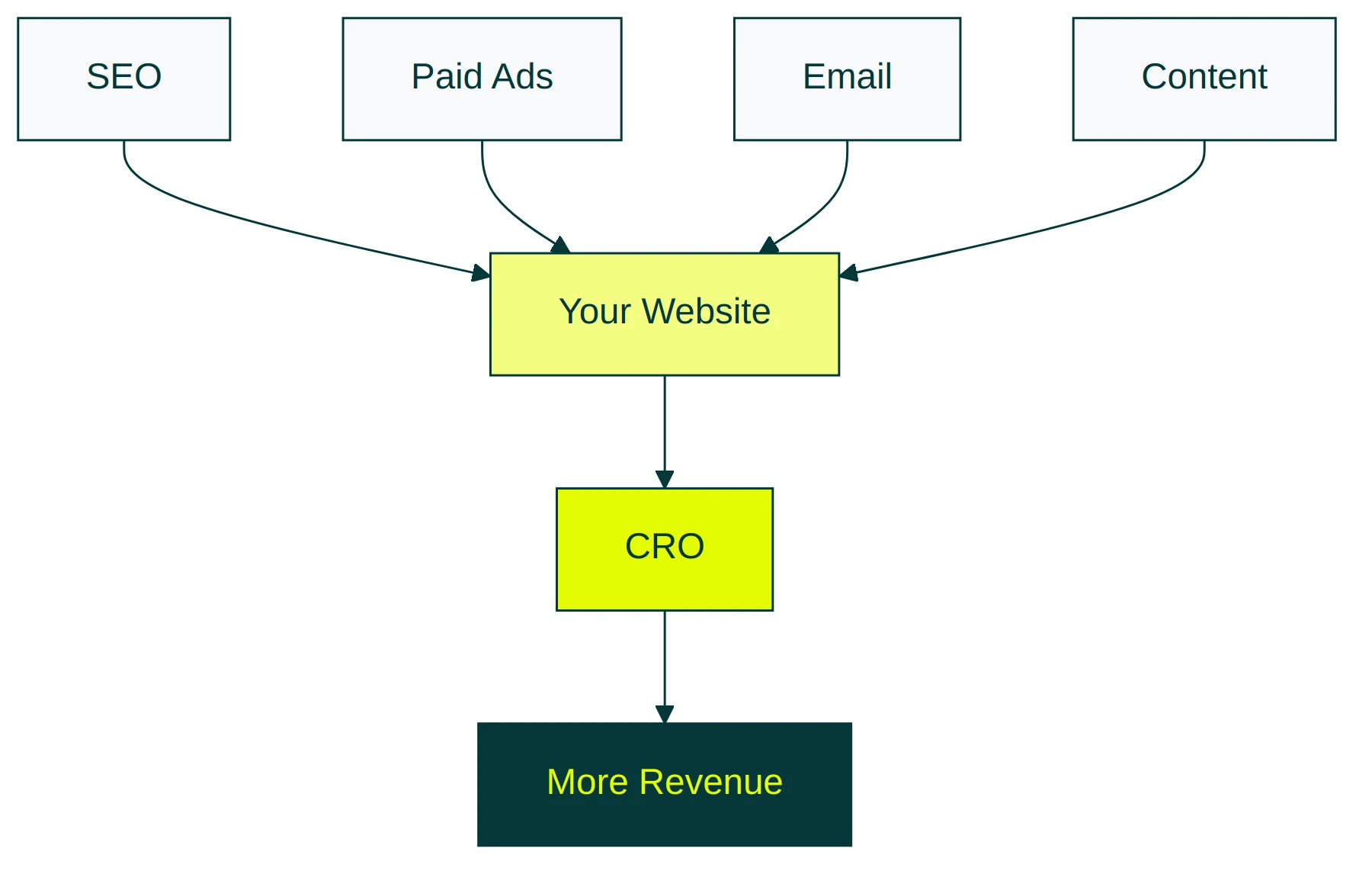
| SEO | Drives organic traffic to your site | CRO converts that traffic. More conversions from the same rankings. |
| Paid ads | Buys traffic from Google, Meta, etc. | CRO lowers your effective cost per acquisition. Same ad spend, more customers. |
| Email marketing | Brings subscribers back to your site | CRO improves the landing pages those emails link to. |
| Content marketing | Attracts and educates visitors | CRO turns readers into leads or buyers. |
Every channel invests in getting people to your website. CRO is the multiplier that makes all of them more effective. Without it, you’re filling a leaky bucket. (Tools like Kirro make running that first test simple enough to do between meetings.)
A practical example. Say you’re running Google Ads at $5 per click. Your landing page converts at 2%. That’s $250 per customer.
Improve the page to 4% conversion, and your cost per customer drops to $125. Same ad spend. Twice the customers. You didn’t need a bigger budget. You needed a better page.
The relationship between CRO and SEO is especially tight. Google rewards pages where visitors stick around and take action. Pages that convert well tend to rank better. Both disciplines feed each other.
CRO also works alongside landing page optimization. Where CRO is the system (research, test, measure, iterate), landing page optimization is one application of that system focused on a single page type.
Our take: If your marketing team is spending 90% of its budget getting traffic and 10% converting it, your budget is upside down. Even a small shift toward CRO pays for itself fast.
When to hire a conversion rate expert
You don’t need a CRO consultant to run your first test. A headline swap, a button color change, a different hero image. You can handle that yourself.
But there are signs you’ve outgrown the DIY approach:
- Results have plateaued. You’ve tested the obvious stuff. Wins are getting smaller. You need someone who can see the problems you can’t.
- No testing infrastructure. You don’t have analytics set up properly, don’t track micro-conversions, and can’t segment results by traffic source. A pro can build that foundation.
- High traffic, low conversion. If you’re getting 50,000+ monthly visitors and converting under 1%, there’s money on the table. A consultant will find it faster than you will.
- You need buy-in. Sometimes the biggest value a CRO expert brings is a structured report your CEO will actually read.
CRO expert vs consultant vs agency. A CRO expert is someone with deep optimization skills, in-house or freelance. CRO consultants audit your site and hand you a roadmap. Want someone to run the whole thing? That’s what a CRO agency does. Some companies also offer packaged CRO services at fixed prices.
Freelance CRO consultants typically charge $100-250/hour. Agencies run $3,000-15,000/month depending on scope. In-house CRO analysts in the US earn $60,000-90,000/year.
The question isn’t whether it’s expensive. It’s whether you’re leaving more money on the table by not doing it.
When DIY is fine: you’re under 10,000 monthly visitors, you’re just starting, and you want to build the muscle yourself. When you need a pro: you have the traffic, you’ve tried the basics, and you want systematic improvement.
Our take: Most small businesses don’t need a CRO agency. They need one person who runs one test per month and actually reads the results. An agency makes sense when you have the traffic and budget to run multiple tests at once.
A word of caution: conversion rate isn’t everything
This sounds counterintuitive. But consider: a 50% discount will boost your conversion rate overnight. It’ll also attract bargain hunters, tank your average order value, and train customers to wait for sales. Your conversion rate went up. Your revenue went down.
Peep Laja puts it directly: “The goal isn’t conversion rate. It’s business growth.” Conversion rate is a useful signal, not the final score.
Always pair it with revenue per visitor, average order value, or customer lifetime value. A test that drops conversion rate by 5% but increases revenue per visitor by 15% is a winner.
There’s also the “local maximum” problem. You can A/B test button colors and headline tweaks until you’ve squeezed every drop out of the current page design. But incremental improvements hit a ceiling.
Sometimes you need a bigger change. A completely different page layout. A new value proposition. You can’t A/B test your way to a higher peak if you’re already at the top of the current hill.
How to get started with CRO
The biggest mistake is trying to optimize everything at once. Don’t. Start with your highest-traffic page that’s underperforming. Usually your homepage or your top landing page.
The simplest path:
-
Pick the page. Open your analytics. Find the page with the most traffic and the worst conversion rate. That’s your candidate.
-
Pick one change. Start with the headline. It’s almost always the biggest lever. If not the headline, try the call-to-action button. Text, color, placement.
-
Pick a tool. You need something to split traffic and measure results. Kirro lets you set up a test in about 3 minutes. Paste a script, open the visual editor, make your change. No code. No developer ticket.
-
Run the test. Let it run until you have a confident result. Don’t peek and stop early. Don’t change things mid-test.
-
Read the results. Did the new version win? Make it permanent. Did it lose? Good. Now you know. Try something else.
Common pitfalls to avoid:
- Testing too many things at once. Change one variable per test.
- Stopping tests too early. Small sample sizes produce unreliable results.
- Ignoring mobile. If 60% of your traffic is mobile, your test needs to work on mobile.
- Copying competitors without context. Their audience isn’t your audience.
For a full step-by-step walkthrough, read our complete CRO guide. And when you’re ready to pick your testing tool, we compared the top options in our CRO tools roundup.
Want a longer-term plan? Our CRO strategy guide helps you build a testing roadmap that goes beyond single pages.
Try Kirro free for 30 days. Three minutes to set up. No credit card. Worst case, you wasted a coffee break.
FAQ
What does CRO mean in marketing?
CRO stands for conversion rate optimization. It means improving your website so a higher percentage of visitors take the action you want, whether that’s buying, signing up, or requesting a demo.
How do you start conversion rate optimization?
Pick your highest-traffic underperforming page. Make one change (start with the headline). Test it with real visitors. Measure whether it improved conversions. That’s the whole process. Scale from there.
What is CRO and SEO?
SEO brings traffic to your site. CRO converts that traffic into customers. They work together. Better-converting pages tend to rank better because visitors engage more. We wrote a full breakdown of CRO and SEO alignment.
How to optimize conversion rate?
Find where visitors drop off (analytics), research why they leave (heatmaps, surveys, session recordings), test a fix (A/B test), and measure results. Repeat. The research step is where most people skip ahead, and it’s the most important part.
What does a conversion rate optimization analyst do?
A CRO analyst studies how visitors behave on your site to find what’s blocking conversions. They design tests, run them, analyze results, and recommend changes. Day-to-day: pulling analytics reports, reviewing heatmaps, deciding what to test next, presenting results to the team.
Do I need a lot of traffic for CRO?
Less than you think. Some testing tools use math that works better with smaller traffic (called Bayesian statistics). If your test page gets fewer than 1,000 visitors a month, you’ll need patience. The less traffic you have, the bigger the change needs to be for the test to pick it up.
Start a free trial with Kirro and see how quickly you get a readable result.
Is CRO only for ecommerce?
No. SaaS companies optimize trial signups and onboarding flows. B2B businesses optimize lead forms and demo requests. Content sites optimize email subscriptions. Apps optimize install-to-activation rates. Any website with a goal benefits from CRO.

Randy Wattilete
CRO expert and founder with nearly a decade running conversion experiments for companies from early-stage startups to global brands. Built programs for Nestlé, felyx, and Storytel. Founder of Kirro (A/B testing).
View all author posts