A conversion rate optimization consultant figures out why visitors leave your website without converting. Buying, signing up, requesting a demo, whatever your goal is. Then they run tests to fix it.
The problem? For every genuine expert, there are three people who’ll charge you $5,000 a month to tell you to “make the button bigger.” The CRO consulting world is full of impressive pitch decks and zero accountability.
This guide helps you tell the difference. Real pricing data (because nobody else shares it). Specific red flags to watch for on sales calls. A scoring rubric for evaluating candidates. And an honest framework for deciding whether you even need a consultant.
What a CRO consultant actually does (and doesn’t do)
A CRO consultant’s day looks something like this. Dig through your analytics to find where people drop off. Watch recordings of real visitors struggling with your site. Build a list of things to test, design those tests, then figure out what the results mean.
The core work is testing different versions of your pages to see which ones get more people to take action (buy, sign up, request a demo, whatever your goal is). They’re looking at your CRO metrics to find the leaks.
Here’s what they don’t do. They don’t drive traffic to your site. They don’t redesign the whole thing. And they definitely can’t guarantee you a specific increase in sales. Anyone who promises “30% more conversions” before looking at your data is selling you a fantasy.
Why does this role even exist? 89% of companies say improving their conversion rate is important. But 63% don’t have a structured way of doing it. That’s the gap a good consultant fills. They bring the process you don’t have time to build yourself.
Our take: Most businesses don’t need a CRO team. They need to start testing. A consultant can jumpstart that, but the real win is building the habit of testing, not paying someone forever.
CRO specialist vs consultant vs agency: when each makes sense
These three titles get thrown around like they’re interchangeable. They’re not.
A CRO consultant (sometimes called a conversion optimization specialist) is one person you hire on contract. They bring deep expertise in a specific area. Maybe they’re great at checkout flows. Maybe they specialize in SaaS landing pages. You get focused attention at a lower price than an agency.
A CRO specialist is the same skillset, but hired full-time on your team. Average salary is $74,771 per year (range: $56K to $101K). Makes sense if you have enough testing volume to keep someone busy 40 hours a week.
An agency brings a team: analysts, designers, developers, project managers. Higher cost, but more tests running at the same time. Browse the full CRO agencies landscape before deciding. One study of 28,000 tests found agencies win 21% more tests than in-house teams. Probably because they’ve seen more patterns across different businesses. If you’re leaning toward that route, here’s how to evaluate when an agency makes more sense. For teams focused on testing specifically, our A/B testing agencies guide covers the real costs and red flags.
| Consultant | In-house specialist | Agency | |
|---|---|---|---|
| Best for | Focused projects, specific expertise | High testing volume, ongoing work | Full programs, multiple specialists |
| Typical cost | $50-300/hr or $2K-5K/mo retainer | $56K-101K/year salary | $5K-30K/month |
| Speed | Fast start, one person’s bandwidth | Steady, but limited to one person | Highest velocity, team effort |
| When to pick | You know what you need, budget is tight | You run 8+ tests per month | You want someone else to own the whole thing |
If you’re wondering about the different types of CRO services available, start there for the bigger picture. UK teams comparing consultants and agencies should also check our CRO agency options in the UK.
How much does a CRO consultant cost? Real pricing data
Nobody in this industry wants to talk about money. Every competitor article I checked dodges the pricing question entirely. So here’s what it actually costs, based on Invesp’s pricing research and public salary data.
Freelance CRO consultants:
- Entry-level: $50-100 per hour
- Experienced: $100-200 per hour
- Top-tier (15+ years, proven track record): $250-300 per hour
Monthly retainers:
- Recommendations only (no implementation): $500-3,500/month
- Entry-level consultant or small agency: $2,000-5,000/month
- Mid-tier agency: $5,000-15,000/month
- Top-tier agency: $10,000-30,000/month
The costs nobody mentions. Your consultant probably uses CRO tools that cost $200-1,500 per month for the licenses alone. Then there’s developer time to actually build the tests (10-30 hours per test on average). And QA time to make sure the tests don’t break your site on mobile.
Add it all up. A “cheap” $3,000/month consultant actually costs $4,500-6,000 once you include tools and dev time.
Here’s a number that puts this in perspective: companies spend $1 on improving their website for every $92 they spend getting people to the website. That’s like spending $92 on advertising a restaurant and $1 on the food.
Our take: For smaller teams, the math often doesn’t add up. At Kirro, the whole platform costs EUR 99/month with no per-visitor fees. That’s less than a single hour of many consultants’ time. If you have the traffic but not the budget, start testing on your own and bring in a consultant when the numbers justify it.
7 red flags that expose fake CRO experts
The conversion rate optimisation best practice? Research first, test second, measure everything. Anyone who skips that process is doing what I call “conversion theater.” Looks impressive. Produces nothing.
Watch for these on your next sales call.
1. They guarantee specific conversion lifts. “We’ll get you 30% more sales” sounds great. It’s also impossible to promise before seeing your data. Real experts talk about process, not guaranteed outcomes.
2. Their first move is “let’s change the button color.” Run. Good CRO starts with data analysis and user research. Jumping to “best practices” without understanding your visitors is a recipe for wasted tests.
3. Ask how they decide what to test. Watch their face. They should have a prioritization system (ranking test ideas by potential impact, confidence, and effort). If they stare blankly, that’s your answer.
4. They treat phone and desktop visitors the same way. 78% of Shopify traffic comes from phones, but phones convert at half the rate of desktops. Any consultant who doesn’t separate these is ignoring half the picture.
5. “Bounce rate improved by 15%!” Cool. Did revenue go up? If they’re reporting vanity metrics instead of money, they’re measuring the wrong things. (Here’s what to actually track.)
6. They hand you a list of changes and expect your dev team to build them. That’s not consulting. That’s a PDF report at consultant prices. A full-service CRO expert handles implementation.
7. They never mention how many visitors a test needs. If your consultant doesn’t bring up sample sizes (the minimum number of visitors before results are reliable), they might be calling tests early and selling you false wins. (Bayesian approaches help with smaller traffic, but there’s still a minimum.)
Research on unethical CRO practices confirms these patterns are widespread. False promises, hidden costs, and sneaky tactics that inflate short-term numbers while killing long-term trust.
10 questions to ask in a CRO consultant discovery call
Don’t just ask about their experience. Test their thinking. Here’s a scoring rubric you can actually use.
Rate each answer: 3 = clear, specific, confident. 2 = vague but reasonable. 1 = red flag or non-answer.
-
“Walk me through your last 3 tests. What won, what lost, what did you learn?” You want specifics, not generalities. A good consultant remembers their losses as clearly as their wins.
-
“How do you decide what to test first?” Look for a structured approach (something like ICE scoring, where they rank ideas by Impact, Confidence, and Effort). Gut feelings aren’t a strategy.
-
“How do you handle a test that shows no winner?” The right answer: “That’s useful data. It tells us the original was already working, and we focus our energy elsewhere.” Wrong answer: “That doesn’t happen to us.”
-
“What tools do you use and why?” Tool-agnostic is good. If they insist on only one expensive platform, ask why. Sometimes there’s a real reason. Sometimes they just get a referral fee.
-
“What does the first 30 days look like?” Expect: audit, data analysis, user research, testing roadmap. If they skip straight to testing, they’re guessing.
-
“How do you measure success beyond conversion rate?” Revenue per visitor, average order value, customer lifetime value. Conversion rate alone can be misleading (a 50% off coupon will boost conversions and destroy your margins).
-
“What’s your approach to making sure results are reliable?” They should talk about minimum visitor counts, how long tests need to run, and how they avoid calling winners too early.
-
“Can you show me a sample audit or testing roadmap?” If they can’t show you what the deliverables look like, you’re buying blind.
-
“What happens if we disagree on what to test?” A good answer involves data. “Let’s test your idea and mine. The visitors decide.” A bad answer: “Trust me, I know what works.”
-
“What’s your minimum engagement and why?” This tells you about their business model. Three-month minimums are reasonable (CRO takes time). Twelve-month locked contracts? That’s an agency protecting its revenue, not your results.
Your scoring guide:
- 25-30: Strong candidate. Move forward.
- 15-24: Proceed with caution. Dig deeper on weak answers.
- Below 15: Walk away. Politely.
What to expect from a CRO engagement
Most people expect results in week two. That’s not how this works. Here’s a realistic timeline.
Weeks 1-4: The audit. Your consultant reviews your analytics, watches visitor recordings, and audits your conversion funnel. This is the research phase. Nothing gets tested yet.
If this feels slow, it is. But skipping it is how you end up testing the wrong things.
Weeks 4-6: The roadmap. You’ll get a prioritized list of what to test, what to fix outright (some things are just broken), and what to investigate further. Good roadmaps include estimated impact and effort for each item.
Weeks 6-12: Testing begins. How fast you move depends on your traffic. More visitors means faster results per test. Typical velocity is 2-12 tests per month. At the lower end, you might only get reliable answers from 2-3 tests per month.
Typical deliverables:
- Audit report with specific findings
- Testing roadmap with prioritized items
- Monthly reports showing what was tested, what won, and what it meant for revenue
What’s NOT included (usually): design mockups, development, content writing, or guaranteed outcomes. If your consultant promises all of that, make sure it’s actually in the contract. And be wary of anyone selling “conversion rate optimisation solutions” as a package without telling you exactly what’s inside.
Fair warning: it always takes longer than you think. But once you’re running tests consistently, wins compound. Each test teaches you something about your visitors. That knowledge makes every future test smarter.
DIY vs hire: a decision framework based on your traffic
This is the section most CRO consultants don’t want you to read. Because sometimes the honest answer is: you don’t need one yet.
The key number is monthly conversions (not traffic, not page views). How many people actually complete your goal each month?
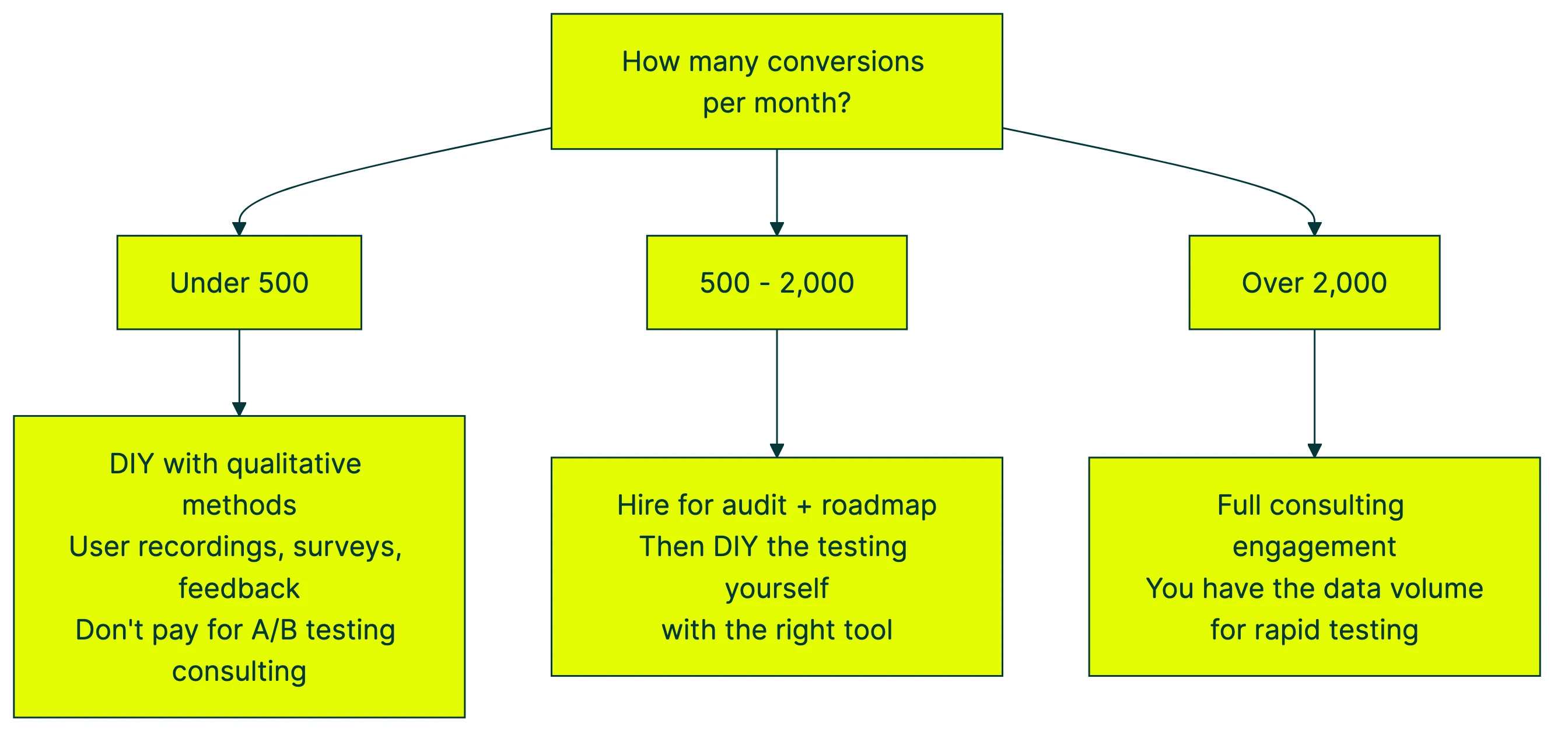
Under 500 conversions/month: Don’t hire a CRO consultant for A/B testing. You don’t have enough visitors to get reliable test results. Instead, use qualitative methods: watch visitor recordings, run surveys, talk to customers. Fix the obvious stuff first. Conversion Rate Experts’ research confirms this threshold.
500-2,000 conversions/month: Hire a consultant for an audit and roadmap, then run the tests yourself with the right conversion rate optimisation tools. There are CRO platforms that don’t require a PhD. You get expert strategy without the ongoing retainer.
When we tested this approach with landing pages, we found that the audit is where 80% of the consultant’s value lives. The actual testing? That’s the part you can handle with the right tool.
Over 2,000 conversions/month: A full consulting engagement makes financial sense. You have the data volume for rapid testing, and a good consultant will pay for themselves in extra revenue.
One number worth knowing: the average Shopify store converts at 1.4%. Top performers hit 4.8%. Know your baseline before you hire anyone. If you’re already at 4%, a consultant has much less room to improve than if you’re at 1%.
For businesses in that middle zone, tools like Kirro are built specifically for this situation. Set up a test in about three minutes, get results in plain language, and save the consultant budget for when your traffic justifies it. If you’re a local or service-area business, our dedicated guide to CRO for local businesses covers the tactics that work when most of your customers come from nearby.
B2B conversion rate optimisation: what’s different
If you’re selling to other businesses, CRO works a little differently. The fundamentals are the same (find what’s broken, test fixes, measure results), but the details shift.
The sales cycle is longer. B2B purchases take an average of 4 months with 10+ people involved in the decision. “Conversion” doesn’t mean someone bought something. It means they requested a demo, downloaded a whitepaper, or signed up for a trial.
Your consultant needs to understand these smaller steps (called micro-conversions) and track them individually.
The numbers tell the story too. B2B websites convert at 1.8% on average, compared to 2.1% for B2C. But each B2B conversion is usually worth a lot more. So even small improvements hit the bottom line hard.
When vetting a B2B CRO consultant, look for someone who talks about the full buying journey, not just the landing page. The person visiting your site might not be the person who signs the check. They should track how test changes affect pipeline quality, not just form submissions.
If you’re thinking about balancing CRO with your SEO strategy, that matters even more in B2B. Organic search often drives most of the qualified leads.
Shopify and ecommerce CRO: what changes
Ecommerce CRO has its own set of priorities. If you’re hiring a consultant for a Shopify or ecommerce store, here’s what matters most.
Cart abandonment is the big one. The Baymard Institute found that 70.19% of online shopping carts get abandoned. That’s 7 out of 10 people who wanted to buy but didn’t finish. Even more interesting: their research shows that better checkout design alone can lift conversion rates by 35.26%. The average checkout has 23 form fields. The ideal number is 12-14.
Mobile is where the traffic lives. Shopify stores get 78% of their traffic from phones, but those visitors convert at just 1.8% compared to 3.9% on desktop. A Shopify CRO consultant who doesn’t prioritize mobile experience is ignoring where most of your visitors are.
What an ecommerce CRO consultant should focus on: product pages (images, descriptions, social proof), checkout flow (fewer steps, fewer fields, trust signals), and mobile experience (speed, thumb-friendly buttons, simplified navigation). If they want to start with your About page, politely redirect them.
For a deeper look at what to focus on, see our Shopify CRO guide covering the specific tests and fixes that move revenue on Shopify. For some businesses, split testing your landing pages yourself is a smarter first step than hiring a consultant. Especially if your traffic doesn’t yet justify the cost.
FAQ
What does a CRO consultant do?
A CRO consultant analyzes why your website visitors don’t take action (buy, sign up, request a demo) and runs tests to fix it. Their core work: dig through analytics, watch how real people use your site, build a prioritized list of what to test, design those tests, and read the results. They bring the structured approach most businesses know they need but haven’t built.
How much does a CRO consultant cost?
Freelance consultants charge $50-300 per hour depending on experience. Monthly retainers range from $2,000 for entry-level consultants to $30,000 for top-tier agencies. Add $200-1,500 per month for tool licenses and 10-30 developer hours per test for implementation. An in-house CRO specialist earns $74,771 per year on average.
When should I hire a CRO consultant?
When you have 500+ monthly conversions, stagnant conversion rates despite growing traffic, or you’ve tried improving your site on your own without results. Below 500 monthly conversions, you don’t have enough data for the A/B tests a consultant would run. Start with qualitative research (visitor recordings, surveys) and a simple testing tool first.
What skills should a CRO consultant have?
Data analysis, A/B testing experience, an understanding of how people use websites (UX design), copywriting ability, and the communication skills to explain findings in plain language. The best consultants combine analytical thinking with creative problem-solving. They can read a chart and write a headline.
How is a CRO consultant different from a CRO agency?
A consultant is one person with deep expertise. An agency is a team with broader skills and higher testing speed, but at a higher cost. Choose a consultant if you need focused work on a specific problem and want to keep costs down. Choose an agency if you want someone to own the entire testing program and you have the budget for $5,000-30,000 per month.

Randy Wattilete
CRO expert and founder with nearly a decade running conversion experiments for companies from early-stage startups to global brands. Built programs for Nestlé, felyx, and Storytel. Founder of Kirro (A/B testing).
View all author posts