CRO software helps you figure out why visitors leave your website without buying, signing up, or doing the thing you want them to do. Then it helps you test changes to fix that.
The category covers everything from A/B testing tools to heatmaps, analytics platforms, surveys, and personalization engines. (For a breakdown of every conversion rate optimization tool by category, we wrote a separate guide. Our CRO tools & software overview ties all of these together.) Some tools show you what’s broken. Others let you test fixes. The best setups combine a few of each.
The catch? Less than 0.11% of websites actually use any CRO tools. That’s a wild number. Especially when CRO tools deliver an average 223% ROI according to a VWO study of nearly 3,000 businesses.
Quick note: if you googled “CRO Software” looking for the waste management company (crosoftware.com), you’re in the wrong place. This is about conversion rate optimization. Less glamorous than garbage trucks, but arguably more profitable.
The 6 types of CRO software (and when you need each one)
A/B testing gets the most attention (and 39% of total CRO market revenue), but it’s one piece of the puzzle.
A/B testing platforms (covered in depth in our A/B testing complete guide) let you show two versions of a page to different visitors and see which one converts better. Kirro is built for small teams (EUR 99/month). Optimizely is the enterprise pick (starting at $36,000+/year). VWO does a bit of everything.
Heatmap and session recording tools show you where people click, scroll, and rage-click. Think of it as watching over your visitors’ shoulders, without the restraining order. Hotjar is the big name, though many teams are now comparing Hotjar alternatives after the Contentsquare merger. Microsoft Clarity is completely free. Crazy Egg is quick and visual. We compared the best session recording software in detail if you want the full breakdown.
Then there’s analytics platforms (GA4 is free and essential, Mixpanel and Heap for deeper dives), survey and feedback tools (Qualaroo for on-site, Typeform for design, SurveyMonkey for features), and personalization engines (Dynamic Yield for enterprise, OptiMonk for small shops). Our website personalization guide covers when you actually need a dedicated engine. Surveys start free. Personalization ranges from $39/month to “call us.”
The one most people forget: form analytics. If your signup form has seven fields and everyone drops off at field four, you’ve got your answer. Zuko and Mouseflow handle this, starting around $30/month.
Our take: Most small businesses need three tools, max: analytics (GA4, it’s free), something to see behavior (heatmaps), and something to test changes (A/B testing). Everything else is nice-to-have until you’ve nailed the basics.
Best CRO software for 2026 (by category)
The CRO software market hit $1.2 billion in 2024 and is growing at 11.4% per year.
Big news in 2026: VWO and AB Tasty merged under Everstone Capital, creating a $100M+ combined company. For the full breakdown on AB Tasty pricing, we wrote a separate deep dive. That kind of consolidation usually means higher prices and enterprise focus. Worth knowing if you’re a smaller team shopping around.
A/B testing
| Tool | Best for | Starting price | Free tier? |
|---|---|---|---|
| Kirro | Small teams, solo founders | EUR 99/month | 30-day free trial |
| VWO + AB Tasty | Mid-market, all-in-one | ~$300/month | Limited free plan |
| Optimizely | Enterprise | ~$36,000/year | No |
| GrowthBook | Dev teams wanting open source | Free (self-hosted) | Yes |
Kirro is the simplest option. EUR 99/month, unlimited tests, unlimited visitors, and a 9KB script (most competitors load 100-200KB). Visual editor, GA4 integration, no per-visitor pricing.
Honest trade-offs: web only, no server-side testing, no feature flags. If you’re a marketer who wants to test a headline without filing a dev ticket, it’s built for you. For redirect-based testing (sending visitors to entirely different pages), see our split testing tools comparison. (Deeper comparison: our guide to choosing an A/B testing tool.)
VWO (now merged with AB Tasty) is the Swiss Army knife. A/B testing, heatmaps, session recordings, surveys, all in one dashboard. Good if you want everything in one place and have the budget.
Optimizely is the industry leader for large teams. Forrester ranked it #1 in their Experience Optimization Wave. But the price tag and learning curve are real. Can’t decide between them? Our VWO vs Optimizely comparison covers pricing, features, and total cost of ownership. If you’re shopping around, the Optimizely alternative roundup covers seven cheaper options.
GrowthBook is free and open-source. Fantastic if you have developers who can self-host it. Not great if you don’t know what “self-host” means.
Heatmaps and session recordings
| Tool | Best for | Starting price |
|---|---|---|
| Hotjar | Most popular, best known | Free (limited) |
| Microsoft Clarity | Best free option | Free |
| Crazy Egg | Quick visual insights | ~$29/month |
Microsoft Clarity deserves more attention than it gets. It’s completely free, built by Microsoft, and records sessions with no limits. No excuse not to install it.
Analytics
GA4 is non-negotiable. It’s free and it’s the foundation everything else plugs into. Mixpanel is great for product analytics and funnels. Heap auto-captures everything (handy if you forgot to set up event tracking).
Surveys
Qualaroo is best for on-site surveys (those little pop-ups asking “why are you leaving?”). Typeform wins on design. SurveyMonkey has the most features. Pick whichever one you’ll actually use.
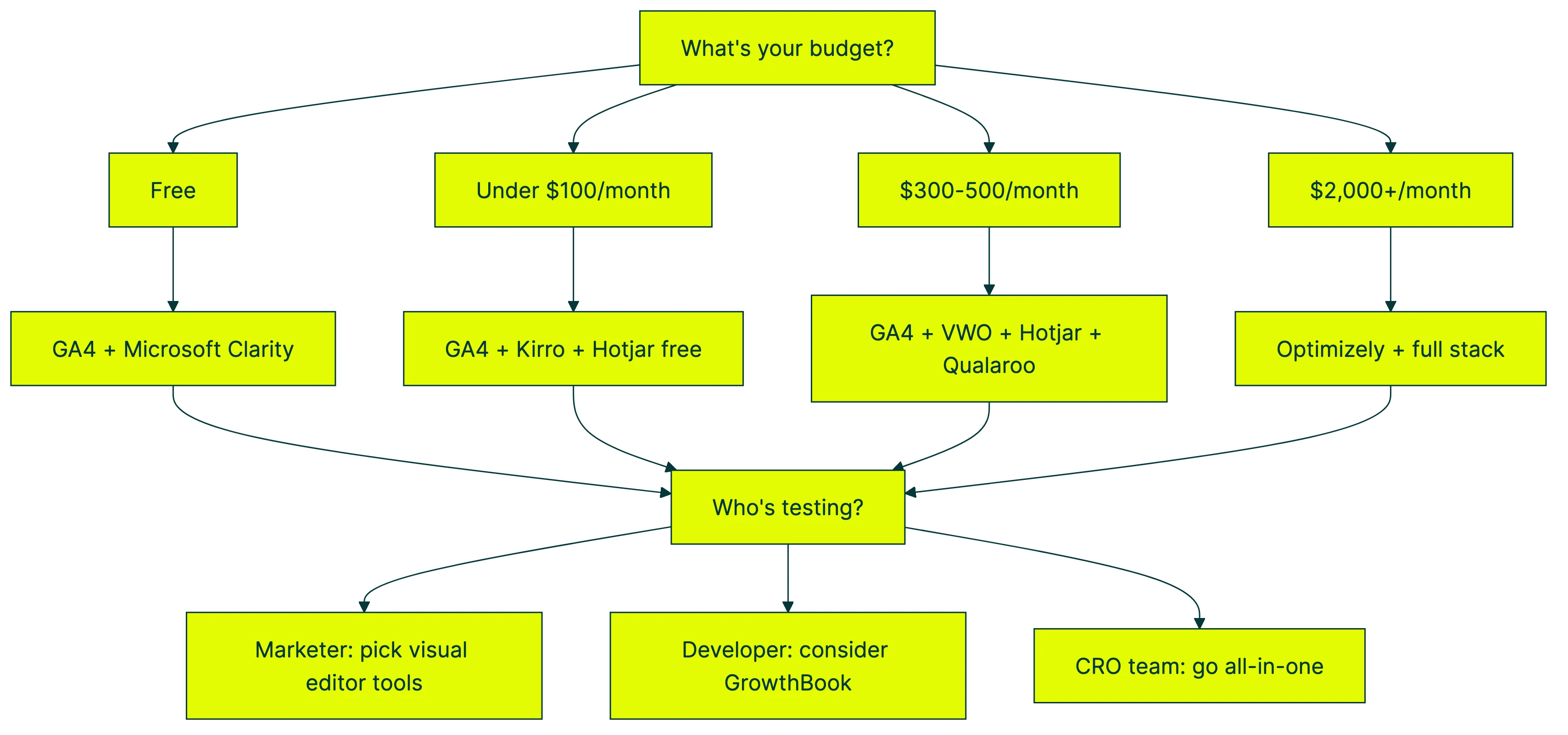
How to build a CRO software stack (by budget)
This is where most “CRO tools” articles stop being useful. They list 20+ tools and leave you wondering which ones to actually buy together. Running an online store? See our ecommerce CRO tools guide for a stack built around product pages, cart, and checkout. Here’s what we’d recommend at each price point.
The $0/month stack
GA4 + Microsoft Clarity + Google Forms
You get traffic data, heatmaps, session recordings, and basic surveys. All free. You can’t run A/B tests, but you can identify problems and gather feedback. Surprising how much you can learn before spending a dollar.
The ~$100/month stack
GA4 + Kirro + Hotjar (free tier)
Now you can actually test changes. Kirro handles A/B testing for EUR 99/month with unlimited everything. Pair it with free GA4 for analytics and Hotjar’s free tier for heatmaps. This covers the three core CRO needs: understand traffic, see behavior, test fixes.
In our experience, this is the sweet spot for most small businesses. You’re spending less than most teams spend on coffee, and you can run real tests.
The ~$500/month stack
GA4 + Kirro (or VWO) + Hotjar Business + Qualaroo
You’re adding deeper behavior analytics and on-site surveys. The surveys matter more than people think. Data tells you what happened. Surveys tell you why.
The $2,000+/month stack
Optimizely + Hotjar + Mixpanel + Qualaroo + Dynamic Yield
Full enterprise CRO. Personalization, advanced analytics, surveys, the works. The average company spends about $2,000/month on CRO tools.
That number has a catch, though. Gartner found that companies only use 33% of their marketing technology capabilities. Down from 58% in 2020.
Most businesses are paying for tools they barely touch. With over 15,000 marketing tools on the market, it’s easy to overbuy.
Our take: Start with the $0 or $100/month stack. Only upgrade when you’ve outgrown what you have, not when a sales rep tells you to. The tools are 10% of the equation. Knowing what to test is the other 90%.
CRO software vs. hiring a CRO agency
Here’s the real math:
- CRO software: $0 to ~$2,000/month depending on your stack
- CRO agency: $3,000 to $16,000/month
- CRO freelancer: $10 to $400/hour
Only 37% of organizations have a dedicated CRO person on staff. And 68% of small businesses haven’t done any CRO work at all.
Tools alone work when you have someone internally who knows (or is willing to learn) what to test and why. Either way, conduct a conversion rate audit first to identify your biggest conversion leaks. Pair affordable CRO software with a course from CXL, a few good books, or the CRO blogs worth reading, and you’re further ahead than most companies.
An agency makes sense when you have zero internal expertise, high-stakes pages (checkout flows doing six figures a month), and the budget to match. Read our CRO guide. If your first thought is “I don’t have time for this,” an agency is probably worth it.
The middle path works for most people. Affordable tools plus upskilling. Pairing software with a CRO expert can accelerate results without the full agency price tag. If you’re wondering where to start, our guide to conversion rate optimization walks through the whole process. You don’t need a PhD. You need to test one thing at a time and pay attention to the results.
Why most businesses don’t use CRO software (and why they should)
This is the stat that should bother you: for every $92 companies spend on getting visitors, they spend just $1 on converting them. That’s like spending a fortune building a store and then leaving the doors locked.
Only 22% of companies say they’re happy with their conversion rates. So most businesses know there’s a problem. They’re just not doing anything about it.
Why? A few reasons:
Enterprise tools scared everyone off. For years, the only “serious” A/B testing tools cost thousands per year and required dedicated specialists. Small businesses looked at VWO and Optimizely and thought “that’s not for me.” They were right. But they threw the baby out with the bathwater.
Google Optimize left a void. When Google shut down its free A/B testing tool in September 2023, millions of marketers lost their only entry point. Some moved to paid tools. Many just stopped testing. If that’s you, check out the Google Optimize replacement options we compared.
The “not enough traffic” myth. People hear you need millions of visitors for A/B testing and give up. That’s true for tiny tweaks. But big, bold changes (a completely different headline, a new page layout) can show results with much less traffic. You can test this on your own site in about three minutes and see.
Ronny Kohavi built Microsoft’s testing platform. His data is humbling: only about a third of tested ideas actually improved the metrics they were targeting. At Google and Bing, it was closer to 10%.
If the smartest people in tech get it wrong two-thirds of the time, imagine how often gut decisions miss. That’s why CRO software matters. Your gut isn’t as reliable as you think.
Amanda Natividad from SparkToro has the contrarian take: “A/B testing is procrastination disguised as optimization” for many small businesses. She’s partly right. Testing button colors when your value proposition is unclear? That’s procrastinating.
But testing whether “Start free trial” beats “Get started” on a page with real traffic? That’s smart business. Just make sure you avoid the common A/B testing mistakes while you’re at it.
What CRO experts actually say about software
We sell A/B testing software. So it might seem weird that we’re about to tell you the software isn’t the important part. But the experts agree, and we’d rather be honest than salesy.
Peep Laja from CXL puts it simply: “The challenge isn’t setting up A/B tests. The hard part is testing the right things.”
Chris Goward (WiderFunnel) and Talia Wolf (Getuplift) say the same thing differently. Goward: “Technology should be a facilitator of strategy, not the originator.” Wolf: “You can’t use any tool unless you have strategy behind it.”
Karl Gilis has been doing CRO for over 20 years at AGConsult. His take? “When CRO and A/B testing is not based on research and facts, you’re gambling.” He thinks most people focus too much on fancy design and not enough on the words.
And Rich Page (15+ years in the field) reminds us that “A/B testing is only one of four main elements of CRO.” Research, UX, and persuasion are the other three.
Every expert says the same thing in different words. The tool is the easy part. The thinking is the hard part. Buy simple tools. Spend the saved money on learning what to test.
Which is exactly why we built Kirro the way we did. Simple enough to set up in three minutes. So you can spend your time on the part that actually matters, figuring out what’s wrong with your page.
Ronny Kohavi ran experimentation at Microsoft, Airbnb, and Amazon. His take: the tool matters far less than the discipline behind it.
How to choose the right CRO software
If you searched for “cro software login” and ended up here, you’re probably looking for the login page of a specific tool. Check that tool’s website directly. But if you’re shopping for the right CRO software in the first place, here’s a simple framework.
Integration checklist
Before you buy anything, check that it works with your existing setup:
- GA4 (if it doesn’t talk to GA4, skip it)
- Your CMS (WordPress, Shopify, Webflow, whatever you use)
- Your consent management (GDPR compliance isn’t optional)
Red flags when evaluating CRO software
- Per-visitor pricing. Your success shouldn’t make your bill go up.
- Mandatory annual contracts. If the tool is good, you’ll stay without being locked in.
- Hidden pricing. “Contact sales” usually means “it costs more than you’d like.”
- 200KB+ script size. Your pages will slow down. Your visitors will notice.
For a deeper look at methodology, see our complete CRO guide. And before you start running tests, read up on the testing mistakes to avoid so you don’t waste your first month.
FAQ
What is CRO software?
CRO software is any tool that helps you improve your website’s conversion rate. “Conversion” just means visitors doing what you want them to do. Buying, signing up, clicking a button.
The category includes A/B testing tools, heatmaps, analytics, surveys, and personalization platforms. If you’re new to this, our guide on what CRO is covers the basics.
How much does CRO software cost?
Free (GA4, Microsoft Clarity) to $36,000+/year (Optimizely). Most small businesses spend $100 to $500 per month. The average across all company sizes is about $2,000/month, but that includes enterprise teams running five or six tools. A lean startup can get meaningful results for under $100/month.
Is CRO software worth the investment?
The data says yes. CRO tools deliver an average 223% ROI. But tools alone aren’t enough. You need to know what to test and why.
Econsultancy found that for every $92 companies spend acquiring customers, only $1 goes to converting them. That imbalance alone tells you where the opportunity is.
What’s the difference between CRO software and A/B testing tools?
A/B testing is one type of CRO software. It’s the biggest slice (39% of CRO market revenue), but a complete setup also includes analytics, heatmaps, surveys, and sometimes personalization.
Think of A/B testing as the “testing” part and the rest as the “understanding” part. You need both. For a deeper comparison of A/B testing software specifically, we’ve got a separate guide.
Do I need CRO software if I have low traffic?
You can still learn a lot. Heatmaps and session recordings have no traffic minimum. Start there.
For A/B testing, focus on big bold changes (completely different headlines, not slightly different button colors) and use Bayesian statistics that work with smaller samples. Rich Page, a CRO expert with 15+ years of experience, suggests you need at least 5,000 visitors per week per page for a meaningful A/B test.
Below that? Stick with heatmaps and surveys first. The data you gather will make your first test much smarter. You can set up a free split test with Kirro when you hit that traffic threshold.

Randy Wattilete
CRO expert and founder with nearly a decade running conversion experiments for companies from early-stage startups to global brands. Built programs for Nestlé, felyx, and Storytel. Founder of Kirro (A/B testing).
View all author posts