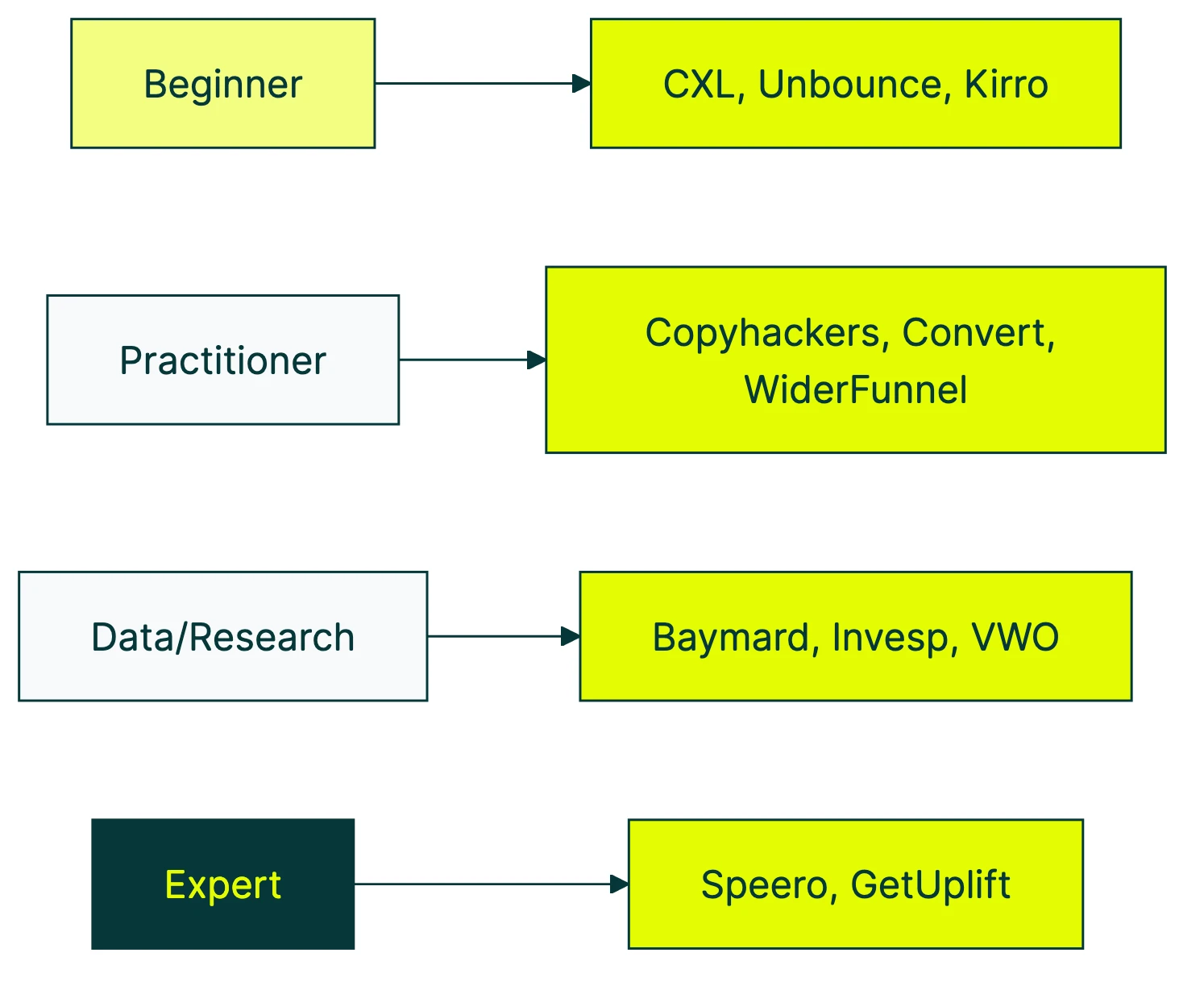
Three CRO blogs stand above the rest: CXL, Baymard Institute, and Copyhackers. If you read nothing else, start there. CXL teaches conversion rate optimization from the ground up (making more visitors do the thing you want them to do). Baymard backs everything with real research data. And Copyhackers shows you how the words on your page change whether people buy.
But “start there” depends on where you are right now. A first-time marketer needs different reading than someone who’s been running tests for two years. And most “best CRO blogs” lists just dump 45 names on you with zero guidance.
This one’s different. We checked which blogs are still actively publishing in 2026. We filtered out the ones running on recycled AI content. And we sorted everything by experience level so you can pick the three or four that actually match where you are.
68% of small businesses still don’t have a CRO strategy. If that’s you, the right blog can change that faster than any course. (New to all of this? Start with our CRO fundamentals overview. For specific changes to make, see our CRO recommendations guide. For the full picture, our conversion rate optimization guide covers everything from strategy to benchmarks.)
How did we pick these blogs?
Not every CRO blog deserves your time. Some haven’t published since 2023. Some just rehash the same “test your button color” advice. And a growing number are quietly filled with AI-generated content that sounds smart but says nothing new.
We filtered for four things:
- Still publishing in 2026. If a blog hasn’t posted in six months, it’s a museum, not a resource.
- Original thinking. Does the author add their own perspective, or are they rewording someone else’s post?
- Real results. Do they share actual test outcomes (wins and losses), or just theory about what you “should” try?
- Free to access. Paywalled content is fine, but you shouldn’t need a subscription just to learn the basics.
The AI content problem is real. Harvard Business Review published a piece in March 2026 asking whether AI has killed thought leadership. Their finding: organizations are drowning in polished content that rarely translates into real change.
CRO blogs aren’t immune. You can spot it: buzzwords everywhere, no specific examples, and a feeling you’ve read this exact post five times before.
Our take: If a blog never shows a test that lost, it’s marketing, not education. Real testing has plenty of losers. 60% of completed A/B tests deliver under 20% lift. The blogs worth reading are honest about that.
Best CRO blogs for beginners
CXL
The gold standard. Founded by Peep Laja, CXL publishes structured guides that take you from “what is this” to “I can do this.” Their Beginner’s Guide to CRO is free and better than most paid courses. They also run the CXL Minidegree for deeper learning.
Posts: 2-4 per month. Research-backed guides, not hot takes.
Unbounce
Landing-page-focused CRO. If your job involves building pages that need to convert, Unbounce’s blog is practical and action-oriented. Good for people who learn by doing.
Posts: Weekly. Tutorials, benchmarks, real examples.
Kirro blog
That’s us. We write hands-on A/B testing guides for people who want to start testing without needing a statistics degree. Real test methodology, plain language, and we show the math without making it scary. Built for marketers and founders who’d rather improve their website than learn another dashboard.
Posts: Weekly. Practical how-tos, tool comparisons, and testing guides.
Try running your first A/B test. Three minutes. Seriously.
Crazy Egg
Behavior analytics meets CRO. Their thing is showing you what visitors actually do on your pages (heatmaps, scroll tracking, click maps) before you start testing changes. They publish multiple times a week, mixing CRO basics with analytics deep-dives.
Neil Patel / NP Digital
Broad digital marketing with strong CRO sections. His CRO Unlocked course is free and surprisingly thorough. He publishes daily, so the quality varies. Cherry-pick the CRO-specific posts and skip the rest.
Best CRO blogs for practitioners and testers
If you’ve got the basics down and you’re running tests (or trying to), these blogs go deeper. They cover methodology, frameworks, and the thinking that separates a random test from one that teaches you something real.
If you’re looking for a conversion optimization blog that goes beyond “try testing your headline,” these are the ones that treat testing like a craft.
Conversion Sciences
Brian Massey calls himself “The Conversion Scientist,” and the blog earns the title. Structured learning paths (CRO 101, 102, 103) with real methodology. One of the few blogs that walks you through how to design a test, not just what to test.
If you’re picking A/B testing software for the first time, his framework for evaluating tools is worth reading first.
WiderFunnel / Chris Goward
Been blogging since 2007, which is ancient in CRO years. Case-study heavy with actual testing frameworks. They post less often now, but when they do, it’s worth your time.
Convert
A testing platform blog, but they publish original data you won’t find anywhere else. Their 2025 A/B Testing Statistics Report found that 70% of tests reach 95% confidence. That’s the threshold where the math says you can trust the result. They also cover Bayesian A/B testing (math that works with less traffic) in practical terms.
GetUplift / Talia Wolf
Most CRO blogs focus on layout and buttons. Talia focuses on why people buy (a technique called emotional targeting). It’s a different angle. If your tests keep producing “meh” results, this might be the missing piece. Sometimes the problem isn’t your button color. It’s your message.
Copyhackers / Joanna Wiebe
Where CRO meets copywriting. If your tests involve changing words on a page (and most tests do), Copyhackers is required reading. Joanna literally invented the term “conversion copywriting.” Before-and-after copy teardowns with real results.
Our take: Most people underestimate copy. A headline test usually outperforms a layout test. If you’re not reading Copyhackers, you’re probably testing the wrong things. Check out our guide on common A/B testing mistakes for more on what to test first.
Best CRO blogs for data and research
If you want a conversion rate optimization blog backed by real data (not just opinions), these four are where the numbers come from.
Baymard Institute
When another CRO blog cites a statistic about checkout abandonment or mobile usability, it probably came from Baymard. They’ve logged 200,000+ hours of real-world UX testing and produced 700+ guidelines that most Fortune 500 ecommerce teams reference.
Dense reading. Worth it if you want to understand why something works, not just that it works.
Invesp
One of the oldest CRO agencies (founded 2006). Their blog publishes CRO statistics roundups and framework content.
Their 45-blog roundup currently ranks #1 for “CRO blogs,” which is ironic since it’s mostly names with one-line descriptions. Their original research is better than their roundups.
VWO
Testing platform with strong case studies and original data. They published the Speero Experimentation Maturity Report, which tracks how companies’ testing programs evolve over time. Good for benchmarking where your team stands against everyone else.
Speero
Founded by Peep Laja (yes, the same person behind CXL). Publishes the annual Experimentation Maturity Benchmark Report.
Their 2025 finding: testing maturity across companies has been stagnant for three consecutive years. Not great news, but it’s exactly the kind of honest data you won’t find in a vendor’s marketing blog.
CRO newsletters and podcasts worth subscribing to
Blogs aren’t the only way to keep up. Some of the best CRO thinking happens in newsletters and podcasts. Here are the ones that earn their spot in your inbox:
- The CRO Weekly (Shane Rostad, on Substack, which is a free newsletter platform) gives you one actionable Shopify CRO tip per week. Short. Useful. No filler.
- How to Win (Peep Laja) covers testing culture and B2B optimization (improving conversion for business-to-business websites). Not CRO-specific, but the thinking transfers.
- Conversion Cast (podcast) runs short episodes with specific test results. Good for commutes.
- Experimentation Island (Ton Wesseling) is for serious testers. Events and community, not just content.
And for raw practitioner discussion: Reddit’s r/CRO and r/bigseo communities. Unfiltered, sometimes messy, but you’ll find real practitioners sharing what they’re actually working on.
One thing we noticed during research: CRO YouTube content is surprisingly thin. The best CRO knowledge lives in blogs and newsletters, not video. If you’re a video learner, Neil Patel’s CRO Unlocked course is the closest thing to a good option.
Which CRO blogs share real test results?
This is the section that matters most. And it’s the one no other “best CRO blogs” list includes.
Most CRO blogs tell you what to test. “Try a different headline.” “Move your call to action above the fold.” “Use social proof.” Fine. But they rarely show you what happened when they tested it.
That’s a problem. Because 60% of completed A/B tests deliver less than 20% improvement. Reading blogs that only show big wins gives you a skewed picture of what testing actually looks like.
Here’s how the blogs stack up:
| Blog | Shares real results? | What you get |
|---|---|---|
| CXL | Yes | Case studies with actual numbers |
| Copyhackers | Yes | Before-and-after copy tests with conversion data |
| WiderFunnel | Yes | Client case studies with methodology and results |
| GetUplift | Yes | Emotional targeting results with specific lift % |
| Most agency blogs | No | They tell you what to do, not what happened |
| Most “best practices” roundups | No | Recycled advice without evidence |
Why does this matter? Speero’s research found that 68% of beginner-level companies don’t even track their testing history. Blogs that share real results teach you what “good” looks like before you start. That’s a head start most people skip.
Real test results also teach you this: most tests don’t produce dramatic results. And that’s okay. Small, consistent wins compound. The blogs that admit this are the ones worth following. If you’re ready to put what you learn into practice, start with our guide to CRO strategy.
Which CRO blog should you read first?
Don’t try to read all of these. Pick three or four that match your stage. You can always add more later.
If you’ve never run a test: Start with CXL’s Beginner Guide for the concepts. Then read Kirro’s blog for hands-on testing guides you can follow along with. Unbounce for landing page split testing basics. That’s enough to get your first test live. You can also look into CRO training courses if you want more structure.
If you’re running tests but not seeing results: Copyhackers (your copy might be the problem). GetUplift (your emotional hook might be missing). Conversion Sciences (your test design might be off). Track the right CRO metrics and make sure you’re measuring what matters. If self-study isn’t enough, hiring a conversion optimization specialist can shortcut the learning curve.
If you’re building a testing program: Speero for maturity frameworks. VWO for case studies. CXL Institute for team training. You’ll also want the right CRO software and a clear audit process before scaling. And if your team touches both organic traffic and conversion testing, our CRO SEO guide explains how to keep the two aligned.
If you’re an agency or freelancer: WiderFunnel for client-facing frameworks. Convert for reporting and benchmarks. Invesp for industry data you can reference in proposals. You might also find multivariate testing (testing multiple things at once) worth reading about once your clients have enough traffic.
Set up your first test today and start applying what you read. Knowledge without action is just trivia.
Which CRO blogs should you avoid?
For every good CRO blog, there are five that waste your time. Here’s what to watch for:
No posts in 6+ months. The CRO space changes. Google’s algorithm updates affect testing strategies. New tools launch. If a blog went silent in 2024, its advice might already be outdated.
No named authors. If every post is “by Admin” or “by the team,” there’s no practitioner behind it. The best CRO content comes from people who actually run tests for a living.
AI-generated roundups with no original perspective. EY’s research on AI content found growing fatigue with content that sounds polished but lacks a human point of view. If a CRO blog reads like it was written by someone who’s never logged into a testing tool, it probably was.
Never shows a losing test. This is the biggest red flag. If a blog only publishes wins, it’s cherry-picking results. Real CRO testing has plenty of tests that don’t move the needle. The honest blogs say so.
Paywalled basics. Advanced methodology behind a paywall? Fair. But if you can’t learn “what is a CRO test” without a credit card, that blog isn’t trying to educate you. It’s trying to capture your email.
FAQ
What is the best CRO blog?
There’s no single best. It depends on where you are. CXL for structured education. Baymard for deep research. Copyhackers for conversion copywriting. Kirro for practical A/B testing guides written in plain language. Start with one that matches your experience level and add more as you grow.
Where can I learn CRO for free?
CXL’s Beginner Guide to CRO is the best free starting point. Neil Patel’s CRO Unlocked is a full free video course. Conversion Sciences structures their blog content into 101/102/103 levels so you can follow a learning path. And Reddit’s r/CRO community has real practitioners answering real questions. For more structured options, check our guide on CRO training courses.
What is CRO in marketing?
CRO stands for conversion rate optimization. It means improving the percentage of visitors who do what you want them to do. Buying, signing up, clicking a button. Instead of paying for more traffic, you make your existing traffic work harder. Read our full explainer on what CRO actually means.
Are CRO blogs still relevant with AI tools?
Yes. AI can suggest changes and generate copy variations. It can’t replace the strategic thinking behind what to test and why. The best CRO blogs teach frameworks and mental models, not just tactics. 72% of organizations plan to use AI for CRO in the next two years. That makes the skill of knowing what to test more valuable, not less.
How many CRO blogs should I follow?
Three to five. Maximum. One data-heavy source (Baymard or Speero). One practical how-to blog (CXL, Kirro, or Unbounce). One that challenges your assumptions (Copyhackers or GetUplift). Quality over quantity. Following 45 blogs means reading none of them.

Randy Wattilete
CRO expert and founder with nearly a decade running conversion experiments for companies from early-stage startups to global brands. Built programs for Nestlé, felyx, and Storytel. Founder of Kirro (A/B testing).
View all author posts