CRO training teaches you how to get more website visitors to take action. Buy, sign up, click. It’s not one skill. It’s a mix of five: data analysis, user research, copywriting, design thinking, and basic statistics.
You don’t need a degree in any of them. And most of what you need is free.
Most articles about CRO training just list courses. Here’s a table. Pick one. Good luck.
Not helpful if you don’t know which skills you’re missing. Or whether a $300/month program is overkill for your CRO process. So we’re doing this differently. Skills first, courses second.
What CRO training actually covers
CRO stands for conversion rate optimization. It’s the practice of making your website work harder so more visitors take action. If you landed here looking for Combat Rescue Officer training or Chief Revenue Officer programs, wrong article. (Seriously, “CRO” means about six different things depending on who you ask.)
Here’s what you’re actually learning when you study conversion rate optimization:
- Data analysis means reading your analytics to figure out where people drop off. Which page loses visitors? Which button gets ignored? You can’t fix what you can’t see. Knowing your CRO metrics is step one.
- User research means talking to real people to understand why they leave. Or watching recordings of them using your site. Surveys, session recordings, heatmaps. Els Aerts of AGConsult puts it bluntly: “The amount of bad surveys out there is appalling.” Asking good questions matters more than any tool.
- Copywriting is about writing words that make people act. Not clever words. Clear words. A better headline can lift conversions more than a complete redesign.
- Design thinking is the “make it obvious” skill. Where does the eye go? Is the button obvious? Can someone figure out what to do in 3 seconds?
- Statistics (the light version) means knowing when your test results are trustworthy and when you need more visitors. You don’t need a math degree. You need to understand confidence: how sure can you be that Version B actually beat Version A? That’s it.
Craig Sullivan, who’s been doing this for decades, argues CRO can’t be learned in a vacuum. You need a bit of UX, a bit of analytics, a bit of psychology. It’s one of the few fields where being a generalist is the point.
Our take: Formal CRO education barely exists. One of the only peer-reviewed papers on CRO as a discipline (Zimmermann & Auinger, 2023) had to build the framework from scratch. If academia hasn’t figured out how to teach this, don’t stress about picking the “wrong” course.
Why most companies get CRO training wrong
Here’s a number that should make you uncomfortable: 95% of experimentation programs lack an explicit education or training program. Nearly all of the mature programs have one. Coincidence? Not really.
The pattern looks like this. A company buys a course subscription. Sends a few people through it. Checks the “we invested in training” box.
Then wonders why their testing program still isn’t producing results. The Econsultancy/RedEye conversion report found that 63% of companies don’t even have a structured approach to CRO. Hard to train people on a process that doesn’t exist.
Peep Laja, who founded CXL (the closest thing to a standard training program), says it well: “80% of CRO is research and data gathering. 20% is testing.”
Most training skips the 80% and jumps straight to running tests. That’s like learning to cook by starting with dessert. You’ll end up with something, but it won’t be dinner.
It gets worse. The DMI 2024 Global Digital Skills Report found that 58% of corporate training decision-makers say generic courses fail practitioners. And 85% cite time and workload as the main barrier to completing training. So most people can’t even finish the courses they start.
This doesn’t mean training is pointless. It means the “buy a course and hope for the best” approach doesn’t work.
You need a CRO strategy first: which skills, in what order, practiced on real projects. If you’re building a CRO program for a team, this is even more important.
The best CRO training options (compared)
Quick reality check: no CRO degree exists. No single industry body certifies CRO practitioners. Every “certification” comes from the company selling the course.
That’s not necessarily bad. But it’s worth knowing before you spend money on one.
Here’s how the major options stack up:
| Course | Price | Time | Depth | Best for |
|---|---|---|---|---|
| CXL Conversion Optimization Minidegree | $299/mo | ~120 hrs | Deep, academic | Career CRO practitioners |
| Conversion Sciences CRO 101 | Free | ~5 hrs | Beginner, testing-focused | Getting started fast |
| Udemy CRO courses (Ruben de Boer) | $20-50 | 5-10 hrs | Practical, hands-on | Budget-conscious learners |
| Simplilearn CRO course | Free | ~3 hrs | Surface-level | Quick overview |
| Google Analytics Academy | Free | 5-10 hrs | Analytics only | Building the data foundation |
| HubSpot Academy | Free | Varies | Marketing foundation | Marketers new to the field |
CXL is the gold standard if you want depth. Twenty courses across four tracks, taught by practitioners. But it’s a 120-hour commitment at $299 a month. If you just want better landing pages, that’s like buying a commercial kitchen to make lunch.
For most people, free resources plus hands-on practice will get you further than any single expensive program.
Our take: The best CRO training is the one you’ll actually complete. An $800 certification you abandon halfway through is worth less than a free course you finish and apply. Check your schedule honestly before you spend money.
Free CRO learning resources worth your time
The internet is stuffed with CRO content. Most of it is thin blog posts repackaged as “guides.” Here’s what’s actually worth reading:
Blogs and research that teach you something real:
- CXL blog: free articles covering testing methodology, research techniques, and real case studies. The paid course is optional. The blog alone is a goldmine.
- VWO blog and knowledge base: practical, well-organized, covers everything from beginner to advanced.
- Baymard Institute: free checkout and UX research summaries. They found the average cart abandonment rate is 70.19%, and that fixing usability issues can improve conversions by up to 35%. That’s specific, actionable research you can use today.
- Check out our roundup of the best CRO blogs for more options.
Books worth the time:
- Influence by Robert Cialdini. The psychology behind why people say yes. Still relevant after 40 years.
- Making Websites Win by Karl Gilis and Bart Schutz. Practical, real-world focused, no fluff.
Communities where practitioners actually help each other:
- r/bigseo and r/CRO on Reddit
- CRO.CAFE podcast (interviews with actual practitioners, not vendors)
A structured path through free resources, paired with hands-on practice, beats an expensive course without application every time.
The Marketing Week 2025 Career Survey found that 60.5% of marketers face a skills gap around marketing effectiveness. The skills exist for free online. The gap isn’t access. It’s application.
You can start putting theory into practice immediately. Kirro’s free trial lets you run real tests on your own site while you’re still learning. That combination of studying and doing is how the skills actually stick.
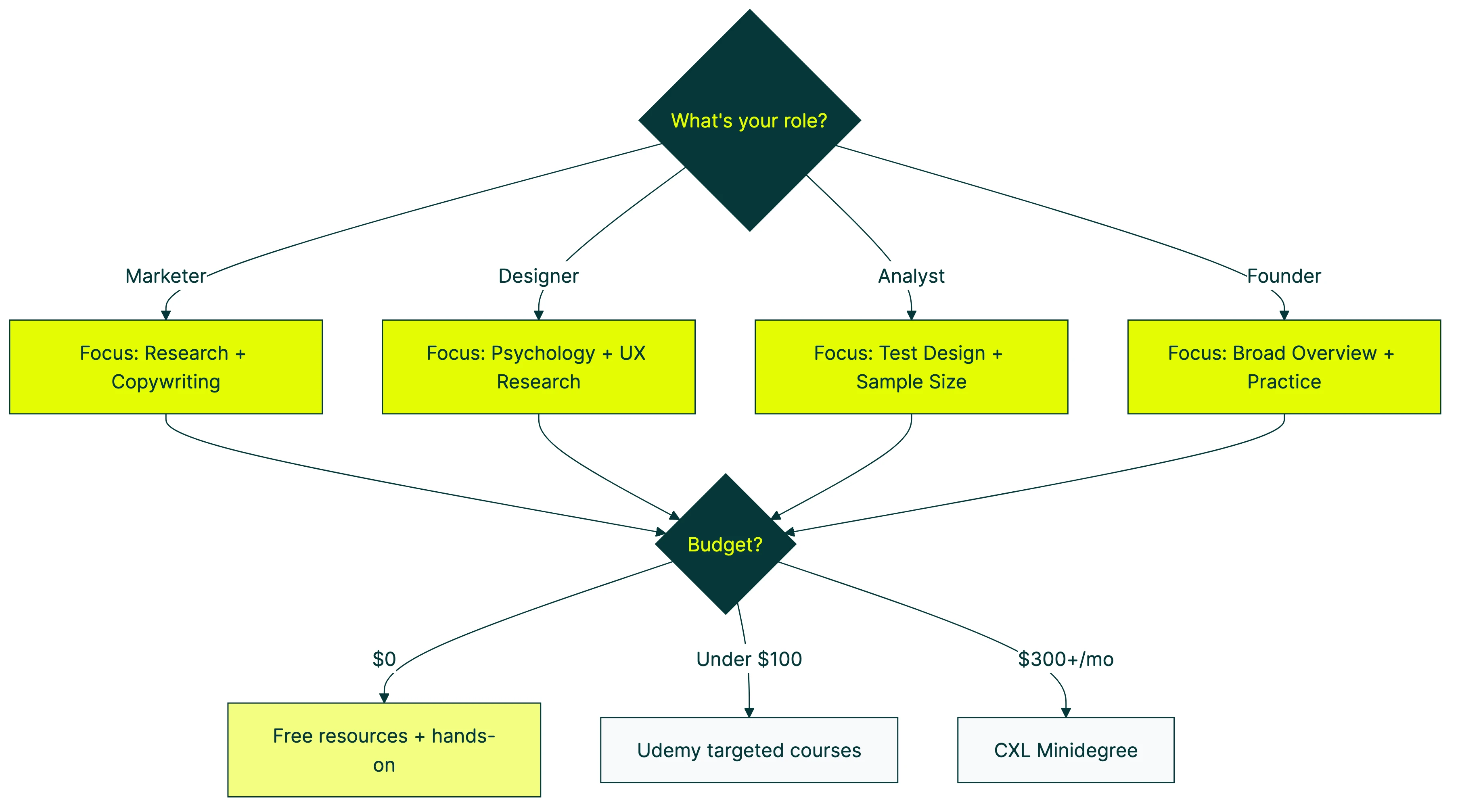
How to choose CRO training for your situation
Everyone asks “what’s the best CRO course?” Wrong question. Better question: “What conversion problem am I trying to solve?”
By role:
- Marketer: Focus on user research and copywriting first. You’re probably already decent at reading analytics. Learn to write better headlines and calls to action. Learn to ask customers the right questions. That combination covers 80% of the wins.
- Designer: You know how to make things look good. Now learn why people click (or don’t). Behavioral psychology and UX research will change how you design pages.
- Analyst: You’re already good with data. Now learn to design tests that answer the right questions. The big thing you’re missing is probably sample size: how many visitors you need before results actually mean something.
- Founder or generalist: Get a broad overview, then practice. You don’t need to go deep on statistics. You need to know enough to run a test, read the results, and make a decision. Tools like Kirro and other CRO tools are built to make this easy.
By experience level:
- Beginner: Start free. Google Analytics Academy, Conversion Sciences CRO 101, and a few good blog posts. Don’t buy anything yet.
- Intermediate: Identify your weakest skill (from the five above) and take a focused course to fill that gap. Maybe that’s a Udemy course on copywriting or a deeper statistics module.
- Advanced: Specialize. Personalization, advanced statistical methods, building CRO programs for teams. CXL makes sense at this level. So does learning from the digital CRO space if you work across channels.
By budget:
- $0: Free resources plus hands-on practice. You’ll be surprised how far this gets you.
- Under $100: One or two Udemy courses that target your specific gaps.
- $300+/month: CXL or similar, but only if CRO is (or will be) your full-time focus.
For a practical overview of CRO concepts, Ruben de Boer covers the complete optimization process:
Hands-on practice beats any certification
This might sound like something a tool company would say to sell you a tool. But the evidence backs it up from multiple directions.
Peep Laja: “Nobody can do A/B testing without actually doing it. Otherwise, you’re just playing with a toy.”
Ton Wesseling built one of Europe’s leading CRO agencies. He hires for mindset first, cultural fit second, trainability third. Notice what’s missing from that list? Certifications.
Reddit threads about CRO careers echo this. Over and over, practitioners say the same thing: show what you’ve tested, what you’ve learned, and what results you got. A portfolio of real tests beats a PDF certificate every time.
The DMI 2024 report found that 85% of practitioners cite time and workload as their biggest training barrier. Most people start courses but don’t finish them. You know what they can finish? Running one test on their actual website. Then another. Then another. That’s training that compounds.
The AMA’s 2025 Marketing Skills Report found the biggest skills gaps are in digital marketing, data analytics, and proving ROI. CRO sits right at the intersection of all three. And the fastest way to close that gap is practice.
Here’s what a practical learning path looks like:
- Read the basics (free resources, one week)
- Run a CRO audit on your own site (find what’s broken)
- Pick one thing to fix and test it
- Read the results. Learn from them. Repeat.
- Apply CRO recommendations and test those too
That loop teaches you more than any 120-hour course watched passively. You don’t need expensive A/B testing software to start.
Theory without practice is trivia. Practice without theory is guessing. You need both, but lean toward practice.
And according to Conversion.com’s ROI research, even a small 2% conversion lift can generate $150K+ annually for small businesses. So the “practice” isn’t just learning. It’s making money while learning.
FAQ
What is the best CRO training?
It depends on where you’re starting and what you can commit. For career CRO practitioners, CXL’s Conversion Optimization Minidegree is the most thorough program available (about 120 hours, $299/month). For beginners on a budget, Conversion Sciences CRO 101 (free) plus hands-on practice is the best starting point. For quick, practical skills, Udemy courses by practitioners like Ruben de Boer cost $20-50 and focus on real-world application. No single “best” exists because it depends on your role, your budget, and your experience level.
Do I need a CRO certification?
No. There’s no universally recognized CRO certification body. Every certificate comes from the vendor selling the course.
Employers and clients care about demonstrated results, not credentials. That said, completing a structured program (like CXL) does signal initiative and gives you a framework. Just don’t expect a certificate to replace a portfolio of real test results.
If you’re deciding between spending $300 on a cert or spending that time running actual tests, run the tests.
How long does it take to learn CRO?
Foundations in 2-4 weeks of focused study using free resources. Working competency takes 3-6 months of study combined with hands-on practice. Mastery is ongoing. Even experienced practitioners keep learning because the web keeps changing.
CXL’s full Minidegree program is about 120 hours. But LinkedIn’s 2025 Workplace Learning Report found that 39% of employees will need reskilling by 2030. CRO skills aren’t a one-time thing. They’re a habit.
What does CRO stand for in marketing?
CRO stands for conversion rate optimization. It means improving the percentage of website visitors who take action. Buying, signing up, requesting a quote, clicking a button.
The term “CRO” is confusingly overloaded. It can also mean Chief Revenue Officer, Combat Rescue Officer, or Clinical Research Organization depending on context. In marketing, it always means conversion rate optimization.
If you’re new to the concept, our guide to what CRO is covers the basics.
Is CRO training worth it for small businesses?
Yes, but you probably don’t need a formal course. Start with free resources and hands-on practice. Baymard Institute found that fixing usability issues alone can lift conversions by up to 35%. Even a small improvement means more revenue without spending more on ads.
If your current approach isn’t working, learn the basics before hiring help. It’ll make you a better buyer. Check out CRO services or hiring a CRO consultant if you’d rather bring in outside expertise.

Randy Wattilete
CRO expert and founder with nearly a decade running conversion experiments for companies from early-stage startups to global brands. Built programs for Nestlé, felyx, and Storytel. Founder of Kirro (A/B testing).
View all author posts