Conversion rate optimization services are outside help. Someone figures out why your website visitors leave without buying or signing up. Then they test fixes. That’s it. The industry wraps it in jargon, but you’re paying someone to make your website work harder.
The problem? There are at least five different types of CRO help, and they range from $1,000 one-time to $30,000 per month. Most businesses pick the wrong one. Some aren’t even ready for any of them yet. And the quoted price almost never matches the real cost.
This guide breaks down what exists, what each type costs, and how to figure out which one (if any) makes sense for you right now.
What are conversion rate optimization services?
Conversion rate optimization (CRO for short) is the process of getting more of your existing visitors to do what you want. Buy something. Sign up. Request a demo. Whatever “success” looks like for your site.
CRO services means hiring someone else to do that work for you. Or at least to teach you how.
The distinction matters because there’s a whole separate world of CRO tools and CRO software you can use yourself. Services are the “people” side of the equation.
Nobody in the industry talks about this: for every $1 businesses spend on conversion, they spend $92 on getting more traffic (Econsultancy). That’s pouring water into a bucket with holes. And just… buying more water.
And yet 89% of companies say CRO is “important to their strategy.” But zero percent, literally zero, say they’re “very satisfied” with their conversion rates. Something doesn’t add up.
Our take: Most businesses don’t have a traffic problem. They have a “nobody’s looking at why visitors leave” problem. Fixing that is cheaper than buying more ads.
The 5 types of CRO services (and what each one delivers)
Every CRO agency lumps CRO into one thing: “hire us.” But there are actually five distinct types of help, and picking the wrong one is the fastest way to waste money.
Think of it like home renovation. An audit is hiring an inspector. Testing-as-a-service is hiring a contractor for a specific job. Full program management is hiring a general contractor who runs everything.
Training? That’s the DIY class at the hardware store. And hybrid sits somewhere in between.
Type 1: CRO audit (one-time)
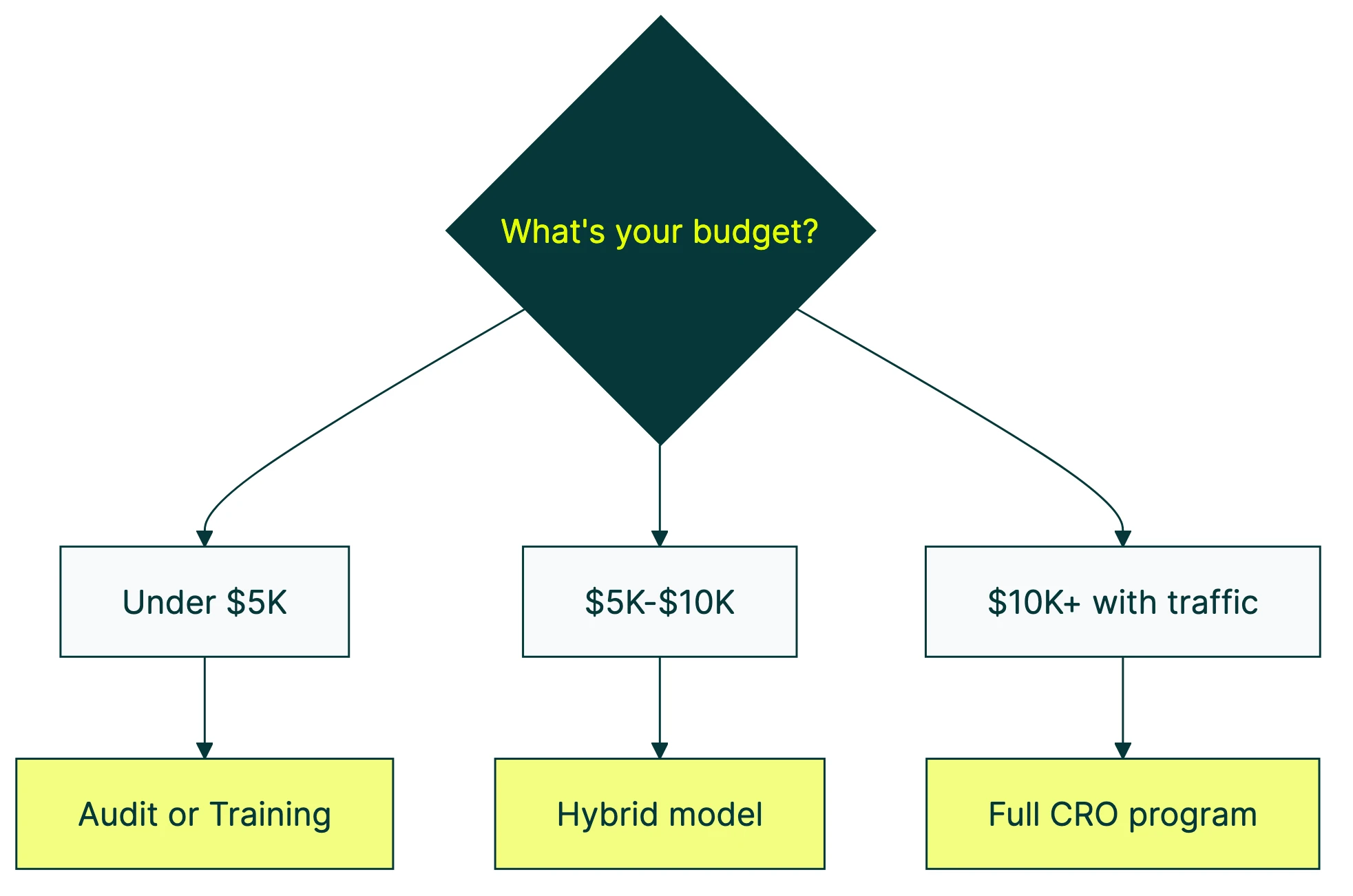
Cost: $1,000 to $25,000
You get a report. Someone reviews your website, finds where visitors drop off, and hands you a prioritized list of what to fix. No implementation included.
Best for teams that have developers who can actually build the fixes. You just need someone smart to point at the right problems. If that sounds like you, our CRO audit guide walks through what a good audit includes.
Type 2: Testing-as-a-service (monthly retainer)
Cost: $3,500 to $15,000 per month
Someone designs and runs A/B tests for you, every month. They come up with ideas, build the test versions, launch them, and report results.
Best for sites with at least 10,000 weekly visitors to the pages being tested. Below that, tests take too long to finish and you’re paying a retainer while waiting. For a deeper look at what these engagements cost and when they pay off, see our guide to hiring an A/B testing agency.
Type 3: Full program management
Cost: $10,000 to $30,000 per month
The works. Research, strategy, testing, analytics, sometimes even development. This is what agencies mean when they say “full-service CRO.” A whole team dedicated to your conversion rate.
If you’re reading this guide, this probably isn’t you yet. And that’s fine. It’s built for high-traffic ecommerce or enterprise teams running 8+ tests per month. If you’re in that camp, our ecommerce CRO checklist covers the tests worth running before hiring an agency.
Type 4: Training and enablement
Cost: $500 to $5,000 (usually one-time)
Someone teaches your team how to do CRO yourselves. The process, the tools, what to test first, how to read results. Then they leave and you run with it.
This is the underrated option. If you’re not at the traffic levels for serious testing, training lets you build the skill now and grow into it. Start with a CRO strategy and learn the basics.
Type 5: Hybrid model
Cost: $5,000 to $10,000 per month
Combines a bit of everything. Usually starts with an audit, includes some training, then runs a limited number of tests each month. Growing in popularity because it builds your team’s skills while still delivering results.
Best for mid-traffic sites that want expert guidance without fully outsourcing everything. If you run a brick-and-mortar or service-area business, there are also CRO services tailored to local businesses worth exploring. Running a Shopify store? Our Shopify CRO guide covers the platform-specific tactics worth trying before hiring an agency. UK-based? Our UK CRO agency buyer’s guide has real GBP pricing and regional picks.
Side by side:
| Type | Cost range | What you get | Best for | Time to results |
|---|---|---|---|---|
| Audit | $1K-$25K (one-time) | Findings report with priorities | Teams with dev capacity | 2-4 weeks |
| Testing retainer | $3.5K-$15K/month | Monthly A/B tests designed and run | 10K+ weekly visitors | 3-6 months |
| Full program | $10K-$30K/month | Research, strategy, testing, dev | High-traffic, enterprise | 6-12 months |
| Training | $500-$5K (one-time) | Skills for your team | Below testing thresholds | Immediate |
| Hybrid | $5K-$10K/month | Audit + training + limited testing | Mid-traffic sites | 3-6 months |
How much do CRO services actually cost?
Pricing in this industry is deliberately vague. Agencies benefit from quoting low and revealing costs later. We dug through actual pricing data (Invesp, Convert.com) so you don’t have to.
Freelance CRO consultants: $50 to $300 per hour, or $2,000 to $5,000 per month on retainer (a retainer is a fixed monthly fee for ongoing work). Our CRO consultant hiring guide has the full breakdown by experience level.
Agency retainers run $2,000 to $30,000 per month depending on scope. WebFX is one of the few that publishes pricing publicly, starting at $1,500 per month.
Enterprise programs? $50,000+ per month. If you need to ask about enterprise pricing, you probably don’t need enterprise pricing.
Think about it this way. If you spend $9,200 per month on ads but $100 on converting that traffic, that’s 99% on getting people in the door. And 1% on getting them to buy. Even a small shift toward CRO website optimization services can pay for itself many times over.
Conversion.com, one of the oldest CRO agencies, reports a typical 12-week timeline to making your money back. That tracks with what we’ve seen across the industry.
The hidden costs nobody mentions
This section is the one no agency will write, because they’re all selling you services. We’re not. So let’s look at what “five thousand a month” actually looks like when you add up all the web conversion optimization costs.
Tool licenses: $200 to $1,500 per month. A/B testing platforms, heatmaps (tools that show where people click), session recording (video of visitors using your site), and surveys. Almost always excluded from the retainer quote. You pay these separately.
Some agencies mark them up. If your agency charges extra for tool access, ask why. Testing tools like Kirro cost a fraction of what most agencies charge for platform access alone.
Developer hours: $1,000 to $12,000 per test. Every test needs someone to build it. Simple tests (swapping a headline) take 10 hours. Complex tests (redesigning a checkout flow) take 40-80 hours. At $100 to $150 per hour for developer time, that math gets ugly fast (Invesp).
QA testing: 2 to 5 hours per test. Every test needs checking on mobile, desktop, and different browsers before it goes live. Sounds small until you’re running four tests a month.
Then there’s the waiting. Low-traffic sites may wait 4 to 8 weeks per test for reliable results. A “$5,000/month” retainer that only completes one test every two months? That’s $10,000 per test result.
And if your tracking isn’t set up properly (it usually isn’t), agencies charge extra to fix it before they can even start testing. Budget $2,000 to $5,000 for analytics cleanup alone.
The real math: A “$5,000/month” retainer actually costs $7,500 to $10,000 per month when you add tools, dev time, and QA. Nobody tells you this upfront.
It’s like hiring a painter. The quote covers labor. But you still pay for paint, brushes, and drop cloths. Except in CRO, the “paint” can cost more than the painter.
Our take: Hidden costs are the #1 reason CRO engagements disappoint. The work is usually fine. The budget just runs out before the results show up. Get the full number before you sign.
Are you actually ready for CRO services?
This is the question every CRO agency should ask you but won’t. They have zero reason to tell you “come back later.” We do.
A/B testing needs traffic. You’re splitting visitors into two groups and looking for a real difference, not random noise. Conversion Rate Experts, one of the oldest CRO firms, says you need 10,000+ weekly visitors to the specific page being tested. Not your whole site. The specific page.
And only 14% of A/B tests produce a winner that’s reliable enough to act on. With low traffic, that number drops even further.
A simple framework:
Under 5,000 monthly visitors: Focus on getting traffic first. CRO services won’t help yet. Spend on SEO, content, or ads instead. Check out how CRO and SEO work together for the best approach.
5,000 to 50,000 monthly visitors: Start with a one-time audit or training. Run your own tests with a simple tool. Set up a free test with Kirro and see what you learn before committing thousands per month to an agency.
50,000+ monthly visitors: You’re ready for testing-as-a-service or full program management. Your traffic can support multiple tests running at once.
Hiring a CRO agency when you have 2,000 monthly visitors? It’s like hiring a personal trainer when you don’t own gym shoes. Get the basics in place first. Build a CRO strategy, run your own tests, and use a tool like Kirro to build the habit. When you outgrow DIY, you’ll know.
The best CRO agency clients we’ve seen are the ones who already ran a few tests themselves. They understand the process. They know their site. They have realistic expectations. That foundation makes the agency work way more productive.
CRO expert vs consultant vs agency: which do you need?
Once you know you’re ready, the next question is what kind of help to get. Think of it like choosing between a tutor (consultant), a full-time teacher (in-house specialist), or a school (agency).
A CRO specialist is a full-time hire on your team. Salary: $56,000 to $101,000 per year. Makes sense when you’re running 8+ tests per month. The upside? They know your product deeply. The downside? One person can only do so much.
A CRO consultant is one conversion rate optimization expert you hire on contract. $50 to $300 per hour, or $2,000 to $5,000 per month. Focused expertise, lower commitment. Great when you need strategic direction without a full team. Our consultant hiring guide covers how to vet and pick the right one.
Then there’s the CRO agency option. A whole team: analysts, designers, developers, strategists. $5,000 to $30,000 per month. Agencies win 21% more tests than in-house teams because they’ve seen patterns across hundreds of sites. Our agency comparison guide helps you pick the right one. And if you’re a B2B company specifically, our B2B CRO strategies guide covers the tactics that work with longer sales cycles and lower traffic.
| Factor | Specialist (in-house) | Consultant | Agency |
|---|---|---|---|
| Monthly cost | $4,700-$8,400 (salary) | $2K-$5K | $5K-$30K |
| Testing volume | 8+ tests/month | 2-4 tests/month | 4-10+ tests/month |
| Best for | Large teams, ongoing programs | Strategic direction, coaching | High velocity, proven process |
| You control | Everything | Strategy direction | Less (they run the show) |
How to tell if a CRO proposal is any good
You’ve decided to hire help. Someone sends a proposal. How do you know if it’s worth the paper (or PDF) it’s printed on?
Nearly half of CRO programs (47%) have no clear goals (VWO). And 62% of companies can’t even measure whether their testing program is working (Speero). A good proposal fixes both problems before any testing begins.
A solid conversion rate optimization service proposal should include:
- A research phase before testing. If they jump straight to “we’ll run 4 tests in month one,” they’re guessing. Good CRO starts with understanding your visitors, not testing random ideas.
- Clear methodology. Not just “we’ll improve your site” but specifically how. What tools do they use? How do they find test ideas? What’s their process?
- Success metrics tied to your business. Revenue, signups, or demo requests. Not “engagement” or “time on page.” Make sure you track the right CRO metrics from day one.
- Realistic timelines. Meaningful results take 3 to 6 months. Compound improvements take 6 to 12 months. Anyone promising results in “2 to 6 weeks” is measuring the wrong things (Aimers).
- Tool transparency. Which platforms do they use? Do you pay for licenses separately? If so, how much?
- Test velocity commitment. How many tests per month? If they can’t give you a number, they can’t give you a budget.
- Knowledge transfer plan. What happens when the engagement ends? Do you walk away with documentation, processes, and the ability to continue? Or do you walk away with nothing?
Watch out for performance-based pricing models too. They sound great (“you only pay when we get results”) but they create bad incentives. The agency runs easy, low-risk tests that show small wins fast. They avoid the harder tests that actually move your business. Simon Girardin from Convert.com calls these “perverse incentives”. We agree.
The biggest red flag: guaranteed conversion lifts. Nobody can guarantee a specific result before seeing your data. CRO is a process, not a magic trick. Anyone who promises “30% improvement guaranteed” either doesn’t understand testing or is measuring something meaningless.
Karl Blanks from Frictionless Commerce has 16 years of CRO work behind him. His take? Most gains don’t come from button colors or layout tweaks. They come from understanding why people buy. The agencies that do research properly deliver real results. The ones that skip it are guessing with your money.
FAQ
What are CRO services?
CRO services are outside help to improve how many of your website visitors take action (buy, sign up, request a demo). They range from one-time audits ($1,000 to $25,000) to full monthly programs ($10,000 to $30,000+). The five main types are: audit-only, testing-as-a-service, full program management, training, and hybrid models that mix several approaches.
How much do CRO services cost?
The short answer: $1,000 for a basic audit up to $30,000+ per month for full program management. The median small business engagement runs $3,000 to $8,000 per month for testing-as-a-service. But add $200 to $1,500 per month for tool licenses and $1,000 to $4,500 per test for developer work. Those extras usually aren’t included in the quoted price.
What should a CRO service include?
At minimum: a research and discovery phase, a prioritized list of tests to run, A/B test design and build, reporting on results, and recommendations for next steps. If they skip research and jump straight to testing, that’s a red flag. Good CRO starts with understanding your visitors, not guessing what to test.
What is the difference between a CRO agency and a CRO consultant?
A consultant is one person you hire on contract for focused expertise ($2,000 to $5,000 per month). An agency brings a full team of analysts, designers, and developers ($5,000 to $30,000 per month). Agencies cost more but can run more tests at once. Check our consultant hiring guide for the full comparison.
How long does it take to see results from CRO services?
Quick wins from an audit can show up in weeks. Meaningful testing results typically take 3 to 6 months. The kind of compound improvements that really change your conversion rate take 6 to 12 months of consistent testing. Anyone promising results in “2 to 6 weeks” is likely measuring vanity metrics, not business outcomes.
Can I do CRO myself instead of hiring a service?
Yes, especially if you have under 50,000 monthly visitors. Start with a CRO audit to find your biggest leaks. Build a CRO strategy to prioritize what to fix. Then run your own tests with a simple A/B testing tool. Many businesses get the best return from DIY testing before they ever hire outside help. Check out the best A/B testing tools and CRO blogs to follow to keep learning.

Randy Wattilete
CRO expert and founder with nearly a decade running conversion experiments for companies from early-stage startups to global brands. Built programs for Nestlé, felyx, and Storytel. Founder of Kirro (A/B testing).
View all author posts