Most “CRO tools” articles list 15 products and tell you to pick a few from each category. That’s advice built for teams with dedicated optimization specialists and five-figure budgets. If you’re a marketer or founder at a smaller company, you need a different approach.
Here’s the reality: only 0.2% of websites use any A/B testing tool at all. The gap isn’t knowledge. It’s that the industry keeps selling full “CRO platforms” to people who need one or two tools.
A/B testing tools and CRO tools are different things, even though people use the terms like they mean the same thing. An A/B testing tool does one job: it shows two versions of a page to different visitors and tells you which one performs better. A CRO tool is a broader category that includes heatmaps, session recordings, surveys, form analytics, and personalization alongside testing. Think of A/B testing as one wrench. CRO tools are the whole toolbox.
The question is whether you need the toolbox or just the wrench. For most small teams, the answer is the wrench plus one or two free tools you probably already have access to.
The 3-tool stack that covers 90% of what you need
This isn’t a theoretical framework. It’s what actually works for small teams:
Google Analytics 4 handles the “measure” part. Track traffic, conversions, funnels, and user behavior. It’s free and it’s the foundation.
Microsoft Clarity handles the “watch” part. Free heatmaps and session recordings with no limits on traffic or sessions. See where people click, how far they scroll, and where they rage-click. No credit card, no caps, no catch. Hotjar still owns 55% of the heatmap market, but Clarity does the same core job for zero dollars.
Kirro handles the “test” part. Change a headline, swap a button, try a new hero section. EUR 99/month, unlimited tests, unlimited visitors, 9KB script. The visual editor means no developer needed.
Total cost: EUR 99/month. The enterprise equivalent (Optimizely + Hotjar Business + GA4 360) runs $50,000+ per year. Same workflow. Different price tag.
Our take: The VWO and AB Tasty merger in January 2026 signals where the industry is heading. PE-backed consolidation pushes tools upmarket and prices up. The gap for small teams keeps getting wider. Building your stack from focused, affordable tools protects you from that trend.
What is a CRO tool (and do you actually need one)?
A conversion rate optimization tool is software that helps you get more from the traffic you already have. Instead of spending more on ads, you improve what your website does with the visitors who show up.
Some CRO tools watch what people do on your site. Others ask them why they did it. And a few let you test changes to see if your fix actually works. They’re different jobs, and no single tool does all of them well.
The trap? People hear “CRO tools” and immediately think they need an eight-tool stack. Heatmaps, session recordings, A/B testing, personalization, surveys, form analytics, plus a dashboard to track the dashboards.
You don’t. Not yet.
77% of companies say they run A/B tests (see our guide to A/B testing for what that involves), but only 0.2% of all websites actually use testing tools. Most businesses are still at the “understand what’s happening” stage. And that’s fine. Start there.
Our take: If you don’t know why visitors are leaving, don’t buy a tool to test changes. Start by watching. Then ask. Then test. In that order.
One more thing. A/B testing needs roughly 1,000 conversions per month to produce reliable results. Below that, tests take months to tell you anything useful. If you’re not there yet, free observation tools will teach you more than any testing platform.
What are the 6 types of CRO tools, and when do you need each?
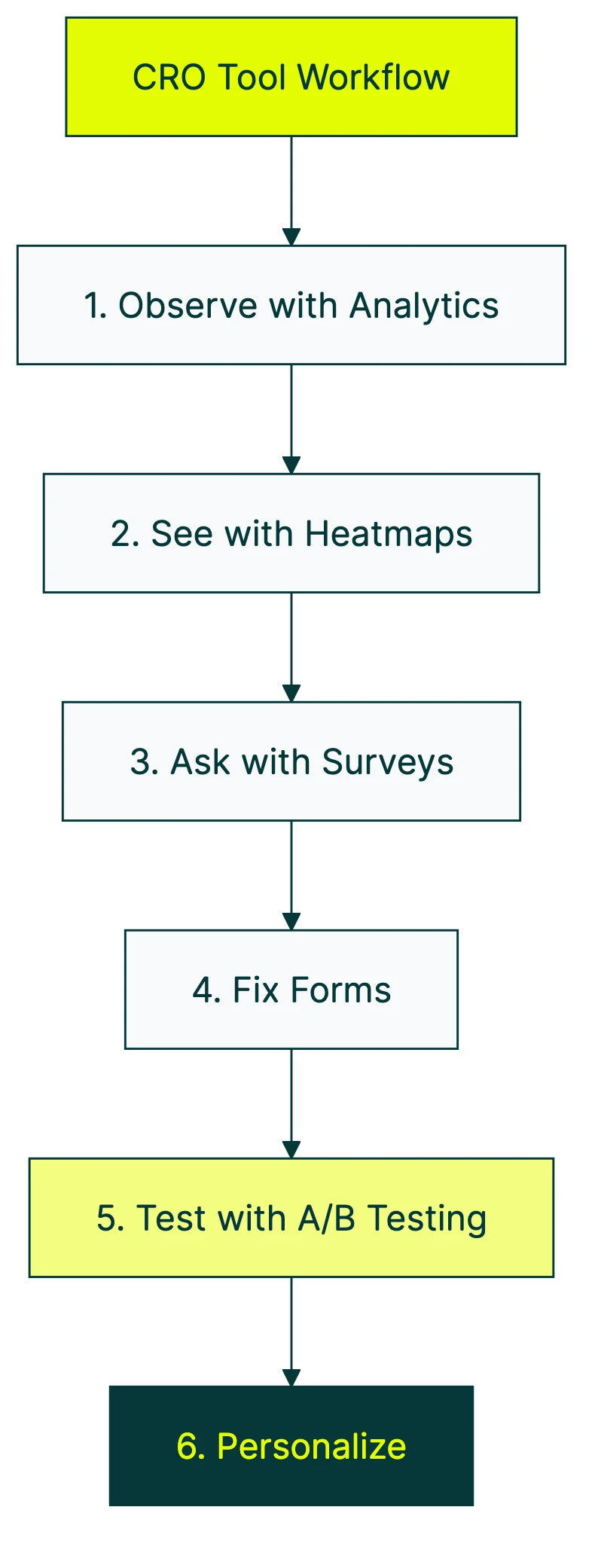
Every conversion optimization tool fits one of six categories. They follow a natural workflow. And the order matters more than most articles admit.
- Web analytics (measure what’s happening)
- Behavior analytics like heatmaps and session recordings (see what’s happening)
- Surveys and feedback (ask why it’s happening)
- Form analytics (find where forms break)
- A/B testing (test your fixes)
- Personalization (tailor experiences by audience)
Categories 1 through 3 are where everyone starts. They’re cheap or free, and they work with any traffic level. Categories 4 through 6 only make sense after you’ve done the research.
Buying a testing tool before you know what to test is like buying gym equipment before you have a workout plan.
For a walkthrough of how these tools work together to drive conversions, CXL covers the key concepts:
The CRO software market hit $10.4 billion in 2024 and is growing at 12.2% per year. But what’s worth buying depends on where you are in the process. Not what’s trending.
Best CRO tools by category
Here are the top conversion rate optimization tools in each category. We’re listing what actually works for small and mid-sized businesses. Not the 34-tool megalist that leaves you more confused than when you started. If you run an online store, our best CRO tools for ecommerce guide focuses on tools for product pages, checkout, and cart flows.
Web analytics tools
Google Analytics 4 is free and covers 99% of what small businesses need. It tracks traffic, conversions, user behavior, and funnels. It’s not exciting. It’s essential.
Mixpanel is worth a look if you run a SaaS product and want deeper funnel analysis. Free tier covers most use cases.
Skip paying for analytics unless you’ve genuinely outgrown GA4. Most people haven’t.
Heatmap and session recording tools
For a detailed comparison of the top products in this category, see our session replay tools roundup. Short version: this category had a quiet revolution. Microsoft Clarity launched as a completely free tool with unlimited heatmaps, unlimited session recordings, and no website limits. That changed the math for everyone.
Before Clarity, you’d pay Hotjar $32/month or more for limited session recordings. Now you can see where visitors click, scroll, and rage-click, all for zero dollars. If you’re weighing your options, our Hotjar alternatives guide covers the full list.
Nielsen Norman Group research found 94% of people cite navigation as the most important website feature. Heatmaps show you exactly where yours is confusing them.
Here’s what the paid tools add:
| Tool | Price | What you get beyond Clarity |
|---|---|---|
| Hotjar | $32-213/month | Surveys, longer data retention, feedback widgets |
| Crazy Egg | $29-599/month | Built-in A/B testing, snapshots |
| FullStory | $299+/month | Enterprise analytics, error tracking |
Only pay for heatmaps if you need surveys bundled in (Hotjar) or built-in testing (Crazy Egg). For observation alone, Clarity is enough.
Heatmaps and recordings do different jobs, by the way. A heatmap shows the pattern: everyone clicks here, nobody scrolls past there. A recording tells the story: this person got confused on the pricing page and left.
Use both. Heatmaps for WHERE. Recordings for WHAT. Surveys for WHY.
Survey and feedback tools
Data shows you what people do. Surveys tell you why. This combination is where real CRO insights come from.
- Hotjar Surveys ($39+/month) works best if you already use Hotjar for heatmaps. Everything lives in one place.
- Qualaroo has a free forever plan. On-site surveys that pop up at the right moment. Good enough for most teams.
- SurveyMonkey (free tier, $25+/month) has the most question types and templates. Better for longer research surveys than quick on-site questions.
Form analytics tools
If checkout or signup forms are your main conversion bottleneck, dedicated form analytics pay for themselves fast. Baymard Institute found the average checkout has 23.48 form elements. The ideal number is 12. That gap is where conversions die.
Zuko’s research backs this up. One company cut their form from 11 fields to 4 and saw a 160% jump in conversions. Multi-step forms beat single-page forms by 35-214%.
- Zuko (formerly Formisimo, ~$100-300/month) is the specialist. Deep form analytics with field-level drop-off data.
- Lucky Orange ($39/month) bundles form analytics with heatmaps and recordings. Good budget option if you want everything in one tool.
Most behavior analytics tools now include basic form tracking. You only need a dedicated form tool if forms are your primary conversion killer.
A/B testing and experimentation tools
This is where the conversation gets real. And where the most money gets wasted. (For a deeper look at just this category, see our best A/B testing tools roundup.)
A/B testing tools let you show two versions of a page to different visitors and measure which one gets more conversions. Change a headline, swap a button color, rewrite your pricing page. The tool splits traffic and does the math.
Only 12.5% of A/B tests produce winning results. Not because testing is broken, but because most people skip the research (categories 1 through 3 above) and test random changes.
A Harvard/Duke study of 35,262 startups found that A/B testing accelerates both success AND failure. Test the right thing, you win faster. Test the wrong thing, you burn through time and money.
The conversion optimization software market for testing, at a glance:
| Tool | Best for | Starting price | Free tier |
|---|---|---|---|
| Kirro | Small teams, solo founders | EUR 99/month | 30-day trial (full product) |
| VWO | Mid-market, all-in-one | ~$314/month | Limited free plan |
| Optimizely | Enterprise | ~$36,000/year | No |
| GrowthBook | Developer teams | Free (open source) | Yes (self-hosted) |
| Convert | Privacy-focused teams | $399/month | No |
Kirro fills the gap that Google Optimize left when it shut down in September 2023. Simple setup, visual editor, Bayesian stats that work with smaller traffic. EUR 99/month with unlimited tests and unlimited visitors.
The script is 9KB. Most competitors load 100-200KB. That matters when 40% of people leave sites that take more than 3 seconds to load.
Honest trade-offs: Kirro is web-only. No server-side testing. No feature flags. If you’re a marketer who wants to test a headline without filing a dev ticket, it’s built for you. It’s especially useful for landing page optimization where quick headline and CTA tests make the biggest difference. Pair it with landing page analysis tools to identify what to test before you start experimenting. Want to test SEO changes instead of conversion changes? That’s a different category with different tools. Need the full workflow? Our landing page split testing guide covers everything from page selection to reading results. If you need enterprise-scale multivariate testing, look at VWO or Optimizely. For split testing software that handles redirect tests specifically, we’ve compared eight tools.
VWO starts around $314/month and includes heatmaps, surveys, and session recordings alongside testing. Can’t decide between the big two? Our VWO vs Optimizely comparison covers pricing and features. Want Optimizely pricing details? We broke down the real costs. Shopping for cheaper Optimizely alternatives? We covered seven of them. If you’re deep in Adobe’s ecosystem, our guide to Adobe Target A/B testing covers whether that integration justifies the price tag.
GrowthBook is free and open-source, but you need developers to set it up. If “self-hosted” sounds like a foreign language, this isn’t your tool.
The Google Optimize shutdown left millions of marketers without a simple, free testing tool. VWO responded by reducing pricing in late 2024. But the gap for affordable, no-code testing is still wide open. See our full list of Google Optimize alternatives for more options.
Personalization tools
Personalization means showing different content to different visitors. Based on who they are, where they came from, or what they’ve done before.
It sounds amazing. In practice, it requires 10,000+ visitors per segment, deep CRM integration, and 1-3 months of setup work.
McKinsey research says personalization drives 10-30% improvement in marketing ROI. But that’s for companies with the traffic and data to pull it off.
- Mutiny (~$500-2,000/month) is built for B2B SaaS. Personalizes pages by company, industry, or campaign.
- Dynamic Yield (enterprise, custom pricing) is the full platform. AB InBev and IKEA use it. You probably don’t need it yet.
Save personalization for when your basic CRO strategy is mature. Clear headlines, working forms, and fast pages will beat any personalization engine running on top of a confusing website. That said, AI conversion rate optimization is making personalization more accessible for smaller teams. And if tools alone aren’t moving the needle, it might be worth exploring when to hire a CRO consultant instead.
How do you choose the right CRO tools?
Every “best CRO tools” article lists 15-30 tools and leaves you to figure out which ones to actually buy. That’s not helpful. What you need depends on where you are. Before buying anything, start with a CRO audit to know what problems you’re solving.
CRO expert Charles Burdett recommends a minimum of 5,000 visitors per week before A/B testing makes sense. Below 10,000 monthly visitors, testing shouldn’t be your primary tool. Here’s a framework based on where you are.
Phase 1: Observe (any traffic level)
Tools: GA4 + Microsoft Clarity (both free)
What you’re doing: Watching. Where do people land? Where do they leave? What do they click? This works even if you get 100 visitors a month. You’ll spot obvious problems (broken pages, confusing navigation, dead-end content) without spending a dollar.
Phase 2: Understand (1,000+ visitors/month)
Add Hotjar or Qualaroo ($0-39/month) and start asking questions. Run a quick on-site survey: “What almost stopped you from signing up?” or “What were you looking for that you couldn’t find?”
Five survey responses often teach you more than 5,000 pageviews. Combine them with your heatmap data. Now you know what’s happening AND why.
Phase 3: Test (1,000+ conversions/month)
Tools: Add an A/B testing tool like Kirro or VWO ($99-314/month)
What you’re doing: Testing the fixes you found in phases 1 and 2. You watched, you asked, now you’re testing your best ideas. This is where conversion rate optimization gets measurable.
Lower traffic? Conversion Rate Experts says you can accept 85-90% confidence instead of the standard 95%. Test smaller changes (button clicks, micro-conversions) instead of waiting months for enough purchase data.
If you want to run your first test in about three minutes, that’s literally how long Kirro’s setup takes.
Phase 4: Personalize (10,000+ visitors per segment)
This is Mutiny or Dynamic Yield territory ($500-2,000+/month). B2B visitors see one hero. Returning customers see another. Powerful, but only after the basics convert well.
McKinsey reports $1.7 trillion in revenue is unlockable through personalization. That number is for companies with serious data infrastructure, though. Not for a 10-page marketing site.
Budget quick-reference
| Monthly budget | Recommended stack |
|---|---|
| $0 | GA4 + Microsoft Clarity + Qualaroo (free tier) |
| $50-200 | Above + Hotjar Plus or Crazy Egg |
| $200-500 | Above + Kirro or VWO Growth |
| $1,000+ | Full stack with testing + personalization |
Our take: Most companies jump straight to Phase 3 (testing) without doing any research in Phases 1 and 2. That’s why 87.5% of A/B tests don’t produce winning results. Two weeks of heatmaps and five survey responses will make every test after that dramatically better. The research is free. The testing doesn’t have to be expensive. The order matters.
CRO tools comparison table
| Tool | Category | Starting price | Free tier | Best for | Min. traffic |
|---|---|---|---|---|---|
| Google Analytics 4 | Analytics | Free | Yes | Everyone | Any |
| Mixpanel | Analytics | Free tier | Yes | SaaS product teams | Any |
| Microsoft Clarity | Heatmaps, recordings | Free | Yes | Everyone | Any |
| Hotjar | Heatmaps, surveys | $32/month | Limited | Teams wanting heatmaps + surveys | Any |
| Crazy Egg | Heatmaps, testing | $29/month | No | Quick visual insights | Any |
| FullStory | Session analytics | $299/month | No | Enterprise teams | High |
| Qualaroo | Surveys | Free | Yes | On-site surveys | Any |
| SurveyMonkey | Surveys | Free tier | Yes | Research surveys | Any |
| Zuko | Form analytics | ~$100/month | No | Checkout/signup forms | Any |
| Lucky Orange | All-in-one | $39/month | No | Budget all-in-one | Any |
| Kirro | A/B testing | EUR 99/month | 30-day trial | Small teams | 1,000+ conv/month |
| VWO | A/B testing + more | ~$314/month | Limited | Mid-market | 1,000+ conv/month |
| Optimizely | A/B testing | ~$36,000/year | No | Enterprise | High |
| GrowthBook | A/B testing | Free | Yes (self-host) | Developer teams | 1,000+ conv/month |
| Convert | A/B testing | $399/month | No | Privacy-focused | 1,000+ conv/month |
| Mutiny | Personalization | ~$500/month | No | B2B SaaS | 10,000+ per segment |
| Dynamic Yield | Personalization | Custom | No | Enterprise | High |
What are the most common CRO tool mistakes?
Buying testing tools without enough traffic. This is the number one waste of money in CRO. If you’re getting 500 conversions a month, an A/B test comparing two headlines needs six months to reach a result. Start with free observation tools until your traffic justifies testing. (Check if your traffic is ready with our conversion rate guide.)
Tools can’t fix bad ideas. Only 1 in 8 tests wins, and a Patreon product manager put it best: “A/B testing is not insurance for critical thinking.” Two weeks of heatmap data and five survey responses will give you better test ideas than a month of guessing. The most common A/B testing mistakes? They all come from skipping the research.
Over-buying enterprise tools for SMB needs. If you’re a 20-person company, you don’t need Optimizely. Or Dynamic Yield. Or a $2,000/month tool stack. Speero’s 2025 maturity research found that even mature programs struggle to move past vanity metrics. More tools won’t solve that. Better thinking will.
Then there’s tool overlap. Hotjar does heatmaps. So does Crazy Egg. So does Microsoft Clarity. So does Lucky Orange. If you’re paying two vendors for the same heatmaps, you’re paying twice for one job.
Forgetting about page speed. A/B testing tools add JavaScript to your site. Some add a lot. HBR research warns about hidden costs of testing infrastructure, and page speed is one of them. Kirro’s script is 9KB. Some competitors load 100-200KB. That gap matters when slow pages directly hurt conversions.
And one that’s easy to miss: Harvard Business Review found that looking at averages hides what’s actually happening. A change might help mobile visitors and hurt desktop visitors. The average looks flat, but half your traffic is getting a worse experience. Segment your results. Always.
Which post should you read next?
Every post in this cluster covers a different part of the CRO toolkit. Start with the one that matches where you are right now.
Ready to buy software? The CRO software buyer’s guide is for people who already know what they need and want to compare specific products. It covers pricing, stacks by budget tier, and the trade-offs between all-in-one platforms and best-of-breed setups. Includes the post-merger VWO/AB Tasty picture.
Need to understand user behavior first? Our session replay tools roundup compares every major heatmap and recording tool, starting with free options. If you want to see what visitors actually do on your site before deciding what to test, start there.
Thinking about switching from Hotjar? The Hotjar alternatives guide covers why teams leave (pricing, session limits on the free plan) and what to use instead. Includes a head-to-head with Microsoft Clarity and the full comparison with FullStory, Mouseflow, and Lucky Orange.
Just want the testing category? Our best A/B testing tools roundup covers that one category in depth, by team size and budget.
The thread connecting all of this
Most businesses get stuck because they either skip straight to testing (without knowing what to test) or they buy observation tools and never act on what they find.
The posts in this cluster cover the full picture, from choosing the right tool categories to comparing specific products. The parent A/B Testing pillar page ties this into the broader testing and experimentation strategy.
When you’re ready to start testing, Kirro’s free trial gives you 30 days with the full product. No features locked. No credit card required. Pair it with Clarity and GA4, and you’ve got the same CRO workflow the enterprise teams use.
FAQ
What is a CRO tool?
Software that helps you understand visitor behavior and test improvements to get more conversions from your existing traffic. Instead of paying for more visitors, you make better use of the ones you have. There are six main types: analytics, heatmaps, surveys, form analytics, A/B testing, and personalization.
How do I choose a CRO tool?
Start with free observation tools. GA4 for traffic data, Microsoft Clarity for heatmaps and session recordings. These work at any traffic level and cost nothing. Only add paid tools when you’ve identified a specific problem to solve and have enough traffic to test solutions properly. Our decision framework above breaks it down by phase.
Are CRO tools worth it?
They can be. CRO tools deliver an average 223% ROI according to a VWO study. But only if you have enough traffic and a research-first approach. Buying tools without a strategy is like buying gym equipment without a workout plan. The equipment isn’t the problem.
What’s the best free CRO tool?
Microsoft Clarity. Unlimited heatmaps, unlimited session recordings, completely free. No catch. Pair it with Google Analytics 4 and you’ve got a solid foundation for $0. Most small businesses can run on just these two for months before needing anything paid.
How many CRO tools do I need?
Two or three. An analytics tool (GA4), a behavior tool (Microsoft Clarity or Hotjar), and eventually a testing tool when your traffic supports it. Don’t build a 10-tool stack on day one. Craig Sullivan, who’s worked with Google and Amazon on CRO, puts it well: “It’s mainly about mindset of the team, not the tools.” For staying sharp on strategy, the top CRO blogs for practitioners are worth bookmarking.
Can I do CRO without tools?
You can start. Review your analytics. Talk to customers. Make changes based on common sense and proven CRO principles. But tools let you validate with data instead of guessing. Microsoft Clarity takes 10 minutes to install and immediately shows you what visitors actually do. No reason not to.
What happened to Google Optimize?
Google shut it down in September 2023. It was the only free, simple A/B testing tool for small businesses. The shutdown left a gap. VWO and other tools reduced pricing to capture those teams, but nothing has fully replaced the simplicity of Google Optimize yet. Our roundup of Google Optimize alternatives covers the closest options, including Kirro at EUR 99/month.
-
 Randy Wattilete
 - 12 Jun, 2026
- CRO Tools & Software
Best CRO tools for ecommerce: 12 picks that actually move revenue
The best CRO tools for ecommerce depend on your store's traffic, budget, and where you're losing sales. For most small-to-mid Shopify stores, Kirro (A/B testing), Microsoft Clarity (heatmaps), and GA4 (funnel analytics) cover about 80% of what you need. Stores with more traffic and budget can layer ...
- Randy Wattilete
- 14 Mar, 2026
- CRO Tools & Software
Best session replay tools in 2026: 8 tools compared honestly
Microsoft Clarity is the best free session replay tool. Hotjar is the most popular all-in-one option. PostHog wins for technical teams who want open ...
- Randy Wattilete
- 14 Mar, 2026
- CRO Tools & Software
7 best Hotjar alternatives in 2026 (and why people are switching)
Microsoft Clarity is the best free Hotjar alternative. Mouseflow is the closest paid swap. FullStory wins for product teams with budget. The bigger ...
- Randy Wattilete
- 11 Mar, 2026
- CRO Tools & Software
CRO software: what it is, what to buy, and what actually matters
CRO software helps you figure out why visitors leave your website without buying, signing up, or doing the thing you want them to do. Then it helps you test cha ...