VWO is the better pick for marketing teams with budgets under $30,000/year. Optimizely is the better pick for enterprise teams that need mature feature flags and server-side testing. And if you’re a small team that finds both of them expensive or complicated, neither is the right tool for you.
That’s the short version. The rest of this post covers why, with real pricing data, G2 scores, and the hidden costs nobody else mentions. We dug through 796 verified reviews on TrustRadius and tested both platforms ourselves.
Looking for a broader comparison? Check our best A/B testing tools roundup or the full A/B testing tool comparisons hub. New to testing entirely? Our A/B testing guide covers the fundamentals.
Quick verdict: VWO vs Optimizely
Here’s who should pick what:
| Your situation | Best fit | Why |
|---|---|---|
| Marketing team, under $30K/year budget | VWO | Built-in heatmaps, easier setup, transparent pricing |
| Enterprise, 50+ person team, $50K+ budget | Optimizely | Mature feature flags, server-side testing, Gartner/Forrester leader |
| Small team (1-10 people), tight budget | Kirro | EUR 99/month, 3-minute setup, works with GA4 |
| Engineering-led product team | Statsig or LaunchDarkly | Developer tools built for code-level testing |
Our take: A lot of teams reading “VWO vs Optimizely” don’t actually need either one. Both are built for companies running 10+ tests per month with dedicated people managing them. If that’s not you, save your money.
What VWO and Optimizely actually are in 2026
VWO (Visual Website Optimizer) started as a straightforward A/B testing tool built by Wingify, based in India. It’s grown into a full CRO software suite: A/B testing, heatmaps, session recordings, surveys, form analytics, and personalization on your website. All under one roof.
The big recent news: VWO and AB Tasty merged under Everstone Capital in late 2025, creating a $100M+ combined company. More on what that means for you below.
Optimizely was founded in 2010 by Dan Siroker and Pete Koomen, both ex-Google. They helped run Obama’s 2008 campaign website testing. Episerver acquired Optimizely in 2020 and rebranded everything under the Optimizely name.
Since then they’ve bought Zaius (customer data platform) and Welcome (marketing platform). Now it’s a full digital experience platform serving roughly 9,000 brands.
Optimizely has been named a Gartner Magic Quadrant Leader for digital experience platforms six years running. They also topped the Forrester Wave for Experience Optimization in Q4 2024.
In this comparison, we’re focused on the A/B testing capabilities of both tools. Not CMS. Not marketing automation. Just testing.
Feature-by-feature comparison
Here’s what the G2 data says (based on verified user reviews, not marketing pages):
| Feature | VWO | Optimizely | Edge |
|---|---|---|---|
| A/B testing | 9.0/10 | 9.0/10 | Tie |
| Ease of setup | 8.6/10 | 8.0/10 | VWO |
| Heatmaps | 7.6/10 | 5.7/10 | VWO |
| Support quality | 8.9/10 | 8.0/10 | VWO |
| Mobile testing | 7.5/10 | 8.9/10 | Optimizely |
| Personalization | 7.0/10 | 7.5/10 | Optimizely |
A few things jump out.
Built-in analytics is VWO’s biggest advantage. Heatmaps, session recordings, and form analytics are all native. You don’t need to pay separately for Hotjar and its alternatives or FullStory ($200-500/month). If FullStory’s cost is a concern, our best FullStory alternatives guide covers cheaper options. For teams running conversion rate optimization programs, that’s a real saving.
Feature flags? That’s Optimizely’s territory. Their system is production-ready and battle-tested. VWO Deploy (their feature flag product) is still catching up. If your engineering team needs gradual rollouts tied to testing, Optimizely is ahead.
Server-side testing is also stronger in Optimizely. VWO has server-side capabilities, but Optimizely’s are deeper. For split testing software that works beyond the browser, Optimizely wins.
VWO has one feature Optimizely completely lacks: surveys and form analytics. Want qualitative data (why visitors leave, what confuses them) alongside your test results? VWO gives you that in one tool.
Both support multivariate testing, though you’ll need a lot of traffic. Most teams get better results from sequential A/B tests than from trying to test five things at once.
And VWO’s support is notably better (8.9 vs 8.0 on G2). When you’re stuck at 11pm and your test isn’t tracking, response time matters.
How the stats work: Bayesian vs sequential testing
This matters more than most comparison articles let on.
VWO uses Bayesian statistics through their SmartStats engine. When you check your test results, VWO tells you “Version B has an 89% chance of being better.” That’s intuitive. Most marketers understand percentages. You don’t need a stats degree.
Optimizely uses sequential testing (their Stats Engine was developed with Stanford University). It gives you a traditional significance call: your test is significant or it’s not. Sequential testing also solves the “peeking problem” (checking results too early) by building that correction into the math.
Which is better? Neither. Seriously.
Both solve the early-peeking problem, just differently. For most marketing teams, Bayesian (VWO) is easier to understand and act on. For data science teams that want mathematical guarantees about future performance, sequential (Optimizely) is more rigorous. Read more about Bayesian A/B testing if you want the full breakdown.
The industry trend is toward Bayesian. Google Optimize used it. AB Tasty uses it. Kirro uses it. It works particularly well for sites with smaller traffic, which is most sites.
Our take: If your team doesn’t have a statistician, go Bayesian. You’ll make faster, more confident decisions. “89% chance this wins” is a much easier conversation with your boss. Try explaining p-values at a Monday standup.
What VWO and Optimizely actually cost
Pricing is where these two tools diverge the most. And Optimizely makes it intentionally hard to compare.
VWO pricing
VWO uses transparent, usage-based pricing tied to monthly tracked users (MTUs). Based on 93 verified purchases tracked by Vendr, the median VWO customer pays $16,660/year. Most teams land in the $2,000-$30,000/year range.
One important change: in late 2025, VWO largely restricted their “Free Forever” plan. The free entry point that attracted many smaller teams is mostly gone.
You can negotiate. Vendr’s data shows an average 20% savings through negotiation.
Optimizely pricing
Optimizely has no public pricing page. You have to talk to sales. That process takes 4-8 weeks.
What we know from user reports and published analyses:
- Entry point: ~$36,000/year minimum
- Typical enterprise: $50,000-$200,000/year
- High-traffic enterprise: $200,000-$400,000+/year
- 10M monthly impressions: $63,700/year (Business) to $113,100/year (Enterprise)
Annual commitment required. No monthly option. Some users report a percentage-of-revenue pricing model, which can get expensive fast. Read our full Optimizely pricing breakdown for more detail.
The real comparison
Take a team with 500,000 monthly visitors running 5-10 tests. The math: roughly $400-700/month for VWO vs $50,000-75,000/year for Optimizely. That’s a 6-8x gap for similar core A/B testing.
The real cost nobody talks about: total cost of ownership
Every other comparison article stops at subscription pricing. “VWO costs X, Optimizely costs Y.” But the sticker price is misleading. Here’s what the first year actually looks like:
Optimizely: first-year TCO
| Cost | Amount |
|---|---|
| Subscription | $36,000+ |
| Implementation (dev hours, setup) | $10,000-$20,000 |
| Training | $5,000-$10,000 |
| Hotjar/FullStory (no native analytics) | $2,400-$6,000 |
| Total first year | $53,400-$72,000 |
Optimizely needs dedicated technical resources for setup and ongoing maintenance. You’re not just buying software. You’re buying a project. As one Hacker News commenter put it: “A generation of new marketers will not be using Optimizely.” They’ve priced out everyone except large enterprises.
VWO: first-year TCO
| Cost | Amount |
|---|---|
| Subscription | $16,660 (median) |
| Implementation | $2,000-$5,000 |
| Training | Minimal (easier UI) |
| Analytics tools | $0 (native heatmaps, recordings) |
| Total first year | $18,660-$21,660 |
VWO’s built-in analytics suite cuts out the need for separate heatmap and session recording tools. That alone saves $2,400-6,000/year. The simpler setup also means lower implementation costs.
For teams where even VWO feels like a stretch, Kirro costs EUR 99/month (about EUR 1,188/year) with unlimited tests and unlimited visitors. No implementation project. No training. Three-minute setup. That’s roughly 15x cheaper than VWO and 50x cheaper than Optimizely.
Adobe Target vs Optimizely vs VWO: the enterprise triangle
If you’re searching “adobe target vs optimizely” or “optimizely vs adobe target,” you’re probably comparing enterprise-level tools. Here’s the honest breakdown:
Adobe Target lives inside Adobe Experience Cloud. It’s the strongest personalization engine of the three. But it only makes sense if you’re already running Adobe Analytics, AEM, and Audience Manager. Buying Adobe Target standalone is like buying a trailer hitch without a truck. For the full picture on licensing, setup, and Adobe Target as an enterprise alternative, we wrote a separate deep dive.
Optimizely is the best standalone enterprise experimentation platform. You don’t need an existing ecosystem. It works with whatever analytics, CMS, and CDP you already use. That independence is its biggest advantage over Adobe Target.
VWO gives you enterprise-adjacent features (A/B testing, personalization, analytics) at a fraction of the enterprise price. For mid-market teams that want conversion rate optimization tools without the Fortune 500 price tag, VWO is the practical choice.
The decision is simpler than it looks:
- Already deep in Adobe’s ecosystem? Adobe Target
- No existing platform lock-in, big budget? Optimizely
- Budget-conscious, marketing-led team? VWO
LaunchDarkly vs Optimizely: feature flags vs A/B testing
If you’re searching “launchdarkly vs optimizely” or “optimizely vs launchdarkly,” you’re comparing two different approaches to testing. Not two versions of the same thing.
LaunchDarkly is developer infrastructure. Feature flags, progressive rollouts, kill switches. It lets engineering teams ship code safely and turn features on for specific groups. Testing is a secondary use case.
Optimizely is marketing and product testing. Visual editor, A/B tests, personalization. It lets non-technical teams test website changes without writing code.
These categories are converging. LaunchDarkly is adding testing features. Optimizely has been building out feature flags. Split.io joined the Harness family in May 2024, signaling more consolidation ahead.
But right now, if you’re an engineering team doing code-level feature rollouts, LaunchDarkly. If you’re a marketing team testing headlines and page layouts, Optimizely (or VWO, or Kirro if you want something simpler).
Many enterprises run both: LaunchDarkly for engineering, Optimizely or VWO for marketing. They’re complementary, not competitors.
Google Content Experiments vs Optimizely: what changed
If you’re searching “google content experiments vs optimizely,” you probably remember when Google offered free A/B testing. Here’s the timeline:
Google Content Experiments became Google Optimize. Google Optimize shut down on September 30, 2023. That affected 2-3 million websites.
Google chose not to rebuild the tool for GA4 integration. They just pulled the plug.
The gap that created is still open. Google Optimize was free and simple. Everything that replaced it costs $2,000/year minimum, often much more. For the millions of small businesses and marketers who used it, the options got worse and more expensive overnight.
If you liked Google Optimize because it was simple and affordable, Optimizely isn’t your replacement (starting at $36,000/year). VWO is closer, but still starts around $2,000/year. We built Kirro for exactly this situation. Simple A/B testing that works with GA4, without enterprise prices. You can also check our list of Google Optimize alternatives.
The VWO + AB Tasty merger: what it means for you
This is something no other VWO vs Optimizely comparison covers, because most were written before it happened.
In late 2025, VWO and AB Tasty merged under Everstone Capital, creating a combined company worth $100M+. That’s a big deal if you’re evaluating either platform right now.
The upside? Broader feature set combining VWO’s analytics with AB Tasty’s enterprise personalization. Bigger engineering team. More resources for R&D.
The risk is what usually happens after SaaS mergers: pricing goes up, overlapping features get killed, support quality dips during the transition. If you’re on AB Tasty, there could be platform migration headaches too. For the full picture on AB Tasty pricing, we broke down what it actually costs. If that’s your situation, our roundup of AB Tasty alternatives covers what to switch to and why.
If you’re evaluating VWO today, ask these questions before signing:
- What’s the merger timeline? When will products change?
- Are current pricing plans guaranteed for my contract term?
- Which features from AB Tasty are being added? Which VWO features might be deprecated?
- What happens to my data and integrations during the transition?
The consolidation wave in A/B testing is real. The global market hit $850 million in 2024 and is growing at 14% annually. When markets consolidate, prices tend to go up. Lock in your terms if you can.
For context: Optimizely itself went through this. When Episerver acquired them in 2020, prices rose and the free plan disappeared. One Hacker News thread about the change had developers saying the high costs motivated them to “create free alternatives.” History tends to repeat.
Who should use what: the decision framework
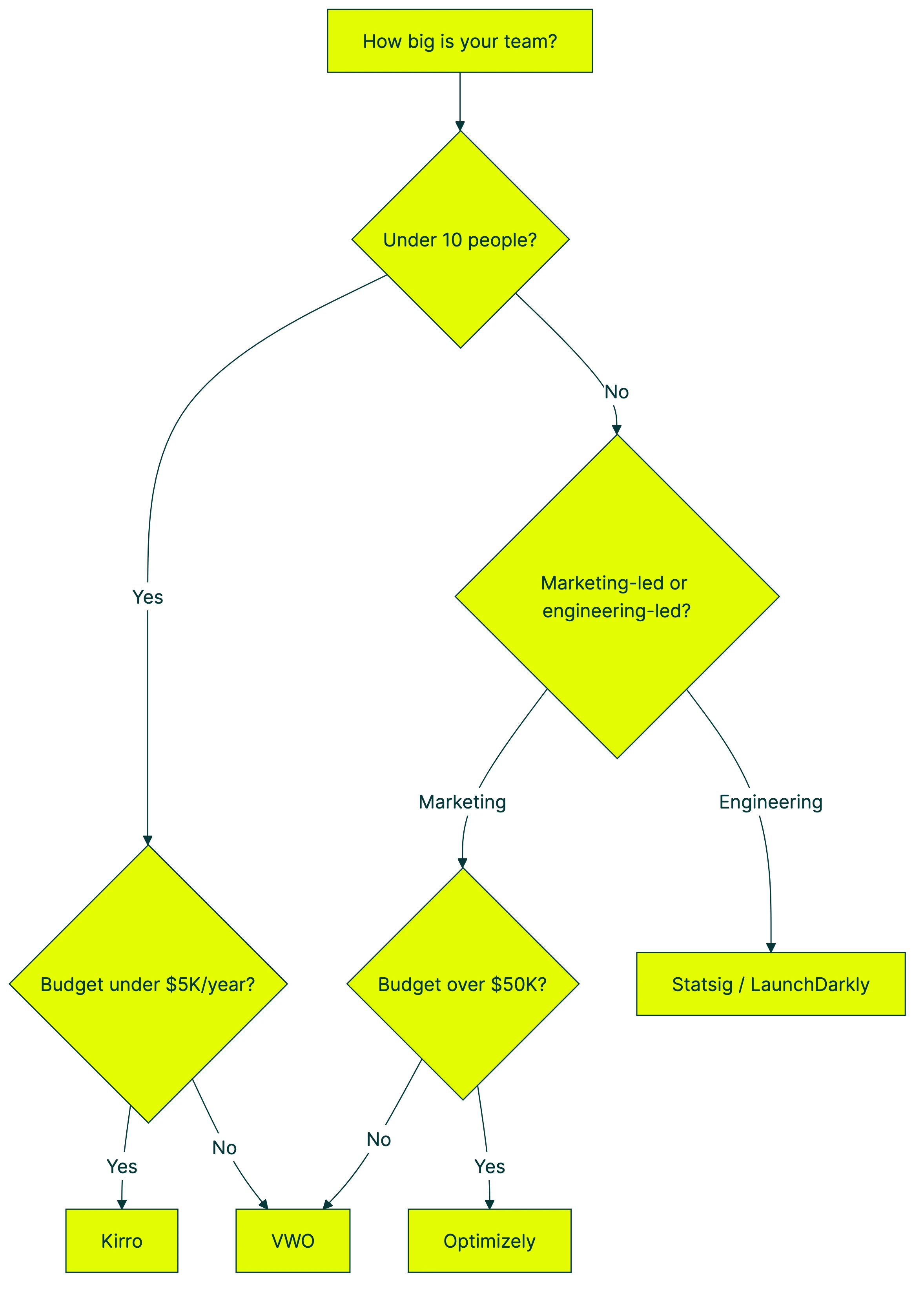
Choose VWO if your team is marketing-led with a $2K-$30K/year budget. You want heatmaps and session recordings included, not bolted on. Transparent pricing matters. You’re mid-market (50-500 employees) and want landing page optimization, split testing landing pages, and measuring A/B test conversion rates in one place.
Optimizely makes sense when you have data science or engineering involvement and a $50K+/year budget. You need production-ready feature flags. Gartner/Forrester recognition matters for procurement. You’re coordinating tests across departments or running SEO A/B testing at scale.
Kirro is for small teams (1-10 people) with budgets under $5K/year. You want to start testing this week, not next quarter. You already use GA4. And you’d rather spend EUR 99/month than $36,000/year for features you’ll never touch.
Engineering-led teams should look at developer tools: Statsig, GrowthBook, or LaunchDarkly. Feature flag infrastructure first, testing second. Our Optimizely alternatives roundup covers more options.
Our take: The A/B testing market has a hole in the middle. Enterprise tools cost $36K-$200K/year. Free developer tools need an engineer to run them. Most small businesses fall in between. We built Kirro to fill that gap at EUR 99/month.
For a deeper look at how these two platforms compare in practice, Invesp breaks down the key differences:
FAQ
What are the competitors of Optimizely?
The main competitors are VWO (now merged with AB Tasty), Adobe Target, LaunchDarkly, Statsig, Convert, and Kameleoon. The market splits into enterprise platforms (Optimizely, Adobe Target), mid-market tools (VWO, Convert), developer platforms (Statsig, LaunchDarkly, GrowthBook), and simple, affordable options (Kirro). See our full A/B testing tools roundup.
Is VWO better than Google Optimize?
Google Optimize no longer exists. It was shut down in September 2023. VWO is far more powerful, but also far more expensive. If you liked Google Optimize because it was free and easy, VWO might feel like overkill. Kirro was built for teams who miss that simplicity.
Is Optimizely owned by Google?
No. Optimizely was founded by two ex-Google employees (Dan Siroker and Pete Koomen) who worked on the 2008 Obama campaign website. But the company was never owned by Google. Episerver acquired Optimizely in 2020, and the combined company rebranded as Optimizely in January 2021.
Is VWO a good tool?
Yes. VWO scores 4.2/5 on G2 with 8.9/10 for support quality. It’s particularly strong for marketing teams that want built-in analytics (heatmaps, session recordings) alongside A/B testing. The main downside: pricing has gone up, and the free plan was largely restricted in late 2025.
How much does Optimizely cost?
Optimizely starts at approximately $36,000/year with no monthly option. Typical enterprise customers pay $50,000-$200,000/year. You have to go through a 4-8 week sales process before they’ll share actual pricing. No free trial. Read our Optimizely pricing breakdown for more details.
Can you switch from VWO to Optimizely (or vice versa)?
Yes, but plan for 2-6 weeks of migration work. You’ll lose historical test data (no standard export format between platforms).
The biggest cost isn’t the software switch. It’s reconfiguring integrations, retraining your team, and the 1-2 months where testing slows down.
Should I build my own A/B testing tool instead?
It’s an option if you have engineering resources. Some companies report building a basic tool in about three months. Add custom integrations and you’re looking at six months to a year.
For most teams, buying makes more sense. The math only flips when you have very specific needs no commercial tool handles well.

Randy Wattilete
CRO expert and founder with nearly a decade running conversion experiments for companies from early-stage startups to global brands. Built programs for Nestlé, felyx, and Storytel. Founder of Kirro (A/B testing).
View all author posts