Kirro, GrowthBook, and VWO are the three strongest Google Optimize alternatives for most teams. The right pick depends on your budget, your technical skills, and whether you have a developer handy.
We compared 10 replacements below with real pricing, honest drawbacks, and a competitor comparisons table.
One thing first: VWO and AB Tasty merged in January 2026. Every other Google Optimize alternative guide was written before that happened. Their recommendations are outdated. Ours aren’t.
What happened to Google Optimize
Google announced the shutdown in January 2023. By September 30, the tool stopped working. Your account, your test data, your experiments? All gone.
Google’s official reason: Optimize “did not have many of the features customers request and need.”
Translation: they couldn’t make money on a free tool, and it wasn’t worth maintaining.
Google pointed people toward VWO, Optimizely, and AB Tasty as migration partners. Those tools start at $299/month or more. The people who used Google Optimize used it because it was free.
Telling them to switch to a $300/month tool is like suggesting someone who drove a Honda buy a Mercedes.
And that’s exactly what happened. According to Convert.com’s research, only 0.2% of all websites use A/B testing tools. Most Google Optimize teams just… stopped testing. The tool disappeared and so did the habit.
If you’re reading this, you’re probably one of the few trying to get back to it. Good. Our complete guide to A/B testing covers the fundamentals if you need a refresher. Let’s find you something that works.
The market changed since Google Optimize shut down
The biggest shake-up since Google Optimize died happened in January 2026. VWO and AB Tasty merged into one company. $100M+ in combined annual revenue. 4,000+ customers. Backed by Everstone Capital.
Why does this matter to you? When big players merge, prices usually go up. VWO’s free plan is already gone. The combined platform is going after bigger customers, which means smaller teams get less attention.
The bright side: a bunch of newer tools have launched or expanded free plans to fill the gap. GrowthBook, PostHog, Mida, and Statsig all offer genuinely useful free tiers now.
The A/B testing market hit $850 million in 2024. More tools exist than ever. The “free and simple” combo that Google Optimize offered hasn’t been fully replicated. You can get close, though.
Our take: The merger is good news for enterprise teams who want one platform for everything. For small teams, it means VWO is becoming less accessible. Plan accordingly.
10 best Google Optimize alternatives (ranked by fit)
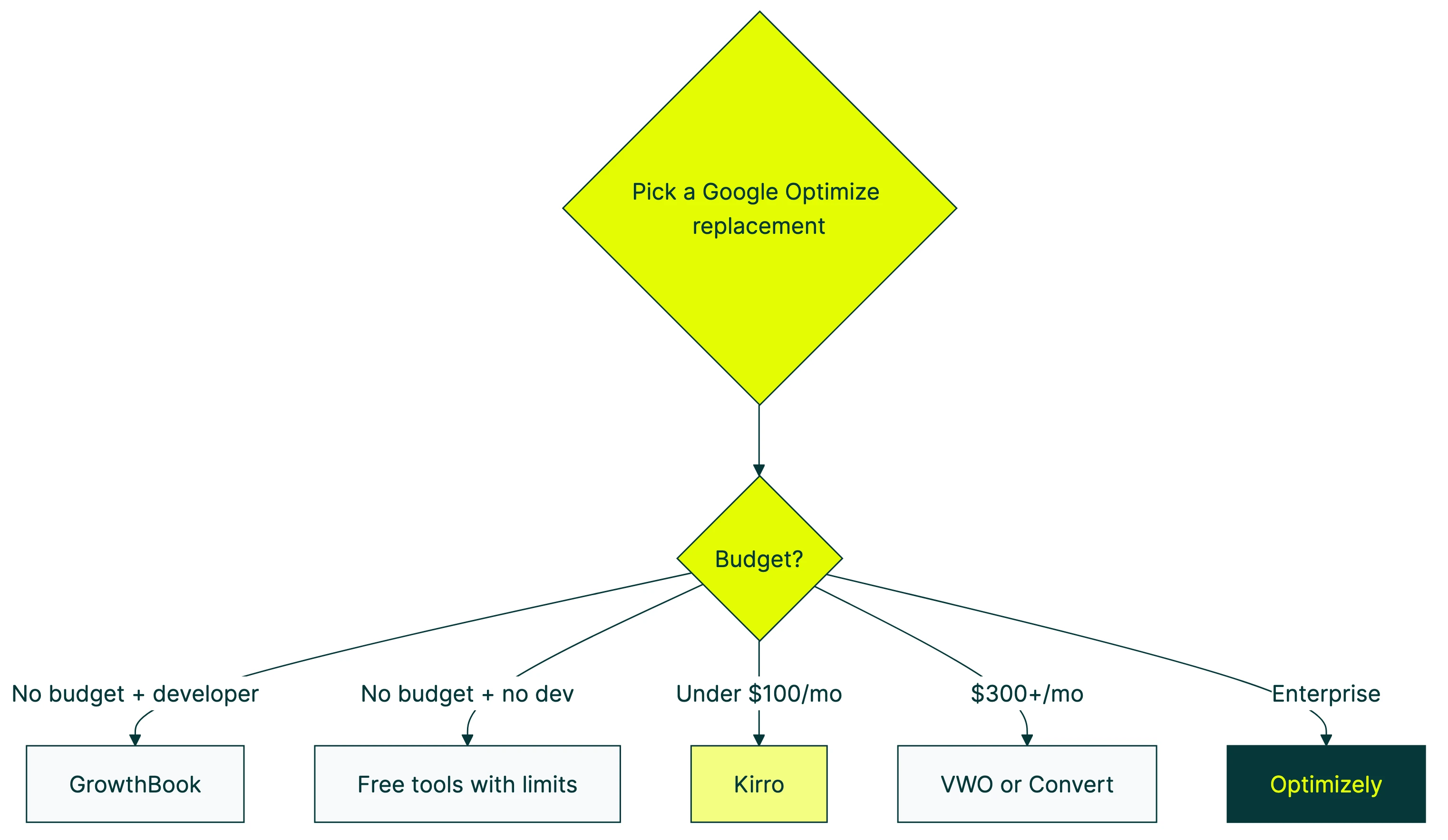
Google Optimize was free. If you used it, price matters to you. We listed these tools starting with the most affordable, working up to enterprise.
Every tool gets an honest drawback. No tool is perfect. Guides that pretend otherwise aren’t helping you.
This video from MeasureMasters walks through what to use now that Google Optimize is gone:
1. Kirro: best for small teams who want Google Optimize simplicity
Full disclosure: we built this one. Specifically because Google Optimize left a gap nobody filled properly.
Kirro costs EUR 99/month. Unlimited tests. Unlimited visitors. No per-visitor pricing that punishes you when your traffic grows. One plan, one price, cancel anytime.
What makes it the closest thing to Google Optimize:
- Visual editor. Click on your live site. Change a headline, button, or image. No code, no developer.
- GA4 integration. Your existing Google Analytics goals become your test goals automatically. If you track purchases or signups in GA4, Kirro picks those up.
- Math that works with less traffic (called Bayesian statistics). Results shown as “Version B has an 89% chance of winning.” No confusing stats jargon.
- 9KB script. Most competitors load 100-200KB of JavaScript. Kirro’s script won’t slow your site down.
- One-click GTM setup. Already using Google Tag Manager? Sixty seconds and you’re running.
The catch: Kirro is newer. Smaller community, fewer integrations than established tools. If you need testing multiple things at once across dozens of variables, you’ll want a bigger platform.
You can try it free for 30 days. Full product, no limits, no credit card.
2. VWO (now merged with AB Tasty): best all-in-one platform
VWO was one of Google’s official migration partners when Optimize shut down. With the AB Tasty merger, it’s now the most feature-packed platform around.
- Free starter plan (limited, but it exists)
- Growth plan at ~$314/month, Pro at ~$972/month
- Testing plus heatmaps (visual maps showing where visitors click), session recordings, and surveys in one dashboard
- The VWO/AB Tasty merger created the most complete platform available
Honest drawback: The free plan is very limited. Paid tiers add up fast. CostBench tracks real purchase data, and the typical VWO buyer pays $16,660/year. That’s a big jump from $0 with Google Optimize. If you were on AB Tasty before the merger, check AB Tasty’s pricing to see what you’re up against, and our AB Tasty alternatives for startups guide covers lighter options.
If you’re deciding between VWO and its biggest competitor, we wrote a full VWO vs Optimizely comparison.
3. GrowthBook: best free option if you have a developer
GrowthBook is open source. The code is free and you can run it on your own servers. Truly free forever if you host it yourself.
- Self-hosted: free. Cloud version: $40/person/month.
- No traffic limits on any plan
- Connects to data you already have (no separate tracking system needed)
- Strong feature flags (a way to turn features on or off for specific visitors)
The trade-off? You need a developer to set up and maintain it. “Self-hosted” means you run it on your own computer or server. If that sentence made you uncomfortable, GrowthBook isn’t for you. Built for engineering teams, not marketers.
4. PostHog: best for product teams who want everything in one dashboard
PostHog bundles A/B testing with analytics, session replay (recordings of how visitors use your site), and feature flags.
- 1 million test requests/month free
- Pay-as-you-go above the free tier
- Includes analytics, session replay, and feature flags
- Open source and self-hostable
Steep learning curve, though. PostHog is built for product and engineering teams. If you just want to test whether headline A or headline B gets more clicks? PostHog is a Swiss Army knife when you just need scissors.
5. Convert: best for privacy-focused teams
Convert is the tool CRO professionals recommend to each other. Built for teams where data privacy isn’t optional.
- $299/month (Growth plan)
- Full feature access on all plans (no gating behind higher tiers)
- Strong privacy compliance (GDPR in Europe, CCPA in the US, Convert covers both)
- Popular with agencies and consultants
Honest drawback: Expensive for what Google Optimize teams are used to paying ($0). At $299/month, that’s $3,588/year to test headlines. Worth it if privacy compliance is non-negotiable. Hard to justify otherwise. If privacy regulations are shaping your testing strategy, our cookieless A/B testing guide covers how to run tests without relying on third-party cookies at all. See our detailed Convert A/B testing review for the full pricing and limitations breakdown.
6. Mida: best free tier for non-technical marketers
Mida.so is the newcomer trying to be what Google Optimize was. Simple and affordable.
- Free plan: 100,000 monthly visitors, 2 projects
- Growth plan at $299/month
- AI-powered test suggestions (it recommends what to test based on your site)
- Visual editor that works without code
Fair warning: Mida is a newer company. Smaller community. Fewer tutorials and third-party integrations than established players. You’re betting on a younger product, which means more upside and more risk.
7. Crazy Egg: best for heatmaps plus basic testing
Crazy Egg started as a heatmap tool and added A/B testing later. If you want both at a low price, solid pick.
- Starting at $29/month
- Heatmaps, scroll maps, session recordings, and A/B testing
- Simple visual editor
Honest drawback: A/B testing is the side dish here, not the main course. The testing engine isn’t as powerful as dedicated A/B testing tools. Fine for simple headline and button tests. Not enough for anything complex. For a deeper look, see our alternatives to Crazy Egg with tools that offer stronger testing alongside heatmaps.
8. Statsig: best for data-driven product teams
Statsig gives you serious testing power at startup-friendly prices.
- 2 million metered events/month free
- $0.05 per 1,000 events above that
- Built by ex-Facebook engineers who designed Facebook’s own testing system
- Built-in checks that catch mistakes in your test setup
Not for marketers. If you don’t have a developer who can write some code, Statsig will be hard to use. The dashboard assumes you speak data. For help deciding between browser-based and backend testing approaches, see our client-side vs server-side testing comparison.
9. Optimizely: best for enterprise teams with big budgets
Optimizely is the biggest name in A/B testing. If money is no object and you need every feature imaginable, this is it.
- Starts at ~$36,000/year
- The most feature-rich testing platform you can buy
- Over $400M in annual revenue. They’re not going anywhere.
- Forrester ranked them #1 for experience testing in Q4 2024
Wildly overpriced for small teams. The auto-renewal clause catches people off guard (check G2 reviews). And the platform has grown so complex it needs dedicated people to manage.
If you’re one person running a website, look elsewhere. For a full breakdown, see our Optimizely alternatives guide and Optimizely pricing analysis.
10. Kameleoon: best for predictable pricing at scale
Kameleoon uses a 12-month rolling average for pricing. Your bill doesn’t spike when your traffic spikes. That’s rare in this market.
- Starts at $495/month
- Rolling average pricing (no surprise bills during busy seasons)
- AI-powered personalization features
- Strong in Europe (French company, EU data residency)
Honest drawback: Expensive entry point. $495/month minimum means Kameleoon is for mid-size companies and up. Not a Google Optimize replacement for small teams.
Quick comparison table
| Tool | Starting price | Free plan? | Best for | Needs a developer? |
|---|---|---|---|---|
| Kirro | EUR 99/month | 30-day trial | Small teams, solo founders | No |
| VWO | ~$314/month | Limited free tier | All-in-one testing + analytics | No |
| GrowthBook | Free (self-hosted) | Yes (open source) | Developer teams | Yes |
| PostHog | Free (1M requests) | Yes | Product teams | Yes |
| Convert | $299/month | No | Privacy-focused teams | No |
| Mida | Free (100K visitors) | Yes | Non-technical marketers | No |
| Crazy Egg | $29/month | No | Heatmaps + basic testing | No |
| Statsig | Free (2M events) | Yes | Data-heavy product teams | Yes |
| Optimizely | ~$36,000/year | No | Enterprise | Depends |
| Kameleoon | $495/month | No | Mid-size, predictable pricing | Depends |
Want to compare beyond Google Optimize replacements? We also wrote a best A/B testing software guide, a CRO software comparison, a split testing software roundup, and a guide to A/B testing for Webflow sites. If your focus is organic search, our guide to dedicated SEO A/B testing platforms covers the tools built specifically for testing changes that affect Google rankings. If you’re weighing dedicated testing tools against feature management platforms, our guide on the difference between feature flags and A/B testing tools breaks down when each approach fits.
What Google Optimize did well (and what to look for in a replacement)
Before you pick a tool, think about what you actually liked about Google Optimize.
It was free. Obviously. But “free” came with limits. If free matters most now, look at GrowthBook (free if you self-host), PostHog (1M requests/month free), Statsig (2M events/month free), or Mida (100K visitors/month free).
Just know that “free” usually means you need a developer or you accept real limitations.
It was simple. Point-and-click visual editor, no code required. If simplicity is what you miss, Kirro, Mida, and Crazy Egg are the closest matches. VWO also has a solid visual editor, but the platform around it is more complex.
It worked inside Google’s ecosystem. GA4 integration, GTM installation. If staying in the Google world matters, Kirro is the tightest fit. GA4 goals become your test goals automatically, including ecommerce conversions you track in GA4. One-click GTM install. That Google-native feeling is exactly what we built for.
It used Bayesian statistics (math that gives you answers faster, even with less traffic). Most enterprise tools use older statistical methods that need huge amounts of visitors. Kirro, VWO, and GrowthBook all support Bayesian stats.
Only 1 in 7 A/B tests produces a clear winner. That’s across 32,000+ tests studied by Invesp. The tool you pick matters less than whether you’ll actually use it regularly. Understanding how A/B test conversion rates actually work matters more than which button you click to launch the test. And if you’re running Google Ads alongside your website tests, our guide to A/B testing Google Ads landing pages covers how to close the gap between ad testing and on-site testing.
Avoiding common A/B testing mistakes matters more than which platform logo is on your dashboard. The most expensive tool is the one you pay for but never open.
Our take: Pick the simplest tool you’ll actually use every month. Not the most powerful one. Not the cheapest one. The one that fits into your Tuesday afternoon between meetings. For most people reading this, that’s Kirro, Mida, or Crazy Egg.
The real cost of switching (what the pricing pages don’t tell you)
Every guide (including this one) lists “starting prices.” The number on the pricing page is never the whole story.
The tool itself. Notice how many tools say “starting at.” VWO “starts” at $314/month, but the median buyer pays $16,660/year. Optimizely “starts” around $36,000/year. Typical enterprise deals run $50K-200K+.
Then there’s setup time. Google Optimize took 15 minutes to install. Some replacements take days. GrowthBook and Statsig need engineering time to configure. That’s not free, even if the tool is. (Kirro’s one-click GTM install and 3-minute setup exist because we know this cost is real.)
Your old tests, results, and settings? Gone with Google Optimize. Starting fresh means rebuilding. The Speero benchmark report found 91% of testing programs feel underfunded. Adding migration costs to a tight budget is rough.
Watch out for contract traps too. Optimizely’s auto-renewal clause is a recurring complaint on G2. Some tools lock you into annual deals. Kirro charges monthly, cancel anytime. Convert requires annual commitment. Read the fine print.
And the biggest cost of all? The tool you pay for but never open. Optimizely’s own data shows only 20% of tests produce winners. For revenue-specific tests, just 10%. If you’re not running tests regularly, you’re paying for a gym membership you never use.
Google Optimize was free. Any replacement is a cost increase. Budget honestly.
The goal isn’t to find the cheapest tool. It’s to find one you’ll actually open every week.
FAQ
Is Google Optimize still available?
No. Google Optimize shut down on September 30, 2023. Your account, your data, and your tests are all gone. Google chose not to rebuild it for GA4 (their newer analytics system). No way to access it, and no plans to bring it back.
What is replacing Google Optimize?
Nothing replaced it directly. The market split into three lanes: free developer tools (GrowthBook, PostHog), affordable marketing tools (Kirro, Mida, Crazy Egg), and enterprise platforms (VWO, Optimizely).
The “free and simple” combination that made Google Optimize special hasn’t been fully replicated. Closest options: Mida’s free tier (100K visitors/month) or GrowthBook’s open source version (free, but needs a developer).
Is Google Optimize better than Adobe Target?
Google Optimize was simpler and free. Adobe Target is an enterprise platform starting at $10,000+/year with a complex setup. Completely different audiences.
Since Google Optimize no longer exists, the comparison is a dead end. If you’re considering Adobe Target, you’re likely an enterprise team. Our breakdown of what Adobe Target costs covers the real pricing and setup requirements. Optimizely or VWO are the comparisons that actually matter.
When was Google Optimize discontinued?
Google announced the sunset in January 2023. The tool officially stopped working on September 30, 2023. Teams had about nine months to find a replacement and migrate.
For background on why it happened and what CRO means for your business, check our conversion rate guide.
Are there any free A/B testing tools left?
Yes, but they come with trade-offs. GrowthBook is open source and free if you host it yourself (you need a developer). PostHog offers 1 million test requests/month free. Statsig gives you 2 million events/month free. Mida has a free plan for up to 100,000 monthly visitors.
VWO still has a limited free starter plan, though its future is uncertain after the AB Tasty merger.
The catch: “free” usually means you need technical skills or you accept real limitations. If you want something simple without limits, Kirro’s 30-day free trial gives you the full product with no restrictions.

Randy Wattilete
CRO expert and founder with nearly a decade running conversion experiments for companies from early-stage startups to global brands. Built programs for Nestlé, felyx, and Storytel. Founder of Kirro (A/B testing).
View all author posts