Optimizely pricing starts at roughly $36,000 per year for web testing alone. Most companies pay between $50,000 and $200,000. Large enterprises with full platform bundles can hit $400,000+. None of these numbers are on Optimizely’s website. You have to call sales to get a quote.
That’s the short version. The longer version involves seven different products, tiered pricing based on traffic, and annual contracts you can’t escape easily. The total cost is usually 35 to 50% higher than the license fee alone. If you’re shopping around, our competitor comparisons cover how Optimizely stacks up. (For a broader A/B testing overview, we wrote a separate guide.)
How much does Optimizely cost?
Optimizely doesn’t publish pricing. You click “Request Pricing,” fill out a form, and wait for a sales rep. There’s no monthly plan. No self-serve checkout. No way to find out if you can afford it without talking to someone first.
That frustrates a lot of people. One person on Quora shared that the sales team told them in their first email they “couldn’t afford Optimizely’s services.” Before even having a conversation.
Here’s what we’ve pieced together from procurement platforms, user reviews, and partner data:
| Tier | Annual cost | What you get |
|---|---|---|
| Essentials | $25,000 to $40,000 | Basic web testing, limited traffic |
| Business | $65,000 to $95,000 | Web testing + more features, higher traffic limits |
| Accelerate | $120,000 to $180,000 | Full platform access, priority support |
These aren’t official tier names from Optimizely. They come from Vendr, a platform that helps companies negotiate SaaS deals. Your actual quote depends on traffic volume, which products you pick, and how well you negotiate.
Our take: If a company won’t show you the price until you’re on a call, the price is designed to be negotiated, not paid. That’s fine for enterprise. But most A/B testing software buyers just want to know what they’ll pay before they invest an hour with a sales rep.
What you’re actually paying for
Optimizely sells seven different products:
- Web Experimentation (the A/B testing part most people want)
- Feature Experimentation (feature flags, which let you turn features on for some visitors and off for others)
- CMS (content management system for building web pages)
- Content Marketing Platform (planning and collaboration for marketing teams)
- Commerce (e-commerce platform)
- Data Platform (a tool that collects customer data in one place)
- Optimizely One (all of the above bundled together)
If you’re searching “Optimizely pricing,” you probably want Web Experimentation. That’s the split testing software piece. But Optimizely’s sales team will push the bundle because they make more money that way.
Think of it like cable TV. You want ESPN. They want to sell you 500 channels. The bundle discount sounds good until you realize you’re still paying for 499 channels you’ll never watch.
Each product is priced separately. You can buy just one. But the per-product pricing isn’t public either, so you’re back to the sales call.
The real cost of Optimizely (beyond the license)
Every other article about Optimizely pricing skips this part. The license is the sticker price. The real cost includes everything you need to actually use the thing.
Implementation costs. Optimizely doesn’t install itself. You need a developer or an agency to set it up. One G2 reviewer described paying “a small fortune to an agency” just for implementation. And when the agency gets it wrong (which happens), you pay again to fix it.
Training costs. Optimizely certification exams cost $300 each. Company training sessions run $2,500. And these aren’t optional if you want your team to actually use the platform well.
Then there’s staffing. Optimizely’s own support docs recommend a five-person team to run testing properly: a web analyst, a marketer, a program manager, a developer, and a UX designer. Five people. For A/B testing.
Your contract also includes a traffic cap (measured in impressions, which is the number of times your test gets shown to visitors). Go over that cap and you’ll pay extra. The overage pricing isn’t always clear upfront.
Add it all up. A $65,000 license can easily become $90,000 to $100,000 in year one. That’s after implementation, training, and the people needed to run it. C2 Experience, an official Optimizely partner, confirms that total cost typically runs 35 to 50% higher than the base license.
Compare that to tools like Kirro where setup takes three minutes, there are no implementation fees, and you don’t need a five-person team. Just paste a script, pick a page, and start testing.
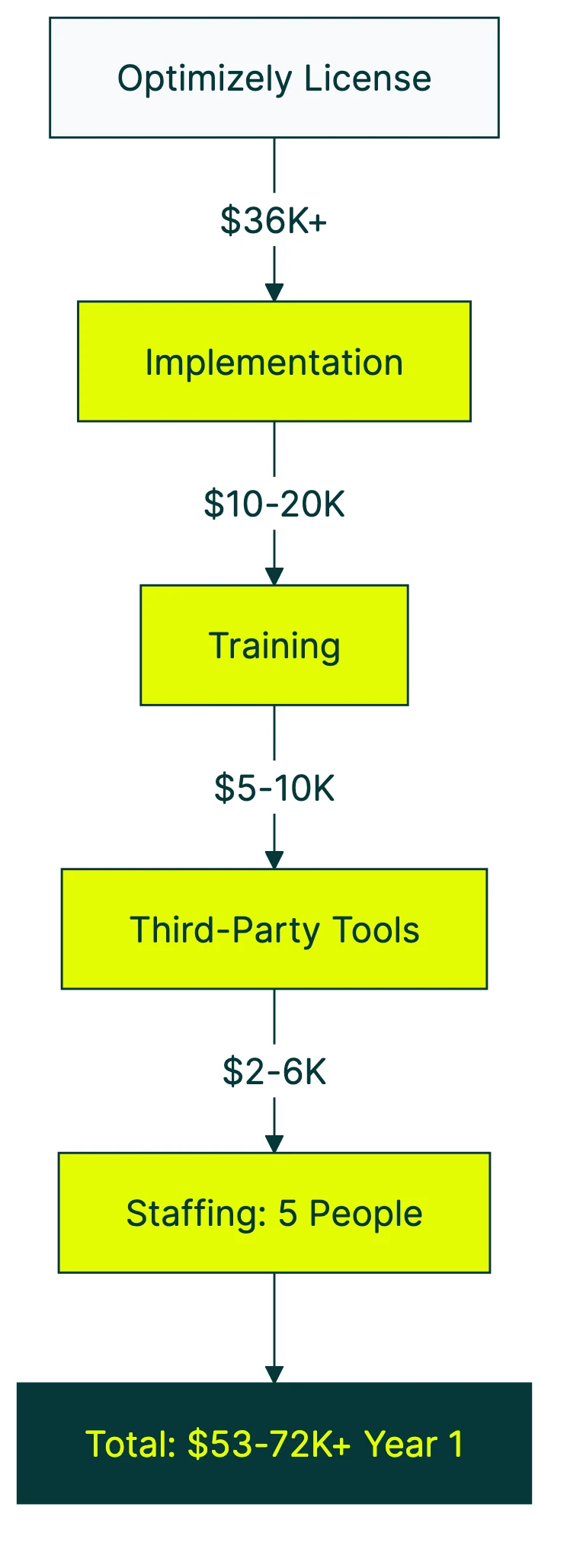
Our take: Buying Optimizely is like buying a house. The listing price doesn’t include renovations, furniture, or property tax. Budget at least 40% above the license before you commit.
How Optimizely pricing has changed over the years
Most pricing articles treat $36,000 as the way it’s always been. It hasn’t.
Before December 2014, Optimizely had a free plan. Plus affordable “Silver” and “Gold” tiers with published pricing. Small businesses and solo marketers could run real A/B tests without a sales call.
Then the free plan went away. By 2018, Optimizely had fully shut down its free “Starter” plan, affecting roughly 70,000 websites. The remaining customers got pushed toward enterprise contracts.
In October 2020, a Swedish company called Episerver acquired Optimizely for under $600 million. They then renamed themselves to Optimizely (yes, the buyer took the seller’s name). After the acquisition, the product expanded from a testing tool into a full digital experience platform. And prices kept climbing.
One Hacker News commenter nailed it: “Out of frustration with Optimizely, I created open-source A/B test projects.” That frustration fueled a whole generation of alternatives (including tools like GrowthBook and Statsig).
After Google Optimize shut down in September 2023, the gap got even wider. The simple, affordable testing tool that millions of marketers used was gone. And nothing in the same price range replaced it properly. If you’re looking for what came next, we have a full breakdown of Google Optimize alternatives.
What Optimizely users actually say about pricing
The product itself gets solid scores (4.2 out of 5 on G2). The pricing? That’s where the complaints pile up.
One company paid $66,000 “for a product that didn’t even include the features we initially requested.”
Another got locked into a $24,000 renewal because of an automatic contract clause they missed. For a product they weren’t even using anymore.
On Gartner Peer Insights: “More costly than other options and does not provide much cost transparency.”
And from TrustRadius: “Pricing model penalizes those just starting with testing, with high fees based on website traffic.”
Some users also reported being offered pricing based on a percentage of their revenue. That’s unusual for software. It means the better your business does, the more your A/B testing tool costs. Not exactly a partnership.
To be fair, some reviewers say the platform is worth it. But those reviewers tend to work at companies with big budgets and dedicated testing teams. If that’s you, Optimizely is genuinely excellent. For everyone else, learning the common A/B testing mistakes is probably a better use of $36,000.
Who should (and shouldn’t) pay for Optimizely
Optimizely makes sense if you have:
- A dedicated testing team (at least 2 to 3 people focused on conversion)
- Six-figure annual budget for testing and tooling
- 1 million+ monthly visitors (enough traffic to run lots of tests in parallel)
- A need for the full platform: CMS, commerce, testing, and content, all in one place
- Enterprise requirements like advanced permissions, single sign-on, and activity logs
Optimizely doesn’t make sense if you:
- Run fewer than 10 tests per year
- Have a small marketing team (or a team of one)
- Don’t have a developer to help with setup and maintenance
- Want to start testing without committing to a 12-month contract
If you’re in the second group, check out alternatives to Optimizely. There’s no shame in picking a tool that matches your team size and budget. A simple tool you actually use beats a powerful one that sits unused.
For what it’s worth, Kirro is EUR 99 per month with unlimited tests and unlimited visitors. No annual contract, no sales call, no developer needed. You can set up your first test in about three minutes. Different league than Optimizely, obviously. Different answer for a different budget.
Optimizely pricing vs alternatives
Optimizely vs the main alternatives on price:
| Tool | Annual cost | Pricing model | Free trial? |
|---|---|---|---|
| Optimizely | $36,000 to $200,000+ | Custom quote, annual contract | No |
| Adobe Target | $50,000 to $500,000+ | Custom quote, annual contract | No |
| VWO | $3,588+ ($299/mo) | Published pricing, monthly | Yes (30 days) |
| Convert | $4,788+ ($399/mo) | Published pricing, monthly | Yes (15 days) |
| GrowthBook | Free | Open source, self-hosted | N/A |
| Statsig | Free tier, custom enterprise | Published pricing | Yes |
| Kirro | EUR 1,188 (EUR 99/mo) | Published pricing, monthly | Yes (30 days) |
Notice a pattern?
The enterprise tools (Optimizely, Adobe Target) hide pricing. The mid-market and small-business tools publish it. That’s not a coincidence. When your pricing is $36,000+, showing the number upfront scares away the leads you want to have on a call.
For a detailed head-to-head, check our VWO vs Optimizely comparison. And for a broader look at the market, the best A/B testing tools guide covers our top 5 picks by use case.
If you’re looking at CRO software more broadly (not just A/B testing), the price gap is even more dramatic. Most conversion rate optimization tools in that guide cost under $500 per month.
Full disclosure: Kirro is our product. We’re biased. But we also publish our pricing because we think you should know what you’ll pay before you talk to anyone. See our pricing and try it free for 30 days.
How to negotiate Optimizely pricing
If you’ve decided Optimizely is the right tool for your team, here are some tactics that actually work. This advice comes from Vendr’s procurement data and patterns we’ve seen in user reports.
Negotiate in Q4. Like most enterprise software companies, Optimizely’s sales team has quarterly targets. End-of-year deals tend to be the most aggressive.
If you’re buying more than one Optimizely product, push for a bundled price rather than per-product pricing. The more products you buy, the more room they have to move.
Before you sign, ask what it costs to add features or upgrade tiers mid-contract. Get that number in writing. Surprises mid-contract are expensive.
Multi-year discounts can save 10 to 20%. Only commit to two or three years if you’re confident the product fits long-term.
Ask for a 30 to 90 day pilot before committing to a full annual contract. Not all reps will agree. Worth asking anyway.
One thing people forget: Optimizely contracts auto-renew with as little as 30 days notice to cancel. Put a calendar reminder 90 days before your renewal date. That $24,000 auto-renewal surprise from the G2 review? It happens more often than you’d think.
Red flags to watch for:
- Revenue-based pricing proposals (your costs go up when your business does well, which seems backwards)
- Vague overage terms (know exactly what happens if you exceed your traffic cap)
- Unclear implementation costs (get a full quote that includes setup, not just the license)
Frequently asked questions
What is the cost of Optimizely?
Optimizely’s minimum cost is approximately $36,000 per year for a basic web testing plan. Mid-market companies typically pay between $65,000 and $200,000 per year. Enterprise customers with full platform access can pay $200,000 to $400,000 or more. There’s no monthly billing option. All contracts are annual.
Is Optimizely owned by Google?
No. Optimizely has no connection to Google. Episerver (a Swedish digital experience company) acquired Optimizely in October 2020 and then rebranded the entire company as Optimizely. Google had its own testing tool called Google Optimize, which it shut down in September 2023.
Is Optimizely a good tool for A/B testing?
Yes, if your team matches its price point. It’s one of the most capable testing platforms out there. But most small and mid-size businesses get the same core results from much cheaper tools. If your goal is testing headlines, buttons, and page layouts, you don’t need a $36,000 platform. Kirro or VWO handles that for a fraction of the cost. For a broader view, see our guide to what conversion rate optimization is.
Who does Optimizely compete with?
At the enterprise level: Adobe Target, AB Tasty, and Kameleoon. For a closer look at how much AB Tasty costs or how much Kameleoon costs, we broke down their pricing separately. In the mid-market: VWO, Convert, and Dynamic Yield. For small businesses and startups: Kirro, GrowthBook, and Statsig. It depends on budget and team size.
Does Optimizely have a free trial?
No. Optimizely does not offer a free trial or free plan for its web testing product. You must contact sales for a demo and custom quote. (They do offer free feature flags for developers, but that’s a separate product aimed at engineering teams, not marketers.)
Can small businesses use Optimizely?
Technically, yes. Practically, no. The $36,000+ annual minimum puts it out of reach for most small businesses. And even if budget weren’t an issue, Optimizely recommends a five-person team to run testing properly. If you’re a small team looking to start A/B testing, a conversion rate optimization guide is a better first step than an enterprise contract.

Randy Wattilete
CRO expert and founder with nearly a decade running conversion experiments for companies from early-stage startups to global brands. Built programs for Nestlé, felyx, and Storytel. Founder of Kirro (A/B testing).
View all author posts