Adobe Target is Adobe’s enterprise A/B testing and personalization platform. It’s powerful, deeply integrated with the Adobe ecosystem, and priced like it. If you’re a Fortune 500 company already running Adobe Analytics, Adobe Target makes sense. If you’re everyone else, it’s probably overkill.
This guide covers what Adobe Target A/B testing actually does, what it really costs (not the “contact sales” non-answer), what people who use it actually say, and what alternatives exist for teams who don’t have a six-figure testing budget.
What is Adobe Target?
Adobe Target lets you run A/B tests, show different content to different visitor groups (that’s personalization), and test multiple page changes at once (multivariate testing). It’s one piece of Adobe’s larger marketing suite, alongside Adobe Analytics, Adobe Experience Manager, and a bunch of other tools that all work best together.
There are two tiers:
- Standard includes A/B testing, multivariate testing, rules-based targeting, and geo-targeting
- Premium adds machine learning features: Auto-Target (AI picks the best version for each visitor), Automated Personalization, a product recommendations engine, and enterprise permissions
The platform is licensed by annual page view traffic. There’s no transparent pricing anywhere on Adobe’s site. More on that in a minute.
Our take: Adobe Target is the A/B testing equivalent of buying a commercial kitchen when you just need a toaster. If you’re a restaurant chain, that kitchen makes sense. If you’re making breakfast, it’s a lot of oven for one piece of toast.
How Adobe Target A/B testing works
The basic concept is the same as any A/B testing tool. Show Version A to half your visitors. Show Version B to the other half. See which one converts more.
Adobe Target gives you three ways to do this:
- Manual A/B test. You set up two (or more) versions, split traffic evenly, and wait for enough data to pick a winner. The classic approach.
- Auto-Allocate. The system gradually sends more traffic to whichever version is performing better. Faster results, but it trades away some statistical rigor to get there.
- Auto-Target. The machine learning option. It shows different versions to different visitors based on what the AI thinks will work best for each person. This is really website personalization, not A/B testing. Requires Adobe Target Premium.
To create a test, you use Adobe’s Visual Experience Composer (VEC). It’s a point-and-click editor that loads your live site and lets you change text, images, and layout without writing code. Then you configure your audience, set traffic allocation, pick your success metric, and launch.
Adobe Target also supports testing that happens on the server instead of the browser (server-side testing). Useful for mobile apps and backend logic. But it requires developer involvement, which brings us back to the complexity question.
Sounds straightforward on paper. In practice, Adobe’s own documentation lists 14 steps to create a single test. And that’s after the initial setup is done.
What Adobe Target actually costs
Adobe doesn’t publish pricing. Their website says “contact sales.” Most competitor articles repeat that and move on. But we dug into real contract data.
VendorBenchmark analyzed 400+ Adobe enterprise contracts and found:
- Reference (list) price: $120,000 to $360,000 per year
- Negotiated price: $72,000 to $240,000 per year
- Average savings from negotiation: 26% below reference pricing
And that’s just the software license. The full first-year cost looks more like this:
| Cost item | Range |
|---|---|
| Adobe Target license | $72,000 to $240,000/yr |
| Implementation (professional services) | $5,000 to $50,000 |
| Training and onboarding | $2,000 to $10,000 |
| Total first year | $79,000 to $300,000+ |
That’s roughly what a mid-level marketing hire costs. For a testing tool.
For context, Optimizely runs $63,700 to $113,100 per year. VWO starts at $299 per month. AB Tasty’s pricing is also enterprise-level. Convert starts at $399 per month. And Kirro is EUR 149 per month with a 3-minute setup and zero implementation cost.
Adobe Target’s first-year cost could fund more than three years of a tool like Kirro. That math matters when 91% of experimentation programs say they’re underfunded.
Our take: “Contact sales” is corporate for “you can’t afford it, and we don’t want you to know that before we’ve got you on a call.” If a company won’t tell you the price, the price is the first red flag.
Who Adobe Target is built for (and who it’s not)
Around 6,320 companies use Adobe Target globally. About 39% are large enterprises with 1,000+ employees. The top industries are IT (21%), marketing and advertising (7%), and financial services (6%).
This surprised us: 29% of Adobe Target customers are small companies with fewer than 50 employees. But the reviews from those smaller teams tell a different story. They consistently say the tool is too complex, too expensive, and too dependent on the rest of the Adobe ecosystem.
Adobe Target makes sense when:
- You’re already running Adobe Analytics, AEM, and the rest of Adobe Experience Cloud
- You have 100,000+ monthly visitors
- You have a dedicated experimentation team (or at least a CRO specialist)
- You need AI-driven personalization across channels, not just simple A/B tests
Adobe Target doesn’t make sense when:
- You’re a small business or startup
- You want to test headlines, buttons, and CTAs (the basics that move the needle for most sites)
- Your annual budget for testing tools is under $10,000
- You need to be running tests this week, not in three to six months
The ecosystem dependency matters more than most people realize. Adobe Target works best when paired with Adobe Analytics for reporting. Without it, you lose features like using Analytics segments as test audiences and Analytics metrics as success goals. Useful if you’re already paying for Analytics. Vendor lock-in if you’re not.
When Google Optimize shut down in September 2023, millions of marketers lost their simple, free testing tool. Many ended up evaluating enterprise options they didn’t need. If that was you, simpler and cheaper tools exist. You don’t need to jump from free to six figures.
The real problems with Adobe Target (from people who use it)
We read through dozens of reviews on G2 and PeerSpot. The patterns were clear.
Learning curve. “Not intuitive” and “steep learning curve” are the most common complaints. The visual editor works well once you know how, but getting there takes training that Adobe charges extra for.
Implementation timeline. Plan for 3 to 6 months before your team runs a single test. Install at.js or the AEP Web SDK, configure the Visual Experience Composer, set up Analytics integrations, train your team. Some tools let you paste one script and launch a test the same day. Adobe Target is not one of them.
Campaign reliability. Multiple reviewers reported campaigns that stop showing content for unknown reasons. Fix? Rebuild from scratch. When your test silently stops working, you waste traffic and time.
Support gaps. “Customer support sometimes lacks responsiveness” is a diplomatic way of saying: when something breaks, you might wait a while. Several reviewers called support “unhelpful,” especially after UI updates.
Statistics opacity. Results show up without explaining how they’re calculated. If you can’t explain your test results to your boss (or validate them yourself), the data loses its value.
The ecosystem catch-22. Adobe Target works best with Adobe Analytics, AEM, and the rest of Experience Cloud. If you’re not already on that stack, adopting Target means adopting the whole ecosystem. That’s not a testing decision. It’s a platform migration that could take a year and cost multiples of the license itself.
Positive reviews exist too. Teams deep in the Adobe ecosystem say the platform is powerful once it’s properly configured. A4T (the feature that pipes Adobe Target reporting into Adobe Analytics) is genuinely useful for segmentation. The AI personalization features work well for companies with enough traffic.
“Powerful once properly configured” is a big qualifier, though. If your team follows CRO best practices, the platform matters less than the discipline. Ron Kohavi ran Microsoft’s experimentation platform (10,000+ tests per year) and found that only 10 to 20% of tests produce positive results, even at Google and Bing. The tool doesn’t make or break your program. Your process does.
Adobe Target alternatives worth considering
Most businesses only need the basics. Test a headline. Try a different button. Compare two landing page layouts. See which one wins. You don’t need Auto-Target ML or a recommendations engine for that. You need a tool that’s fast to set up, easy to use, and priced for real businesses.
Here’s how the main options stack up:
| Feature | Adobe Target | Kirro | VWO | Optimizely |
|---|---|---|---|---|
| Starting price | ~$72,000/yr | EUR 149/mo | $299/mo | ~$63,700/yr |
| Setup time | 3-6 months | 3 minutes | 1-2 weeks | 2-4 weeks |
| Visual editor | Yes | Yes | Yes | Yes |
| AI features | Auto-Target, Automated Personalization (Premium) | AI test suggestions | SmartStats | Statsig integration |
| Analytics integration | Adobe Analytics (A4T) | GA4 | Built-in | Built-in |
| Best for | Fortune 500 on Adobe stack | SMBs and founders | Mid-market teams | Enterprise engineering teams |
If you’re comparing enterprise tools, our VWO vs Optimizely breakdown covers the differences. If you’re shopping for Optimizely alternatives, we’ve got a list. Same for AB Tasty alternatives, Google Optimize replacements, and our Kameleoon A/B testing review.
The real question isn’t which tool has the most features. It’s which features you’ll actually use.
An Optimizely analysis of 127,000 experiments found that only 12% win on the primary metric. Qubit found that 90% of tests change revenue by less than 1.2%. Most companies don’t need an enterprise platform. They need to start testing at all.
Start with a tool you can afford and actually use. If you outgrow it, upgrade. Most teams never outgrow a good mid-market tool.
You can set up your first A/B test in about three minutes with Kirro. No six-month implementation. No “contact sales.” Just pick a page, make a change, and see what happens.
When to choose Adobe Target (and when to skip it)
Here’s a simple decision framework:
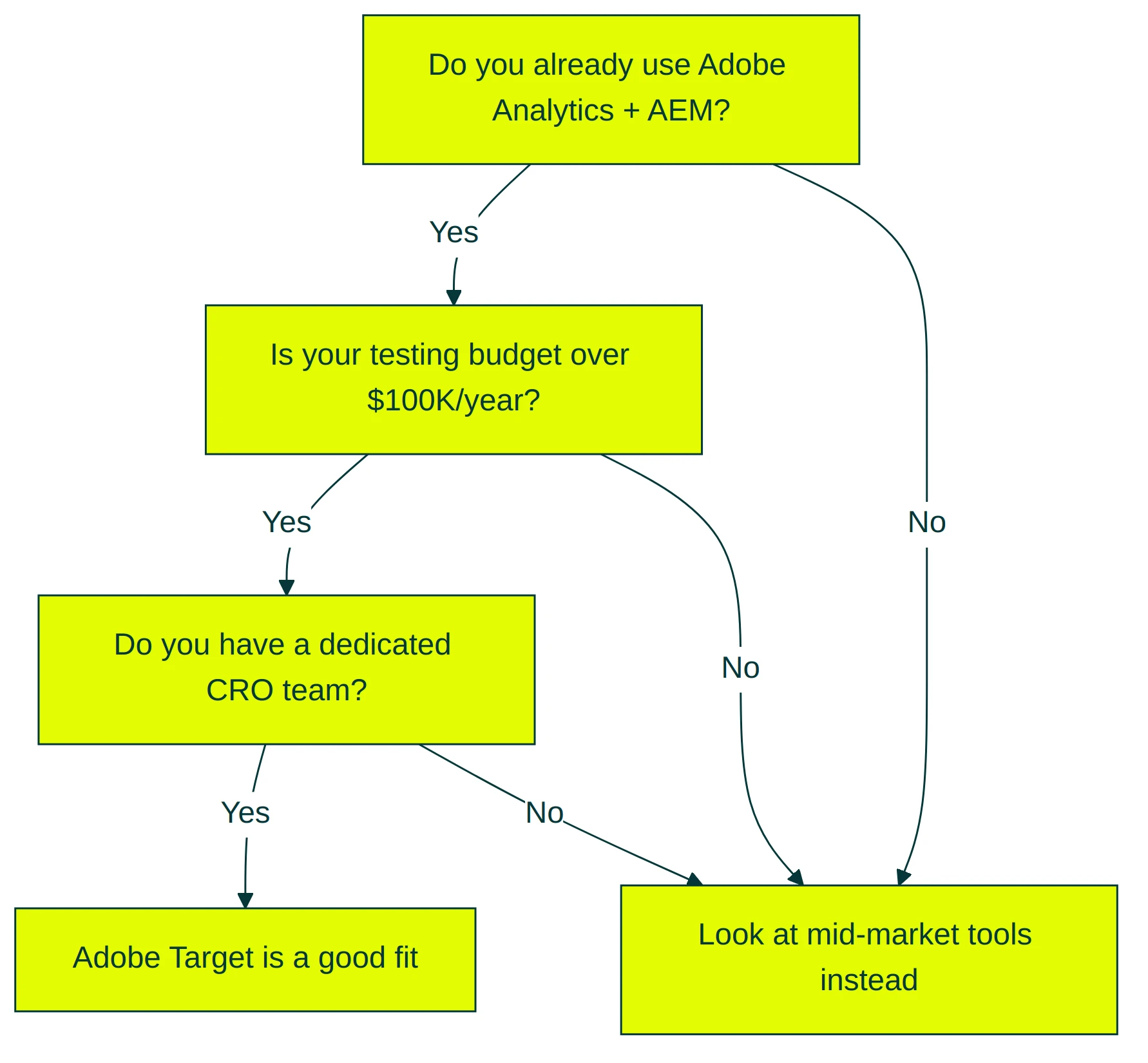
The A/B testing market is heading toward $2 billion by 2030. And the fastest-growing segment isn’t enterprise. It’s small and mid-size businesses, growing at 15.8% per year. More small teams are testing than ever before.
If you’re in that growing group, you want a tool that matches your current needs, not your aspirational ones. Start with something you can launch today. If you ever reach the scale where Adobe Target makes sense, you’ll know. You’ll have the team and budget to support it.
In the meantime, try a tool built for teams your size. Run a few tests. Learn what works. That’s worth more than any enterprise platform collecting dust.
FAQ
Is Adobe Target free?
No. Adobe Target has no free tier and no public pricing. Procurement data from 400+ enterprise contracts shows annual costs of $72,000 to $240,000 for the software alone. Add implementation and training, and first-year costs can top $300,000. For affordable alternatives, see our guide to the best A/B testing tools.
What’s the difference between Adobe Target Standard and Premium?
Standard includes A/B testing, testing multiple page elements at once, and rules-based targeting (showing specific content to specific visitor groups). Premium adds AI features: Auto-Target (machine learning picks the best version per visitor), Automated Personalization, a recommendations engine, and enterprise permissions. Premium costs significantly more. And most of its features need high traffic volumes to work well.
Can I use Adobe Target without Adobe Analytics?
Technically yes, but you lose most of the value. Adobe Target is designed to work inside Adobe Experience Cloud. Without Adobe Analytics, you can’t use A4T (Analytics for Target). That means limited reporting, no Analytics-based audience segments, and your testing data lives separately from your site analytics. If you’re not on Adobe Analytics, you’re paying for integration you can’t use.
How long does it take to set up Adobe Target?
Expect 3 to 6 months for a full implementation with professional services. That includes deploying at.js or the AEP Web SDK, configuring the Visual Experience Composer, integrating with Adobe Analytics, and training your team. Even after setup, creating one A/B test involves a 14-step workflow. For comparison, Kirro’s setup takes about 3 minutes.
What is the best Adobe Target alternative for small businesses?
For small businesses that want A/B testing without the enterprise complexity and cost, Kirro offers the core capabilities (visual editor, AI-powered test suggestions, Bayesian statistics) at EUR 149 per month. No annual contracts, no implementation project, no developer required. You can also explore our full comparison of CRO tools and A/B testing software.

Randy Wattilete
CRO expert and founder with nearly a decade running conversion experiments for companies from early-stage startups to global brands. Built programs for Nestlé, felyx, and Storytel. Founder of Kirro (A/B testing).
View all author posts