Digital CRO is conversion rate optimization applied to online channels. Websites, mobile apps, email campaigns, landing pages, chatbots. Any place where someone visits a screen and you want them to do something specific.
If you searched “digital CRO” and found results about clinical research organizations or pharma, you’re not alone. Google mixes those up too. (Our guide to what CRO stands for sorts out all three meanings.) This page is about the marketing kind. The practice of getting more of your existing digital traffic to actually convert.
The short version: out of every 100 people who visit your website, roughly 2 will do what you want them to do. Buy something, sign up, fill out a form. Digital CRO is the work of turning that 2 into a 3, a 4, or better. Without spending more on ads or chasing more traffic.
What digital CRO actually means (and what it doesn’t)
Most people hear “CRO” and think “making my website better.” Fair enough. But digital conversion rate optimization covers every screen your customer touches before they convert.
Your website is the obvious one. But what about the email that brought them there? The landing page your ad pointed to? The chatbot that answered their question at 11pm? Each of those is a digital touchpoint, and each one has a conversion rate that can be improved.
The formula is simple. Take the number of people who did the thing you wanted (bought, signed up, clicked). Divide by the total number of visitors. Multiply by 100. That’s your conversion rate. CRO metrics go deeper, but this is where it starts.
Our take: Most businesses treat CRO like it only happens on their homepage. That’s like only cleaning the kitchen when the whole house needs work.
What digital CRO isn’t: a one-time project. A “redesign the website and hope for the best” situation. Or guessing which button color converts better (though that’s what most people picture). It’s a continuous CRO process. Test a real change, measure what happens, keep what works.
The difference between companies that grow their conversion rate and companies that stay stuck? The first group treats this as a habit. The second group treats it as a to-do item they’ll get to eventually.
Digital CRO vs. traditional (offline) CRO
If you run a physical store, you already do CRO. You just call it something else. Moving the bestseller to the front display. Training staff to greet customers differently. Rearranging the checkout counter. That’s all conversion optimization.
The digital version has some serious advantages. This is how digital marketing CRO stacks up against the offline kind:
| Digital CRO | Traditional (offline) CRO | |
|---|---|---|
| What you’re improving | Websites, apps, emails, landing pages | Store layouts, signage, staff scripts |
| How you measure | Every click, scroll, and tap tracked automatically | Foot traffic counters, manual observation |
| How fast you can test | Hours. Change a headline this morning, see results this week | Weeks or months to rearrange a store and wait for data |
| Cost per test | Low. Most testing tools cost under $300/month | Six figures per year in rent, staffing, and fixtures before you even start testing |
| Scale | One test reaches every visitor instantly | One store at a time |
| Customer intent | Lower. People browse casually online | Higher. Walking into a store takes effort |
That last row matters more than people think. Physical store visitors already committed time and energy to showing up. Digital visitors clicked a link and can leave in a second. That’s why website conversion rates sit around 2% while physical retail stores can see 20-40%.
Think of it this way. Imagine rearranging your store overnight, tracking exactly which layout sold more, and rolling back the change if it didn’t work. That’s what digital CRO lets you do. Except it takes minutes, not months.
The five digital channels where CRO happens
Most CRO guides focus entirely on websites. That misses four other channels where your customers make decisions every day.
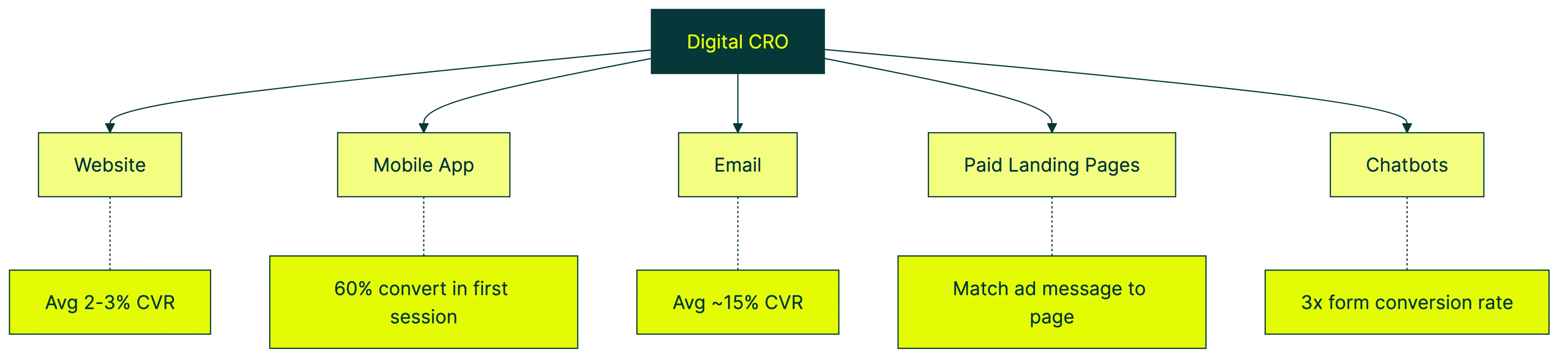
Your website. This is the big one. Average conversion rate sits between 2-3%. The biggest levers? Your headlines, your calls to action (the buttons and links you want people to click), web personalization, and your checkout flow. Speed matters too. A one-second delay in page load drops conversions by about 7%.
For ecommerce, checkout is where the real money hides. 70.19% of online shopping carts get abandoned before purchase, according to Baymard Institute. Their research shows that better checkout design alone can recover about 35% of those lost sales. That’s real money sitting on the table.
Your mobile app. Apps behave differently than websites. 60% of app purchases happen during the very first session. If your onboarding doesn’t convert visitors immediately, you may not get a second chance. The patterns are different too. Thumb-friendly navigation, simplified flows, fewer steps. For more on this, see our guide to mobile app A/B testing.
Email. This one surprises most people: email converts at roughly 15% on average. That makes it the highest-converting digital channel by a wide margin. Testing subject lines, send times, and the buttons inside your emails is one of the easiest places to start with CRO. You don’t need special tools. Most email platforms already have A/B testing built in.
Paid landing pages. These are the dedicated pages your ads point to, and landing page optimization best practices apply here more than anywhere else. The #1 rule: match your landing page message to whatever the ad promised. If your ad says “Free trial, no credit card,” your landing page better say the same thing above the fold. HubSpot’s data shows that 93% of leads come from text links rather than banner-style buttons. So don’t overthink the design. Nail the words. For the full playbook, check out split testing your landing pages.
Chatbots and live chat. The newest CRO channel and growing fast. Chatbot leads convert at 3x the rate of traditional signup forms. Makes sense. A conversation feels personal, a form feels like homework. AI-powered chatbots are showing conversion improvements between 23-70% depending on the industry.
Our take: Start with your website. It’s the one channel every business has, and it’s where most of your traffic already goes. Once that’s working, branch out to the others.
This video from HubSpot walks through what CRO means in digital marketing and how to get started:
What a digital CRO program looks like
If you’ve never done this before, the loop is simple. Research what’s not working. Come up with a change that might fix it (your hypothesis, or in plain language, “what you’re testing”). Test it by showing some visitors the original and some visitors the new version. Measure the results. Keep the winner. Repeat.
That’s it. The CRO process in five sentences. For a deeper look at a systematic CRO process with detailed steps for each stage, we wrote a dedicated guide. If you want to make this loop sustainable (with governance, reporting, and a knowledge base), see our full guide to building a CRO program.
Start with one channel. Your website. Don’t try to improve everything at once. That’s the fastest way to improve nothing.
You’ll need three tools to get going. An analytics tool to see what’s happening (Google Analytics 4 works fine). A testing tool to run A/B tests, where half your visitors see one version and half see another. And something to show you why visitors aren’t converting. Heatmaps or session recordings work well for that. You watch what people actually do on your pages, and the problems become obvious.
When Google shut down Google Optimize in September 2023, it left a massive gap. Millions of small businesses lost their only simple, free testing tool. Many just stopped testing altogether. The Google Optimize alternatives that exist now range from free developer tools to enterprise platforms costing $36,000+ per year. For most small businesses, something simple like Kirro fills that gap at a fraction of the cost.
One more thing. Only 12% of A/B tests produce a clear winner. That’s from over 127,000 real experiments. Most tests end in a tie. And that’s fine. It means your original was already decent, and you learned something.
Think of it like a fitness routine. Small, consistent improvements beat one big overhaul. A 2% improvement this month doesn’t sound exciting. But compound that across 12 months and thousands of visitors, and it adds up to real revenue. Companies running regular A/B tests see a 49% average improvement over time.
You can start testing your own site in about three minutes with a free trial. Paste a script, pick a page, change a headline. See what happens.
Digital CRO metrics worth tracking
There are dozens of metrics you could track. Most of them don’t matter when you’re getting started. These four do.
Conversion rate (broken out by device). This is the big one. But don’t just look at the overall number. Desktop visitors convert at 4.14% on average, while mobile converts at just 1.53%. That’s a 3x gap.
If you’re only tracking the blended number, you’re hiding a problem. Mobile gets the majority of traffic now. If it converts at a third of the rate, that’s worth investigating separately.
Percentage of visitors who leave without doing anything (what the industry calls “bounce rate”). If 70% of visitors leave your landing page without clicking anything, the page isn’t working. Period. Check this per page, not site-wide. A blog post with a high bounce rate might be fine. A pricing page with a high bounce rate is a fire.
Cart abandonment rate (for ecommerce). The average is 70.19%. Seven out of ten people add something to their cart and just… leave. If yours is higher than average, your checkout has friction. If it’s lower, you’re ahead of the pack.
Revenue per visitor. This one metric combines your conversion rate and your average order value into a single number. It answers the real question: “How much money does each visitor bring in?” This is the metric that makes CRO and SEO work together, because it connects traffic quality to actual revenue.
For a deeper look at what to measure and how, see CRO metrics worth tracking.
Common digital CRO mistakes
After working with A/B testing and conversion rates across hundreds of tests, a few patterns keep showing up.
Testing button colors instead of value propositions. Changing a button from blue to green doesn’t move the needle. Changing “Sign up” to “Start my free trial, no credit card required” often does. The simple stuff works. But “simple” means clear messaging, not color swaps. For ideas on what to test, browse these value proposition examples.
Running tests without enough visitors. If you have 200 visitors per month, a standard A/B test won’t give you a reliable answer. You need a few thousand to reach confidence. For smaller sites, Bayesian testing (math that works with less traffic) helps.
But there’s a floor. If your traffic is very low, focus on qualitative research first: talk to your customers, read your support tickets, watch recordings. For more traps like this, see common A/B testing mistakes.
Then there’s mobile. Most traffic comes from phones now, but mobile converts at a fraction of the desktop rate. If you’re only testing the desktop experience, you’re improving the version fewer people see. Always check your test results by device. For a structured UX conversion optimisation approach, that guide covers turning UX research into testable hypotheses.
Copying what competitors do is another trap. Their audience is different. Their traffic sources are different. Their product is different. What worked for them may actively hurt you. Use competitor sites for inspiration, not blueprints. Run your own tests.
Looking at the wrong numbers. Pageviews feel good. Revenue feels better. If a test increases pageviews but doesn’t change signups or purchases, it didn’t actually work. Track the metric that pays the bills. Before you start testing, a CRO audit helps you figure out where to focus.
Getting started with digital CRO today
Skip the theory. Pick the page on your website that gets the most traffic and the worst results. Maybe it’s your homepage. Maybe it’s a landing page with a 1% conversion rate. That’s your starting point.
Now pick one thing to change. Not three things, not a full redesign. One thing. Your headline is usually the best first test. It’s what people read first, it’s what sets expectations, and it’s where most pages fall apart.
Run the test. Let half your visitors see the original, half see the new version. Wait until you have enough data to be confident in the result. If the new version wins, keep it. If it doesn’t, try something else.
If you want to try this on your own site, you can set up a free A/B test and let the numbers decide. No dev needed.
That’s digital CRO. One page, one change, one answer. Then do it again.
For a full framework on what to test and in what order, read our guide to building a CRO strategy. For specific CRO recommendations to try, we’ve organized every change by impact and effort. If you want actionable CRO tips you can apply right away, that’s a good next stop. For tools that help at every step, see the best CRO tools in 2026. And if you want to build your skills, our guide to CRO training resources compares courses, certifications, and free learning paths.
FAQ
What is CRO in digital marketing?
CRO stands for conversion rate optimization. In digital marketing, it means improving the percentage of website visitors, app users, or email recipients who take a desired action. That might be purchasing, signing up, downloading something, or clicking an important link. It’s a process that uses testing and research to remove friction. Not guesswork. Not redesigns based on gut feelings. Actual tests with actual data.
How does digital CRO differ from traditional CRO?
Digital CRO covers online channels: websites, apps, email, landing pages, and chatbots. Traditional CRO covers physical touchpoints like retail stores and call centers. The core idea is the same. Remove barriers so more people complete the action you want. But digital CRO is faster (test in hours, not months), cheaper (no store fixtures or staff retraining), and more precise (every click is tracked). The tradeoff is that digital visitors have lower intent. Walking into a physical store takes effort. Clicking a link takes none. So conversion rates for physical retail can be 10-20x higher than websites.
What is a good digital conversion rate?
It depends on your channel and industry. For websites across all industries, the average is 1.7-2.5%. Email converts around 15%. Ecommerce sits between 1.9-3%. But the most useful benchmark is your own past performance. Are you improving month over month? A site converting at 1.5% that improves to 2% made a bigger gain than a site stuck at 4% doing nothing.
How much does digital CRO cost?
You can start for free with Google Analytics and a free testing trial. Most small businesses can run meaningful CRO work for under €100/month. Enterprise tools run from $300 to $36,000+ per year. Kirro sits at €99/month with unlimited tests and visitors, no per-visitor pricing. That puts professional A/B testing within reach for any business with a website. On average, businesses get back about 2x what they spend on CRO tools, so the investment pays for itself pretty fast.
Do I need a lot of traffic for digital CRO?
You need enough visitors to reach confidence in your test results. For most A/B tests, a few thousand visitors per month gets you there. If your traffic is lower, Bayesian testing (a method that reaches answers with smaller samples) helps. And CRO isn’t limited to A/B tests. Reviewing heatmaps, watching session recordings, and simply talking to your customers can all improve your conversion rate with any amount of traffic. Don’t wait until you have “enough” traffic. Start with what split testing means and build from there.

Randy Wattilete
CRO expert and founder with nearly a decade running conversion experiments for companies from early-stage startups to global brands. Built programs for Nestlé, felyx, and Storytel. Founder of Kirro (A/B testing).
View all author posts