Your click conversion rate is the percentage of people who click your ad, email, or link and then actually follow through. It’s one of the most important metrics in conversion rate optimization. Buy. Sign up. Fill out the form. In Google Ads, you’ll see it in the “Conv. rate” column: conversions divided by clicks, times 100.
It’s different from click-through rate (CTR), which measures how many people clicked out of everyone who saw your ad. And it’s different from the conversion rate in GA4, which uses sessions as the denominator instead of clicks.
Three metrics. Three different denominators. Same word (“rate”) slapped on all of them. No wonder people get confused. Knowing your conversion rate benchmarks by channel helps you set the right expectations.
What is click conversion rate?
Here’s the formula:
Click conversion rate = (Conversions ÷ Clicks) × 100
This is one variation of the general conversion rate formula, with clicks as the denominator instead of sessions or visitors. You’ll often see it abbreviated as CVR in ad platforms like Google Ads and Meta.
Say you run a Google Ad. It gets 500 clicks and 15 people buy something. Your click conversion rate is 3%. Simple.
But here’s where it gets tricky. That 3% means something different depending on which tool you’re looking at. Google Ads calculates it as conversions divided by clicks. GA4 calculates conversion rate as conversions divided by sessions. Same visitors, different math, different number on screen.
Think of it this way. Someone clicks your ad, visits your site, leaves, then comes back the next day and buys. That’s one click but two sessions. Google Ads says you converted. GA4 says only 50% of sessions converted. Both are technically right. Both will give you a different number.
This is what people in the industry call the denominator problem. CTR uses impressions as its base. Click conversion rate uses clicks. Website conversion rate uses sessions. You’re not comparing apples to apples unless you know which denominator you’re working with.
If you’re staring at a number in Google Ads labeled “Conv. rate,” that’s your click to conversion rate. It’s the CRO metric most advertisers should care about first. It tells you whether your clicks are actually worth what you’re paying for them.
Our take: Most articles about “click conversion rate” skip right past the Google Ads definition and jump into a generic CTR-vs-CR explainer. If you landed here because you saw a confusing number in your ad dashboard, now you know what it means.
Click through rate vs conversion rate: the real difference
These two metrics live in different parts of your conversion funnel. CTR sits at the top. It answers: “Did people click?” Conversion rate sits at the bottom. It answers: “Did people follow through?”
Click-through rate = (Clicks ÷ Impressions) × 100
This tells you how good your ad, email subject line, or search result snippet is at getting attention. A high CTR means people found your message interesting enough to click.
Conversion rate = (Conversions ÷ Clicks or Sessions) × 100
This tells you how good your landing page, offer, or checkout process is at closing the deal. A high conversion rate means people who showed up actually did something valuable. If you want to calculate either number quickly across different campaigns, our marketing conversion rate calculator handles the math for both.
The relationship between them is upstream/downstream. CTR is a leading indicator (what happens before the visit). Conversion rate is a lagging indicator (what happens after). They measure completely different skills: attraction vs. persuasion.
The whole conversion rate vs click through rate debate isn’t about which one is “better.” It’s about which one answers your specific question right now.
And “CTR” means different things in different channels. Your Google Ads search CTR, your email click rate, and your organic search CTR all have wildly different benchmarks. An email click rate of 2.6% is perfectly normal. A Google Ads CTR of 2.6% would be below average. Context matters.
A peer-reviewed study from Tilburg University found that different types of ad copy drive CTR and conversion rate independently. Expert evidence in ads boosted CTR. But causal evidence (explaining why something works) boosted conversion rates. What gets the click isn’t what gets the sale.
Why a high CTR with low conversion rate is a warning sign
This is the most common and most expensive mistake in paid advertising. Your ad is great at getting clicks. Your landing page is terrible at turning those clicks into customers. And because you’re paying for every click, you’re essentially paying to disappoint people.
The mechanism is straightforward: message mismatch. Your ad says “50% off summer sale” but the landing page shows full-price products. Or your email subject line says “Free template inside” but the landing page asks for a webinar signup first. The visitor expected one thing and got another.
WordStream’s 2025 benchmark data (covering 16,000+ campaigns) shows this pattern in neon. Arts & Entertainment has the highest CTR across all industries at 13.10%, but its conversion rate is just 4.84%. Finance & Insurance pulls an 8.33% CTR but converts at only 2.55%. Meanwhile, Automotive Repair has a modest 5.56% CTR but the highest conversion rate of any industry at 14.67%.
More clicks does not mean more customers.
dunnhumby analyzed 60+ advertising campaigns and found the correlation between CTR and actual sales was -0.28. Not weak. Negative. They replicated it two years later with 40+ more campaigns. Same result. CTR doesn’t just fail to predict conversions. It slightly predicts worse conversions.
Google actually makes this problem worse. Optmyzr studied 93,000+ ads and found something wild. Google’s own recommendation (more headline variants in responsive search ads) increases CTR but lowers conversion rate. Google’s ad tools are pushing you toward more clicks, not better clicks.
Research published in Nature (2024) helps explain why this happens psychologically. Studying 27,000+ A/B headline tests, researchers found that vague, curiosity-driven headlines get more clicks but leave readers less satisfied. The “curiosity gap” drives the click. Disappointment follows when reality doesn’t match the tease. That same dynamic plays out every time a compelling ad leads to a mediocre landing page.
Our take: If your CTR is climbing but your conversion rate is flat (or dropping), don’t celebrate. You’re probably just paying more to attract people who won’t buy. The fix is almost always on the landing page, not the ad.
The 2x2 diagnostic: what your CTR and conversion rate tell you together
No competitor article gives you this framework. They all say “high CTR doesn’t mean high conversion rate” and then stop. That’s describing the weather without telling you to bring an umbrella.
Here’s how to actually diagnose what’s going on. Plot your campaign on this grid:
| High conversion rate | Low conversion rate | |
|---|---|---|
| High CTR | Everything’s working. Scale it. | Message mismatch. Fix the landing page. |
| Low CTR | Qualified but small audience. Broaden reach. | Start over. Targeting and messaging both need work. |
High CTR + High conversion rate
The dream. Your messaging attracts the right people and your landing page closes them. Don’t touch what’s working. Instead, put more budget behind it. Test new audiences. See if you can scale without losing the conversion rate.
High CTR + Low conversion rate
The most common (and most expensive) problem. People are clicking because the ad is interesting. They’re not converting because the landing page doesn’t match what the ad promised.
Fix this by checking three things. First, does your landing page headline mirror your ad copy? Second, is the offer on the landing page the same one the ad promised? Third, are you targeting the right audience, or are you attracting curious browsers instead of qualified buyers?
This is a good time to split test your landing page to figure out which version actually converts. Kirro’s visual editor lets you test a new landing page version without needing a developer. Set up a free test in a few minutes. Match the headline to your ad copy and let the data tell you which version works.
Low CTR + High conversion rate
Not a crisis. You have a small but very qualified audience. The people who click are ready to buy. They’re just not seeing your ad (or it’s not grabbing them).
Fix this by testing new ad creative. Try broader targeting. Write a more compelling subject line. Your landing page is already doing its job, so the lever is getting more people to the door. Be careful though: as you broaden, keep watching the conversion rate. If it drops, you’ve gone too wide.
Low CTR + Low conversion rate
Both sides are broken. Or you’re targeting the wrong audience entirely. Before tweaking ads or landing pages, step back and ask: am I reaching the people who actually need this?
Revisit your targeting. Research your audience. Then rebuild messaging from scratch. Tweaking a bad foundation doesn’t help. Sometimes you need to start fresh and avoid common A/B testing mistakes along the way.
What counts as “high” or “low” depends on your channel and industry. The benchmarks below will help you figure out where you stand. For click-through rate benchmarks by industry, we have a dedicated breakdown. For a broader view, see what counts as a good conversion rate across different contexts.
CTR and conversion rate benchmarks by channel
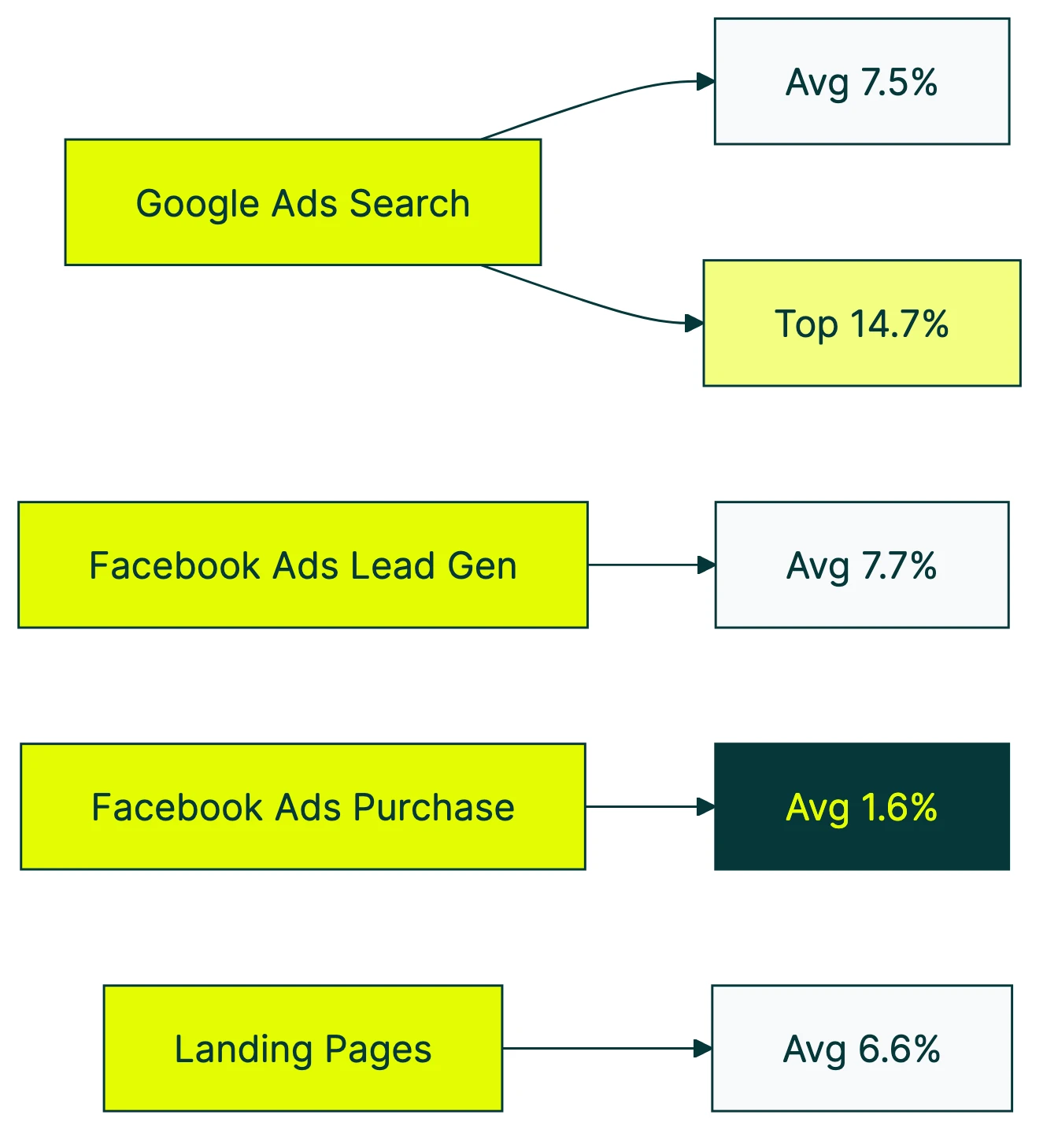
One thing that surprised me during research: nobody puts these numbers next to each other. You can find CTR benchmarks in one report and conversion rate benchmarks in another, but rarely in the same table. That makes it hard to see the relationship between the two metrics.
Here’s what the data shows:
| Channel | Average CTR | Average conversion rate | Source |
|---|---|---|---|
| Google Ads (search) | 6.66% | 7.52% | WordStream 2025 |
| Google Ads (display) | 0.46% | Varies by industry | WordStream 2025 |
| Email marketing | 2.62% | Varies by platform | Mailchimp benchmarks |
| Landing pages (all) | N/A | 6.6% | Unbounce 2024 |
| Facebook/Meta Ads | N/A | 7.72% (leads) / 1.6% (purchases) | WordStream/Triple Whale 2025 |
| Amazon Ads | 0.4-0.5% | 9.96% | Industry data |
| Ecommerce (add to cart) | N/A | 6.34-7.9% | Dynamic Yield |
Notice the CTR-conversion paradox in Google Ads by industry:
| Industry | CTR | Conversion rate | The pattern |
|---|---|---|---|
| Arts & Entertainment | 13.10% | 4.84% | High clicks, low conversions |
| Finance & Insurance | 8.33% | 2.55% | High clicks, lowest conversions |
| Automotive Repair | 5.56% | 14.67% | Modest clicks, highest conversions |
| Physicians & Surgeons | 6.73% | 11.62% | Average clicks, high conversions |
The pattern holds: industries with the flashiest, most clickable ads often have the worst conversion rates. Industries where people search with real urgency (my car is broken, I need a doctor) convert like crazy with ordinary ads.
And the trend is getting worse. WordStream’s year-over-year data shows CTR across all industries went up 3.74% while conversion rates dropped 9.28%. More clicks, fewer conversions, higher cost per lead. That’s not progress.
For ecommerce conversion tracking in GA4, the numbers look different again. And mobile app conversion rate benchmarks operate on an entirely different scale. Context matters.
How to improve your click-to-conversion rate
If you’ve diagnosed a gap between your CTR and conversion rate, here’s what to do about it. These are ordered by impact.
Match your messages. Your landing page headline should echo your ad copy. If your ad says “Free shipping on orders over $50,” those exact words should appear above the fold. This is the single biggest lever for closing the CTR-to-conversion gap.
Then simplify the conversion path. Extra form fields, extra checkout steps, every “just one more thing” between the click and the conversion? That’s where people leave. Cut anything that isn’t essential.
Write at their reading level. This one surprised me. Unbounce found that landing pages written at a 5th-to-7th grade reading level convert at 11.1%. Pages at a professional reading level? Just 5.3%. Simple words sell better. And that gap is 62% wider than it was in 2020, so reading level matters more now than ever.
This one’s counterintuitive: show your ad to fewer, more qualified people. Your CTR might drop, but your conversion rate often goes up. You’ll pay for fewer clicks, but more of them will convert. That’s a better deal.
Test your landing pages, not just your ads. Most advertisers spend all their time testing ad copy and none testing the landing page. That’s like rehearsing your pickup line but never cleaning your apartment. The page where the conversion actually happens deserves just as much attention.
This is where proper A/B testing comes in. Instead of guessing which landing page version converts better, test them head-to-head. Change the headline. Try a shorter form. Swap the hero image. You can try this with Kirro in about three minutes, and it works with your existing Google Analytics setup.
The whole point of conversion rate optimization is closing this gap. For a fuller playbook, see our guide to landing page optimization and CRO best practices that actually move the needle.
When to prioritize CTR over conversion rate (and vice versa)
Not all campaigns have the same goal. When you’re focused on different outcomes, different metrics take the lead.
Prioritize CTR when you’re building brand awareness, testing new messaging angles, or trying to improve organic search visibility. In these cases, getting eyeballs matters more than closing sales. You’re learning what people respond to.
Prioritize conversion rate when you’re running paid campaigns, chasing revenue goals, or working with a tight budget. You’re paying for every click, so a higher conversion rate almost always means lower cost per customer.
Watch both when you’ve validated your messaging and you’re scaling spend. At that point, you want to make sure broadening reach doesn’t dilute your conversion rate.
Amazon’s search algorithm is a good example. It uses CTR for ranking (more clicks = higher placement). But it penalizes sellers who get high CTR with low conversion rate. Amazon reads that as a sign the product isn’t delivering on its listing promise. Both metrics matter, but conversion rate is the tiebreaker.
Sometimes a lower CTR is actually better for business. Say you tighten your targeting. Your CTR drops from 8% to 5%, but your conversion rate doubles. You’re making more money from fewer clicks. That’s the goal. Track the right conversion goals and the right conversion rate metrics for your business. Don’t let a flashy CTR distract you.
Kirro was built for exactly this kind of testing. Not just measuring which headline gets more clicks, but which one actually converts visitors into customers. Clicks don’t pay the bills. Conversions do.
FAQ
What is the difference between click rate and conversion rate?
Click rate (CTR) measures how often people click your ad, email, or link out of everyone who saw it. It’s calculated as clicks divided by impressions. Conversion rate measures how many of those clickers actually followed through. Bought something, signed up, filled out a form. CTR measures appeal. Conversion rate measures follow-through. They’re related but independent. Research shows the ad with the highest CTR only has a 14.3% chance of also having the highest conversion rate.
Is CTR more important than conversion rate?
It depends on what you’re trying to achieve. For brand awareness campaigns, CTR tells you whether your message is getting attention. For revenue, ROI, and paid advertising, conversion rate is the metric that actually matters. The data is clear: CTR and conversion rate are essentially independent metrics. A study of 60+ campaigns found a -0.28 correlation between CTR and sales. If you can only focus on one metric for paid campaigns, focus on conversion rate.
How do you calculate conversion rate from clicks?
Divide your conversions by your clicks, then multiply by 100. For example: 15 conversions from 500 clicks = 3% click conversion rate. This is the exact formula Google Ads uses in its “Conv. rate” column. It’s different from GA4’s conversion rate, which uses sessions as the denominator instead of clicks. If your Google Ads conversion rate and your GA4 conversion rate don’t match, this denominator difference is usually why.
Can you have a high CTR but low conversion rate?
Yes, and it’s one of the most common problems in digital advertising. It usually means your ad or email is compelling enough to earn clicks. But your landing page doesn’t deliver on the ad’s promise. The fix is message match: make sure your landing page headline, offer, and imagery align with what the ad said. WordStream’s data shows entire industries (like Arts & Entertainment at 13.10% CTR but only 4.84% conversion rate) where this pattern plays out at scale.
What is a good click conversion rate?
It varies widely by industry and channel. The average across all Google Ads search campaigns is 7.52%, but the range spans from 2.55% (Finance & Insurance) to 14.67% (Automotive Repair). For landing pages across all industries, the average conversion rate is 6.6%. Rather than chasing an industry average, track your own click conversion rate over time and use A/B testing to improve it. Your best benchmark is your own historical performance.

Randy Wattilete
CRO expert and founder with nearly a decade running conversion experiments for companies from early-stage startups to global brands. Built programs for Nestlé, felyx, and Storytel. Founder of Kirro (A/B testing).
View all author posts