Your conversion rate for lead generation depends on which part of the funnel you’re measuring. The average visitor-to-lead rate is around 2-3%. The average lead-to-customer rate is 2-7%. And those numbers mean almost nothing without context.
Here’s why. Two consulting firms in the same industry reported lead-to-customer rates of 0.35% and 40%. Same business type. Wildly different results. The difference? One relied on cold outbound (see our cold calling conversion benchmarks for what to expect from that channel). The other got warm referrals.
Use the conversion rate calculator to crunch your own numbers. So before you Google “what’s a good lead conversion rate,” stop. Good conversion rate optimization starts with knowing which conversion you’re measuring. (For a starting point, see our lead conversion rate definition and benchmarks.) Which channel your leads come from. And what stage of the funnel you’re looking at. This guide covers all of it.
What is a lead generation conversion rate (and which one are you measuring?)
A lead generation conversion rate measures how many people take the next step in your conversion funnel. But “the next step” changes depending on where you’re looking.
Here’s the full funnel, in plain language:
- Visitor → Lead. Someone lands on your site and fills out a form, signs up for a trial, or calls you. They went from anonymous to known.
- Lead → MQL. A marketing-qualified lead (MQL) is a lead that’s actually interested, not just someone who downloaded a free PDF to get your email off their back. They visited your pricing page, read three blog posts, or came back twice this week.
- MQL → SQL. A sales-qualified lead (SQL) means your sales team talked to them and agreed they’re worth pursuing. They have the budget, the need, and the timeline.
- SQL → Opportunity. They’re in active conversations. There’s a real deal on the table.
- Opportunity → Customer. They signed. Money changed hands. Celebration time.
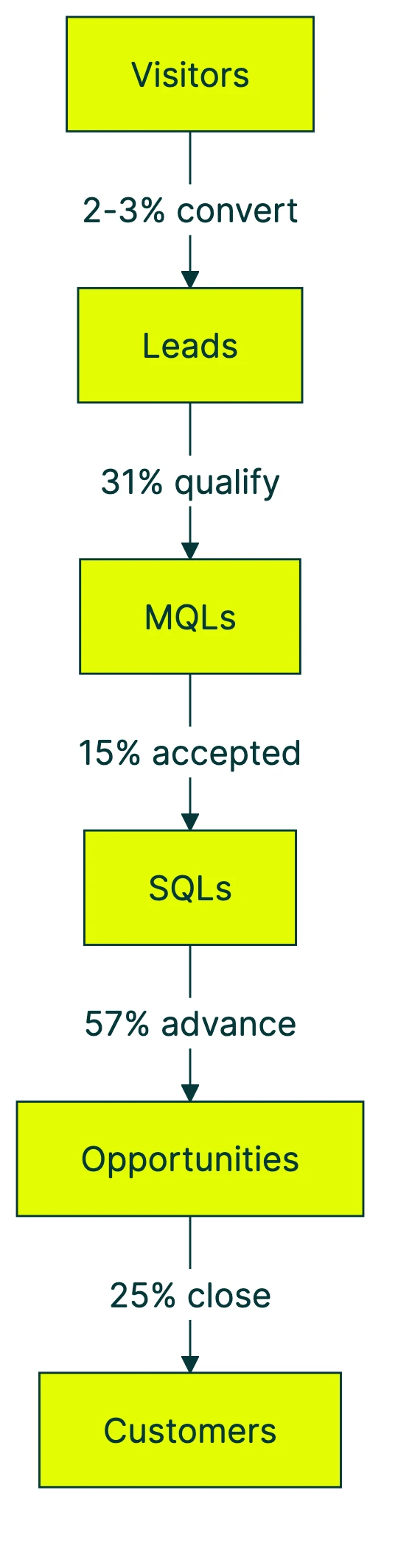
Every one of these transitions has its own conversion rate. When someone says “our lead conversion rate is 15%,” they could be talking about any of them.
That’s why benchmarks you find online can be misleading. A blog post claiming the “average lead conversion rate is 7%” might be measuring visitor-to-lead while you’re measuring MQL-to-SQL. You’d compare your 15% to their 7% and think you’re crushing it. In reality, you might be behind.
Our take: Before you worry about whether your number is good, make sure you know which number you’re actually looking at. The biggest waste of time in lead gen analytics is comparing apples to oranges.
The CRO metrics that matter go beyond a single conversion rate. Track each stage separately with proper funnel analytics. That’s how you find where your funnel leaks.
For a visual breakdown of the B2B lead generation funnel with real examples, Patrick Dang walks through the key concepts:
Lead conversion rate formula for every funnel stage
Here’s how to calculate conversion rate at each stage of your lead funnel:
| Funnel Stage | Formula | Example |
|---|---|---|
| Visitor → Lead | (New leads ÷ website visitors) × 100 | 300 leads from 10,000 visitors = 3% |
| Lead → MQL | (MQLs ÷ total leads) × 100 | 93 MQLs from 300 leads = 31% |
| MQL → SQL | (SQLs ÷ MQLs) × 100 | 14 SQLs from 93 MQLs = 15% |
| SQL → Opportunity | (Opportunities ÷ SQLs) × 100 | 8 opps from 14 SQLs = 57% |
| Opportunity → Customer | (Closed deals ÷ opportunities) × 100 | 2 customers from 8 opps = 25% |
Follow that example all the way through: 10,000 visitors turned into 2 customers. That’s a 0.02% overall conversion rate. Sounds terrible, right?
It’s actually pretty normal. Forrester found that even top-performing companies only convert 1.54% of all marketing leads to revenue. The average is below 0.75%.
And small improvements compound across stages. If you improve each of those 5 stages by just 10%, you don’t get 50% more customers. You get 61% more. That’s because 1.1 × 1.1 × 1.1 × 1.1 × 1.1 = 1.61. The math multiplies, it doesn’t add.
So you don’t need to double any one stage. A modest improvement at three or four stages does more heavy lifting than a dramatic improvement at one.
You can plug your own numbers into a conversion rate calculator to see where you stand and model the “what if” scenarios. If you track conversion rates in GA4, you already have most of the inputs.
Lead to MQL conversion rate benchmarks by industry
A marketing-qualified lead is someone who showed real interest, not just passing curiosity. The lead to MQL conversion rate tells you how good your lead capture is at attracting the right people.
First Page Sage analyzed 10 years of agency data across 29 industries:
Top-performing industries (lead to MQL):
- Environmental services, higher education, solar energy: 45%
- HVAC, biotech: 42%
- B2B SaaS, cybersecurity: 39%
Lower-performing industries:
- Construction: 17%
- Industrial IoT: 22%
Your channel matters more than your industry:
| Channel | Lead-to-MQL Rate |
|---|---|
| Client referrals | 56% |
| Executive events | 54% |
| SEO / organic search | 41% |
| Email marketing | 38% |
| Social media | 30% |
| PPC / paid search | 29% |
| Outdoor advertising | 14% |
Referrals convert at nearly double the rate of paid search. That’s not a small gap. If your lead-to-MQL rate is below 25%, the first question isn’t “what’s wrong with our forms?” It’s “where are these leads coming from?”
A life insurance company reported 27% conversion on organic leads versus 7% on PPC leads. Same product. Same team. Same funnel. The only difference was the source.
Our take: Before you spend money fixing your funnel, check where your leads come from. A mediocre funnel fed with referral traffic will outperform a perfect funnel fed with cold ads. Every time.
For details on what is a good funnel conversion rate across more industries and stages, we’ve put together a separate deep dive.
MQL to SQL and lead to opportunity conversion rate
The lead to opportunity conversion rate measures how well your sales team turns qualified leads into real deals. But first, those leads have to get past the MQL-to-SQL handoff. That’s where most funnels lose people.
First Page Sage benchmarks across 25 industries show MQL-to-SQL ranges from 10% to 26%:
Higher MQL-to-SQL rates:
- Business insurance, HVAC: 26%
- Ecommerce, heavy equipment: 23%
Lower MQL-to-SQL rates:
- Legal, real estate: 10%
- Fintech, engineering: 11%
After the MQL-to-SQL stage, the numbers get better. SQL-to-opportunity rates typically run 50-62%, and opportunity-to-close rates are 15-30%.
The MQL-to-SQL stage is the bottleneck because it’s where sales and marketing definitions collide. Marketing says “we sent you 100 qualified leads.” Sales says “maybe 15 of those were real.” Both are right, they’re just using different definitions of “qualified.”
Salesforce found that companies where sales and marketing agree on lead definitions generate 65% more pipeline. That’s not a tool problem. It’s a conversation problem.
The traditional way of scoring leads (gave us their email + has the right job title = qualified) is losing ground. Companies that score leads on behavior achieve 39-40% MQL-to-SQL conversion versus the 15% average. 2025 pipeline data confirms this gap is widening. Behavioral scoring tracks which pages they visited, how often they came back, and whether they checked pricing. Job title alone doesn’t cut it.
Lead to sale conversion rate: what “good” looks like
The lead to sale conversion rate is the finish line: how many leads turned into paying customers? Here are the ranges, based on data from SerpSculpt and Ruler Analytics (100M+ data points):
By industry (lead to customer):
- Legal services: 7.4% (highest B2B)
- Professional services: 4-5%
- B2B SaaS: 3-5% (see our full SaaS conversion rate benchmarks for stage-by-stage data)
- B2B ecommerce: 1.8% (lowest B2B)
By channel (lead to customer):
- Referral: 2.9%
- Organic search: 2.6-2.7%
- Email: 2.4%
- Paid search: 1.5-3.2%
- Social: under 1%
There’s a sneaky problem with these numbers: what counts as a “lead” isn’t the same everywhere. Is it everyone who filled out a form? Only people who booked a demo? Anyone who called your office? The formula is always the same (customers ÷ leads × 100), but the denominator changes everything.
If you define “lead” broadly (everyone who filled any form), you’ll get a lower rate. If you only count demo requests, your rate goes up. Neither is wrong. But you can’t compare them.
For the bigger picture on what counts as a good conversion rate and how to benchmark yours, we break it down by industry and context. And for a quick check on your lead conversion rate benchmarks, that guide covers the definitions in more detail.
How to increase lead conversion rate
Here are 7 tactics ranked by typical impact, starting with the one most businesses are getting wrong.
1. Respond faster (this is the big one)
A Harvard Business Review study audited 2,241 companies and found the average response time to a new lead was 42 hours. Even worse, 23% of companies never responded at all.
Meanwhile, leads contacted within 5 minutes are 21x more likely to be qualified than those contacted after 30 minutes.
Most companies wait almost two days. The data says five minutes. That gap is enormous, and it’s free to close. No new tools needed. Just faster follow-up.
If you can respond in under a minute, the numbers get even better. Chili Piper analyzed 4 million form submissions in 2025. Offering immediate scheduling doubled the form-to-meeting conversion rate: 30% to 66.7%.
2. Fix your forms (but not the way you think)
Fewer form fields generally means more leads. That’s CRO 101. But fewer isn’t always better.
For high-value B2B leads, adding a qualifying question (like “what’s your budget range?”) can actually improve conversion quality. You’ll get fewer form fills but more real prospects. The right number of fields depends on how much each lead is worth to you. Our lead capture form guide breaks down exactly which fields to include by form type.
Unbounce’s 2024 benchmark report analyzed 57 million conversions and found something surprising: landing pages written at a 5th-7th grade reading level converted 56% better than those with complex language. Simpler copy beats clever copy. Even on lead gen forms.
If you want to test which version of your form works better, you can run a quick A/B test on your lead capture page. Change the headline, the number of fields, or the button text and let real visitors decide.
3. Score leads on what they do, not who they are
Traditional lead scoring looks at demographics: job title, company size, industry. Behavioral scoring looks at actions: which pages they visited, how often they came back, whether they looked at pricing.
The difference is massive. Companies using behavioral scoring achieve 39-40% MQL-to-SQL conversion versus the 15% average with demographic scoring alone.
Think about it. Someone who visited your pricing page three times this week is more interested than a VP who downloaded a whitepaper six months ago. Their job title doesn’t matter if they’ve gone cold.
4. Nurture leads with relevance, not volume
Sending the same drip sequence to everyone is like giving every patient the same prescription. Forrester research found that companies excelling at lead nurture generate 50% more sales-ready leads at 33% lower cost.
Even better, nurtured leads make 47% larger purchases according to Annuitas Group. They don’t just convert more. They spend more.
The key word is “relevance.” Segment by where they are in the funnel and what problem they’re trying to solve. A lead who just discovered you needs different content than one who’s comparing you to a competitor.
5. Get sales and marketing to agree on definitions
Marketing says the conversion rate is 5%. Sales says it’s 15%. Both are correct, they’re measuring different stages.
This misalignment isn’t just annoying. Salesforce reports that when sales and marketing agree on lead definitions, companies generate 65% more pipeline. That means sitting down and defining what counts as an MQL. And what triggers the handoff to sales. Not glamorous work. But possibly the highest-ROI meeting you have all quarter.
6. A/B test your lead capture points
Your landing page, form layout, headline, and call-to-action button all affect how many visitors become leads. Small changes here compound through the entire funnel.
Testing one element at a time gives you a clear answer about what works. A headline change on a lead capture page can shift conversion by 10-30%. You don’t need to guess which version works. You can set up a split test in about three minutes and let the data decide.
A/B testing your conversion rate is the fastest way to find out what’s working. And Kirro makes it easy to test lead gen pages without needing a developer.
7. Fix the handoff (30% of leads are never contacted)
That HBR study didn’t just find slow response times. It found that nearly a third of leads were never contacted. They filled out a form, showed interest, and heard nothing.
Usually this is a routing problem. The lead goes into your CRM (whatever system tracks your leads), nobody is assigned, and it sits there. Or it gets assigned to a rep who’s on vacation. Or it lands in a queue behind 200 other leads.
Check your CRM. Pull a report on leads generated last month versus leads contacted. If there’s a gap, that’s revenue sitting on the floor. For tips on conversion funnel optimization, that guide covers the handoff and every other stage in more detail.
Lead conversion rate calculator: measure every stage
Here’s a simple way to calculate your lead conversion rate at every stage. Grab these numbers from your CRM or analytics tool:
- Website visitors (last month)
- New leads generated
- Marketing-qualified leads (MQLs)
- Sales-qualified leads (SQLs)
- Opportunities created
- Closed deals
Now divide each stage by the one above it, multiply by 100. You’ll get five conversion rates. The lowest one is your bottleneck.
The “what if” scenario: Say your MQL-to-SQL rate is your weakest at 12%. Improve it to 13.2% (a 10% relative bump). Do the same at two other stages. You get 33.1% more customers. Not 30%. The compounding effect gives you a bonus.
That’s not theoretical. It’s just math: 1.1 × 1.1 × 1.1 = 1.331.
Our conversion rate calculator doubles as a conversion rate increase calculator. Plug in your current numbers, model a 10% bump at your weakest stages, and see the compound result. Once you know which stage is weakest, optimize your conversion rate there first. Focus beats spreading effort across everything.
If your bottleneck is at the top of the funnel (visitors not becoming leads), that’s a lead capture page and click conversion rate problem. Different fix, different playbook. And if it’s your landing page or form that’s underperforming, Kirro lets you run A/B tests on it without a developer.
FAQ
What is a good lead generation conversion rate?
It depends on which stage you’re measuring. Visitor-to-lead: 1-5%. Lead-to-MQL: 25-35%. MQL-to-SQL: 13-26%. Overall lead-to-customer: 2-7%. Compare within your industry and channel, not against a generic “average.” A 2.5% lead-to-customer rate is solid for complex B2B products. It’s below average for simpler ones.
How do you calculate lead to sale conversion rate?
Divide your customers by your total leads, then multiply by 100. If you got 500 leads last month and 15 became customers, your lead to sale conversion rate is 3%. The formula is simple. The key is defining what counts as a “lead.” All form fills? Demo requests only? Inbound calls? Same formula, very different numbers depending on the denominator.
What is MQL to SQL conversion rate?
It’s the percentage of marketing-qualified leads that your sales team accepts as worth pursuing. The average is about 15%, but top performers hit 25-35%. The gap usually comes from misaligned definitions between marketing and sales, or from relying on demographic scoring instead of behavioral signals.
Is a 2.5% lead conversion rate good?
For overall lead-to-customer conversion, 2.5% is right around the B2B average. If you sell complex, high-value products with long sales cycles, that’s perfectly solid. If you sell a simple, low-cost product, you should expect higher. Context matters more than the raw number. Check the channel breakdown and industry benchmarks in the sections above for a better comparison point.
What’s the difference between lead conversion rate and conversion rate?
Conversion rate is any action you’re measuring: a purchase, a signup, a download. Lead conversion rate specifically tracks how leads progress through your sales funnel, from visitor to lead to customer. All lead conversion rates are conversion rates. But not all conversion rates are about leads. An ecommerce conversion rate measures purchases. A lead conversion rate measures funnel progression.
Why does speed to lead matter so much?
Because buying interest decays fast. A lead who filled out your form five minutes ago is actively thinking about your product. An hour later, they’re in a meeting. A day later, they’ve found a competitor. The HBR research is clear: responding within 5 minutes makes you 21x more likely to qualify the lead. And most companies wait 42 hours.

Randy Wattilete
CRO expert and founder with nearly a decade running conversion experiments for companies from early-stage startups to global brands. Built programs for Nestlé, felyx, and Storytel. Founder of Kirro (A/B testing).
View all author posts