What is a cold calling conversion rate?
The cold calling conversion rate (or CVR in shorthand) most people quote is around 2%. You’ll see that number everywhere. And it’s not wrong, exactly. It’s just not useful without context.
When someone says “cold call conversion rate,” they could mean any of these:
- Dial-to-connect: Did someone pick up the phone?
- Connect-to-conversation: Did you actually talk, or did they hang up in three seconds?
- Conversation-to-meeting: Did they agree to a follow-up?
- Meeting-to-close: Did they eventually buy?
Each stage has a completely different conversion rate. Lumping them together into one “2%” is like saying the weather is “medium.” Technically a number. Practically useless.
Think of it as a conversion funnel, just like the ones you’d track on a website. Comparing your numbers against conversion rate benchmarks by channel tells you where you stand. Every step has drop-off. And the number you should care about depends on what your team is actually trying to improve. Calculating conversion rate for any channel works the same way. Define the action, count the attempts, do the math.
Every number below comes from studies tracking tens of millions of calls. Not the same recycled stats from 2015.
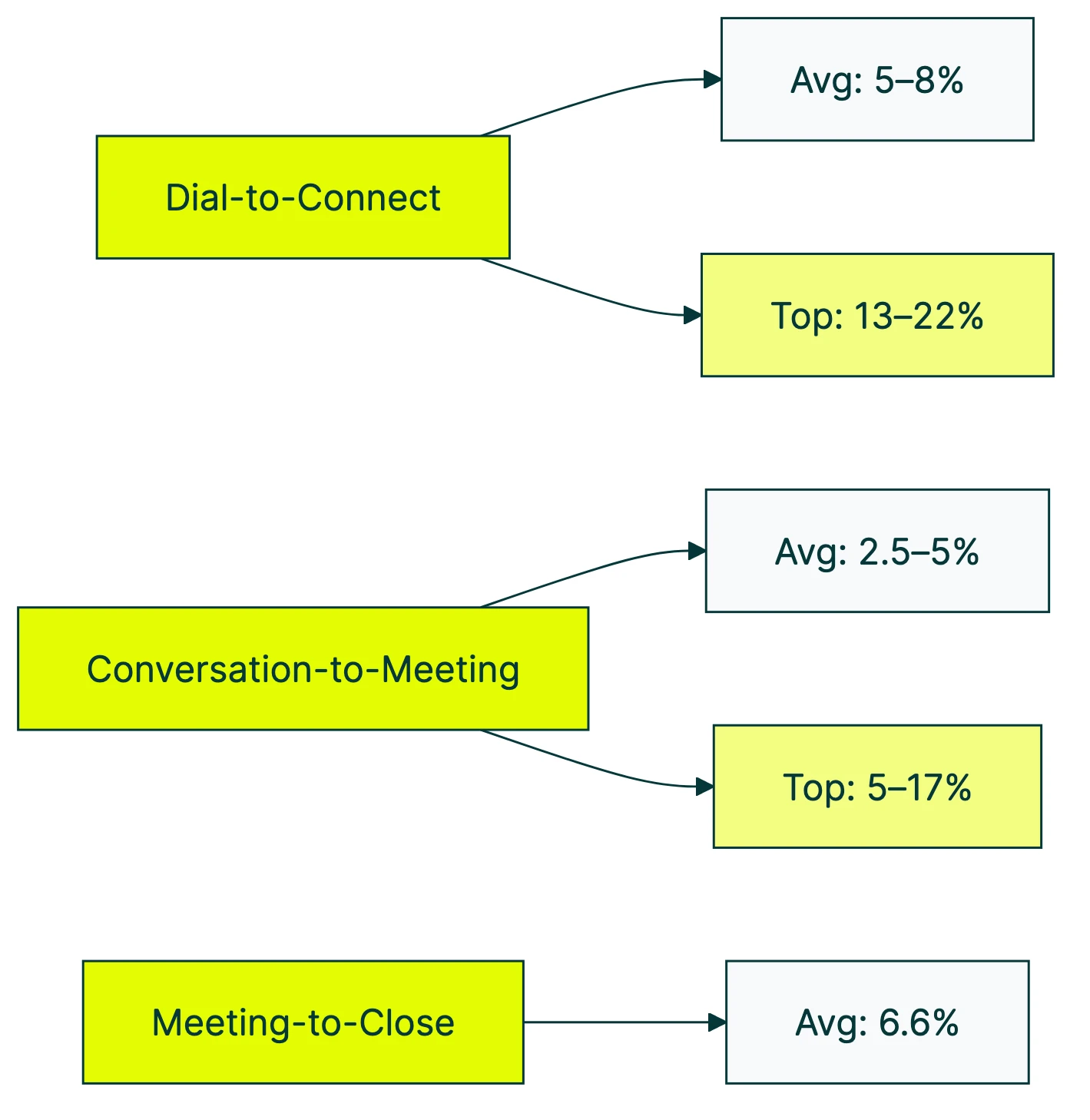
Average cold call conversion rate by funnel stage
This video from Gong walks through the anatomy of successful cold calls in detail:
Here’s where the “2% average” falls apart. Each stage of the cold calling funnel has its own benchmarks, and understanding conversion rate metrics at each stage shows why they look very different from each other.
Dial-to-connect rate
This is the percentage of calls where a human actually picks up.
| Source | Dataset | Connect rate |
|---|---|---|
| Gong | 300M+ calls | 5.4% average, 13.3% top quartile |
| Cognism | 55,701 dials | 16.6% |
| Orum | 60M+ calls | 5.35% baseline, 22% with local numbers |
| Bridge Group | 365 B2B companies | 7.7% |
Why the wide range? Data quality, time of day, and whether you show a local area code. Orum’s data shows matching your caller ID to the prospect’s area code can 4x your connect rate. Five people reached per 100 calls vs. 22. Not a small tweak.
Connect-to-conversation rate
Someone picked up. Do they actually talk to you?
Cognism’s 2024 report puts this at 56.9%. Orum’s data shows about 40%. In other words, roughly half of the people who answer will give you at least a few seconds.
Conversation-to-meeting rate
This is the number most sales teams actually care about. You had a real conversation. Did they agree to a meeting?
| Source | Average | Top performers |
|---|---|---|
| Cognism 2024 | 4.82% | Not broken out |
| Gong (300M calls) | 4.6% | 16.7% |
| Optifai (939 companies) | 2.5% | 5–8% |
Notice that gap between average and top. We’ll come back to it. It matters more than any single benchmark.
Meeting-to-close rate
The Bridge Group’s 2023 report tracked this across 365 B2B sales teams. 55% of booked meetings actually happen. Of those, 60% get accepted by the sales team. About 20% close. End result: roughly 6.6% of meetings turn into revenue.
The funnel in action
Here’s what 1,000 cold call dials look like using average conversion rates. Think of this as a rough conversion rate calculator for cold calling:
| Stage | Conversion rate | People remaining |
|---|---|---|
| Dials made | - | 1,000 |
| Connected (picked up) | 7.7% | 77 |
| Real conversation | 50% | 39 |
| Meeting booked | 4.6% | 2 |
| Meeting happens | 55% | 1 |
One meeting from 1,000 dials. That’s the average. But averages are misleading here.
Compared to other channels and their benchmarks, cold calling’s overall funnel sits at the lower end. But that’s not quite fair. Each cold call takes seconds. Other channels need content, design, or ad spend upfront.
Our take: The “2% average” everyone quotes is a lazy shortcut. Which 2%? Dial-to-connect? Conversation-to-meeting? The overall funnel? It’s like asking “what’s the average score in sports?” and expecting one number to cover bowling and basketball. Know which stage you’re measuring, or the number is meaningless.
Cold calling conversion rates by industry
Not all cold calls are created equal. A real estate agent calling homeowners has a very different conversation than a SaaS rep calling a VP of Engineering.
| Industry | Avg. conversion rate | Calls per sale |
|---|---|---|
| Real Estate | 2.20% | 45 |
| Insurance | 2.12% | 47 |
| Financial Services | 1.54% | 65 |
| Telecom | 1.29% | 78 |
| Pharmaceuticals | 1.21% | 83 |
| Technology / SaaS | 0.95% | 105 |
Source: Focus Digital. Directional benchmarks, not large-sample academic data. Use as a rough guide.
There’s a pattern: higher-priced products convert at lower rates. That makes sense. Nobody buys enterprise software from a cold call. They agree to a meeting. The actual sale happens weeks or months later.
Rain Group’s buyer research tells a different story: 54% of B2B technology buyers actually prefer phone as their initial contact. Professional services? 50%. Financial services? 40%. Buyers are more receptive to cold calls than most marketers assume.
For SaaS conversion rate benchmarks specifically, the 0.95% makes more sense in context. SaaS deals have longer sales cycles and bigger buying committees. The cold call just opens the door.
How many cold calls does it take to get one sale?
This is the question everyone really wants answered.
| Source | Metric | Number |
|---|---|---|
| Baylor/Keller Center (2012) | Dials per appointment | 209 |
| Bridge Group 2023 | Dials per closed deal | 1,788 |
| Optifai 2025 | Dials per meeting (average) | 40 |
| Optifai 2025 | Dials per meeting (top performers) | 12–20 |
The Baylor study is from 2012 and used real estate agents calling completely cold. Optifai’s 2025 data (939 B2B SaaS companies) is more realistic: 40 dials per meeting on average.
The 9x performance gap
Gong analyzed over 300 million calls. At 200 dials per week (same activity for everyone), average reps book 2 meetings per month. Top-quartile reps book 18.
Same number of calls. Same channel. Nine times the results.
That’s not a rounding error. That’s a completely different business outcome. And it means “cold calling doesn’t work” is usually a performance problem, not a channel problem. The channel works fine. The execution might not.
Understanding what is a good lead conversion rate at every stage depends on rep skill, data quality, and targeting. Not just on whether you pick up the phone at all.
Rain Group’s research backs this up: 82% of buyers accept meetings from sellers who reach out cold. 57% of C-level executives prefer the phone over email or LinkedIn. The door is open. Most reps just aren’t walking through it very well.
Our take: Stop blaming the channel. If your top rep books 9x more meetings than your average rep from the same dial volume, you don’t have a cold calling problem. You have a training problem. Fix that first.
Cold calling vs. cold email vs. LinkedIn outreach
Everyone wants to know which channel “wins.” The honest answer: they measure different things, so comparing them straight-up is like comparing apples to velociraptors.
| Channel | Metric | Rate | Source |
|---|---|---|---|
| Cold calling | Call-to-meeting | 2–5% | Multiple (Gong, Cognism, Optifai) |
| Cold email | Reply rate | 1–5% (general), 8.5% (targeted) | Industry benchmarks |
| LinkedIn outreach | Personalized message reply | 9.36% | Belkins/Expandi (20M+ attempts) |
LinkedIn’s 9.36% looks great until you realize it’s measuring replies, not meetings. A reply might be “thanks, not interested.” Cold calling’s 2–5% measures actual meetings booked. Different endpoints, different math.
For comparison, Facebook Ads conversion rate benchmarks measure something else entirely (clicks to purchase or lead form). Each click conversion rate metric tracks a different action, so cross-channel comparisons need context.
Forget picking a winner. Combining channels moves the needle way more. Optifai’s study of 939 companies found that phone plus email sequences produce 3x better conversion than phone alone.
The voicemail paradox
Gong’s analysis of 300 million calls found that leaving 1–2 voicemails doubles the reply rate on subsequent emails. The email reply rate jumps from 2.73% to 5.87%. The voicemail itself doesn’t need to produce a callback. It primes the prospect so your email feels familiar instead of cold.
But leave 3 or more voicemails and the whole thing reverses. Reply rates drop to 2.2% (below the no-voicemail baseline), and future connect rates tank by 28%.
The sweet spot is exactly 1–2 voicemails. Not zero. Not three. Two. Then switch to email.
Most cold calling guides skip over this data entirely.
Best time and day to make cold calls
Six different studies, millions of calls, and they mostly agree:
| Source | Best day(s) | Best time(s) |
|---|---|---|
| MIT/InsideSales (100K calls) | Wednesday, Thursday | 8–9 AM, 4–6 PM |
| Cognism 2024 (55,701 dials) | Thursday | 11 AM, 2 PM |
| HubSpot 2025 (379 sales pros) | Tuesday | 10 AM–12 PM |
| Orum 2024 (60M calls) | Monday, Wednesday | 8–9 AM, 5–6 PM |
The consensus: Tuesday through Thursday, between 10–11 AM or 4–5 PM. Friday afternoon is where cold calls go to die.
One more data point. The MIT/InsideSales study found that calling an inbound lead within 5 minutes boosts your contact rate 100x over waiting 30 minutes. Not 100%. One hundred times. Someone fills out a form and you wait an hour? Might as well not call.
And when you do connect? Gong’s data shows successful cold calls average 5 minutes and 50 seconds. HubSpot’s survey says most reps report 2–5 minutes as the sweet spot. Keep it focused.
How to improve your cold calling conversion rate
Based on the research, here’s what actually moves the needle. In order of impact.
Fix your data first. Cognism’s 2025 report shows their users achieved a 6.7% success rate compared to the 2.56% average. The difference? Better phone data. Having the right number is the single biggest variable.
Your opening line matters more than you’d think. Gong’s data on 300 million calls shows that “How’ve you been?” produces 6.6x higher success rates. Stating your reason for calling doubles success. And “Did I catch you at a bad time?” makes you 40% less likely to book a meeting. Kill that phrase.
Talk more than you think you should. Successful reps talk 55% of the time on calls, according to Gong. The “listen more, talk less” advice? Wrong for cold calls. You called them. They don’t know why yet. Explain it.
Use phone plus email together. Multi-channel sequences convert 3x better than phone alone. Call, leave a voicemail (max two), then email. The voicemail primes them for the email. It’s one sequence, not three separate channels.
And train daily, not quarterly. Focus Digital’s data shows daily practice pushes conversion rates to 9.03%. Almost 4x the average. Reps who practice a few times a month stay stuck.
If your cold calls drive prospects to a booking page, what happens on that page matters. You’ve done the hard work of getting someone interested. Don’t lose them to a confusing form or a weak headline.
A/B testing the pages your reps send people to can have an outsized impact. Kirro lets you test headlines and layouts on your booking page. More of those hard-won conversations turn into actual meetings. For a deeper look at B2B conversion rate optimization, we’ve covered that separately.
You can set up a test on your booking page in about three minutes. If your reps are generating meetings but the page isn’t converting, that’s a fast fix.
Average mobile conversion rate
Different topic entirely. “Average mobile conversion rate” is about how well mobile websites convert visitors into buyers. Not cold calling on phones. But people search for both together, so we’re covering it.
| Device | Conversion rate | Source |
|---|---|---|
| Desktop | 3.85–4.0% | Contentsquare (43B sessions) |
| Tablet | 3.1–3.49% | Contentsquare / Dynamic Yield |
| Mobile | 2.1–2.96% | Contentsquare / Dynamic Yield |
Mobile drives over 70% of ecommerce traffic. But it converts at nearly half the rate of desktop. That gap represents some of the easiest wins in online selling.
For deeper data on mobile app conversion rate benchmarks, we have a full breakdown. And if cold call prospects visit your site on their phones (they probably do), testing your mobile experience matters. Even small changes to how your landing page looks on mobile can close that gap.
If your team drives outbound traffic to a page that looks rough on phones, test a mobile-first version. Takes about 3 minutes to set up.
FAQ
What is the average cold calling conversion rate?
The most commonly cited figure is 2%, originally from the Baylor University/Keller Center study of 6,264 calls. Modern data puts it at 2–5%. That range is wide because it depends on which stage you measure. Dial-to-connect runs 5–17%. Conversation-to-meeting is 2.5–5% for average reps and up to 16.7% for top performers (Gong, 300M+ calls). There’s no single number that captures the full picture, which is why the funnel breakdown above matters.
How many cold calls does it take to get one sale?
On average, about 40 dials per meeting booked (Optifai, 939 B2B SaaS companies) and roughly 1,788 dials per closed deal (Bridge Group 2023 sales development data, 365 companies). Top performers need only 12–20 dials per meeting. The difference comes down to data quality, opening technique, and timing.
Is cold calling still effective?
Yes. Rain Group’s research (488 B2B buyers) shows that 82% of buyers accept meetings from sellers who reach out cold. 57% of C-level executives prefer the phone over email or social. And Gong’s data shows top-quartile reps book 9x more meetings than average reps from the same dial volume. The channel works. The question is whether your execution matches the top quartile.
Cold calling vs. cold email: which converts better?
Direct comparison is tricky because they measure different things. Cold calling produces 2–5% meeting booking rates. Cold email gets 1–5% reply rates. A reply isn’t a meeting, and a meeting isn’t a reply. The best results come from combining both: Optifai found that phone plus email sequences convert 3x better than phone alone. Don’t pick one channel. Use them together.
What is the best time to make cold calls?
Tuesday through Thursday, between 10–11 AM or 4–5 PM local time. This is consistent across Cognism (55,701 dials), HubSpot (379 sales pros), and MIT/InsideSales (100K+ calls). Avoid Friday afternoons. And if you’re following up on an inbound lead, call within 5 minutes. The MIT study found that waiting just 30 minutes drops your contact rate by 100x.

Randy Wattilete
CRO expert and founder with nearly a decade running conversion experiments for companies from early-stage startups to global brands. Built programs for Nestlé, felyx, and Storytel. Founder of Kirro (A/B testing).
View all author posts