A landing page is a single page built around one goal. Sign up. Buy. Download. That’s it.
A website is a collection of pages. Visitors browse around, learn about you, read your blog, find their own way.
The landing page vs website question isn’t really “which is better?” It’s “which do I need right now?” And most businesses eventually need both.
Think of it like this. A landing page is a spotlight. It shines on one thing and asks for one action. A website is more like a store with aisles. Visitors can wander, compare, and explore. Both useful. Different jobs.
Most articles stop at “they’re different.” We’ll go further. When does each one make sense? And can a landing page actually replace your website? (If you’ve already chosen a landing page, audit it with the optimization checklist to make sure it’s converting as well as it can.)
The core difference between a landing page and a website
A landing page has one job. Maybe that’s getting someone to sign up for a free trial. Maybe it’s collecting email addresses. Maybe it’s selling a single product. Everything on the page points toward that one action. The button you want people to click. Marketers call this a CTA (call to action).
That’s why landing pages strip away distractions. No navigation menu. No sidebar. No links to your blog or about page. Every extra link on a page is an exit door. Landing pages close those doors. For the full list of best practices for landing pages, we wrote a dedicated guide.
A website is the opposite. It’s your whole online presence. Homepage, about page, services, blog, contact form, maybe a store. Visitors arrive from Google, type your name in the address bar, or click a link someone shared. They’re browsing. Exploring. Deciding if they trust you.
Our take: Most articles treat “homepage” and “website” as the same thing. They’re not. Your homepage is one page of your website. A landing page is usually a separate page with a completely different job. Mixing these up is how bad advice gets made.
Understanding conversion rate optimization helps you get more from both. But first, you need to know which one to build.
Landing page vs website: side-by-side comparison
| Landing page | Website | |
|---|---|---|
| Pages | One | Many (5 to hundreds) |
| Goal | One specific action | Multiple (inform, build trust, sell, support) |
| Navigation | Minimal or none | Full menu and internal links |
| Buttons/CTAs | One (maybe two) | Many, across different pages |
| Traffic source | Paid ads, email campaigns, social posts | Organic search, direct visits, referrals |
| Lifespan | Campaign-based or evergreen | Permanent |
| SEO value | Low (thin content, few links) | High (content depth, internal linking) |
| Cost to build | Low (single page) | Higher (multiple pages, ongoing content) |
| Best for | Converting a specific audience | Building credibility with a broad audience |
Landing pages aren’t always temporary, though. A SaaS company’s free trial page or a lead generation landing page can run for years. The “landing pages are campaign-only” advice you’ll read elsewhere? Only half true.
When to use a landing page
Here’s the scenario. You’re running Google Ads for your consulting business. Each click costs money. Where does that traffic go? Your homepage. 15 navigation links, a blog feed, a team photo, and a contact form buried at the bottom.
That’s like paying for a taxi to a mall and hoping people find your store. Most won’t.
A landing page fixes this. One page. One offer. One button. The visitor either takes the action or they don’t. No wandering.
When landing pages make sense:
- Paid ad campaigns. Google Ads, Facebook Ads, Instagram. If you’re paying per click, every distraction costs real money.
- Product launches. One product. One message. One page.
- Email list building. Offer something valuable (a guide, a template, a discount) in exchange for an email address.
- Event registrations. Webinars, conferences, workshops.
- Testing a specific offer. Not sure if your new pricing works? A landing page lets you test it without changing your whole site.
The data backs this up. Unbounce analyzed 41,000 landing pages across 464 million visitors. Median conversion rate: 6.6%. Typical website pages sit around 2-3%.
Those numbers are messy, though. The “landing pages convert 2-5x better” claim that gets passed around? There’s no single study behind it. It’s assembled from different benchmarks measuring different things. A case study from BetterWorld showed a dedicated landing page converting at 17.1% versus 7.9% for the homepage. That’s real. But it’s one test, one company.
The biggest variable isn’t “landing page vs website.” It’s the traffic source. Email traffic converts at nearly 20% on landing pages. Display ads? Under 1%. Same page, wildly different results.
What actually matters is matching the page to the traffic. And then making it a high-converting landing page through testing. Want to know what a good conversion rate looks like for your industry? The benchmarks vary more than you’d expect.
When to use a website
Not every problem is a landing-page problem. If you’re a local plumber, people Google “plumber near me,” find your site, read your reviews, check your service list, and call you. A landing page can’t do all that.
Websites earn trust over time. They let visitors explore at their own pace, read your story, compare your services, and decide you’re legit before they reach out. That browsing behavior is part of the conversion funnel.
When a website makes sense:
- Organic traffic. Google sends people to websites with depth, not single pages. If you need search traffic, you need content. Lots of it.
- Selling six services? You need six pages. At least. A landscaping company can’t explain everything on one screen.
- Brand credibility. Real businesses have real websites. A landing page alone can feel thin.
- Blog posts, guides, case studies. Content marketing brings in visitors who weren’t looking for you yet.
- Serving both small businesses and agencies? They need different pages with different messaging.
Organic search still drives 53% of all website traffic. That’s traffic you don’t pay for, visit after visit. A landing page can’t deliver that. Need more? Here are 7 ways to increase your conversion rate, ranked by impact.
Want to improve how your pages rank and convert at the same time? CRO and SEO aren’t competing goals. They’re the same job.
Can a landing page replace your website?
Everyone Googles this. Nobody answers it straight. So we will.
If you’re validating a new idea: yes. A single landing page is the fastest way to test whether anyone actually wants what you’re building. Put up a page, describe the offer, add a signup button. If nobody clicks, you saved yourself months of building a full website for something nobody wanted.
If you sell one product and all your traffic is paid: probably yes. Plenty of solo founders run a single-page site that’s really just a well-built landing page. It works as long as your traffic comes from ads, social media, or email rather than organic search.
If you need Google traffic, serve multiple audiences, or want people to trust you before buying: no. A landing page is too thin. No blog for SEO. No about page for credibility. No service pages for different offerings. You’ll hit a ceiling fast.
Our take: Start with a landing page if you’re in a hurry. Build the website when you’re ready to grow. The people who wait until their website is “perfect” before launching? They usually don’t launch.
The trade-off is clear. A landing page gives you speed and focus. A website gives you depth and staying power. Most businesses that start with a landing page end up building a website within a few months. And that’s fine. That’s the right order.
How to decide: a simple decision tree
You don’t need a 20-page strategy document. You need five questions.
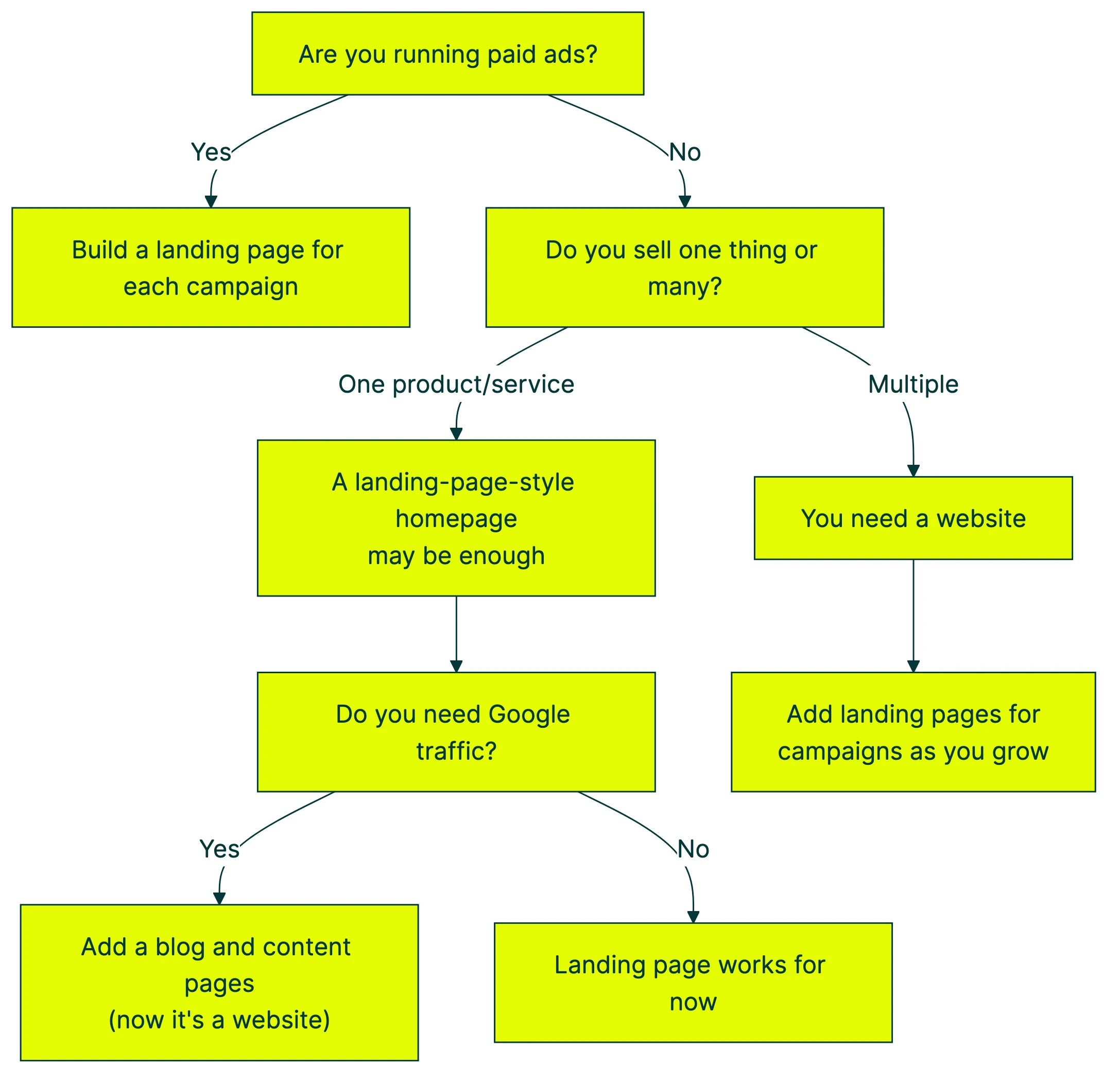
The quick version:
- Running paid ads? Build a landing page for each campaign. Don’t send paid traffic to your homepage.
- Sell one thing or many? One product might only need a single page. Multiple offerings need a real site.
- People searching for your brand name? They need a website to explore.
- Validating a new idea? Landing page first. Website later.
- Need organic Google traffic? That means a website with content.
Not sure which version of your page converts better? You can test both versions for free and let the data decide.
How landing pages and websites work together
Here’s how it works in practice. Your website handles the long game. Blog posts bring in organic traffic. Your about page builds credibility. Your product pages explain what you do. That’s the foundation.
Your landing pages handle the short game. Running a Black Friday sale? Landing page. Launching a new feature? Landing page. Promoting a webinar? Landing page. Each one focuses on a single campaign with a single goal.
The technical setup is simpler than you’d think. Landing pages can live right on your website (yoursite.com/summer-sale) or on a separate tool like Unbounce or Leadpages. Both approaches work. Keeping them on your domain is better for SEO and trust. If you use WordPress, Elementor landing page templates let you build conversion-focused pages without starting from scratch.
HubSpot found that companies with 10 to 15 landing pages generate 55% more leads. Companies with fewer than 10? Way behind. Not because more pages equals more magic. Each landing page targets a specific audience or offer. More focus, more conversions.
The key is measurement. Track where visitors come from, which page they land on, and whether they convert. That’s the only way to know what’s working.
Once you have both a website and landing pages running, the next step is testing. Split test your landing pages against each other. Test your homepage. Test your product pages. Tools like Kirro let you test any page on your site. Campaign landing page, main homepage, product page. Three minutes to set up, no code needed.
And if you want to go deeper on improving specific pages, start with landing page optimization. Small changes (a better headline, a clearer button, removing a distraction) often make a bigger difference than a full redesign.
Track your A/B testing conversion rate to see the actual impact. In our experience with A/B testing, the biggest wins come from testing the obvious stuff first. Headlines. Buttons. Hero sections. The simple stuff works.
Want to see which version of your page gets more conversions? Set up a free test and find out in minutes, not weeks.
For a clear visual explanation of the differences, Wes McDowell breaks it down:
FAQ
What is the difference between a landing page and a website?
A landing page is a single page designed to get visitors to take one specific action (buy, sign up, download). A website has multiple pages serving different purposes. Informing visitors, building trust, showcasing products, supporting customers, ranking in search engines. The biggest structural difference is navigation. Websites have menus and internal links. Landing pages remove those to keep visitors focused.
Do I need a landing page if I have a website?
Yes, if you’re running paid advertising or email campaigns. Your website serves people who are browsing and exploring. A landing page serves people who clicked a specific ad or link and need to make a specific decision. Sending paid traffic to your homepage is one of the most common (and expensive) mistakes in digital marketing. Lead generation conversion rates improve significantly when you match the page to the traffic source.
When should I use a landing page?
When you have one specific offer and a traffic source pointing at it. That includes paid ads (Google, Facebook, Instagram), email campaigns, social media promotions, product launches, and event registrations. If you’re paying per click, a landing page is almost always the right move. For CRO best practices on making those pages convert, start with the headline and work down.
Can a landing page act as a website?
Temporarily, yes. If you’re testing a new idea or selling a single product with paid traffic, a landing page can serve as your entire web presence. Plenty of early-stage startups do this. But you’ll hit a wall eventually. Landing pages don’t rank well in search engines (thin content, no internal links), they lack credibility signals like an about page, and they can’t serve multiple audiences. Build the full website when you’re ready to grow. For more on making landing pages search-friendly, check out landing page SEO best practices.
Do landing pages help or hurt SEO?
Landing pages themselves don’t usually rank well in search engines. They have minimal content, few (if any) internal links, and often duplicate messaging from your main site. They don’t hurt your website’s SEO either, though. Think of them as a conversion tool, not an SEO tool. Your website handles search traffic. Your landing pages handle campaign traffic. Both have a job. Neither replaces the other. Match the page to the traffic, and you’re good.

Randy Wattilete
CRO expert and founder with nearly a decade running conversion experiments for companies from early-stage startups to global brands. Built programs for Nestlé, felyx, and Storytel. Founder of Kirro (A/B testing).
View all author posts