Hotjar pricing ranges from $0 to $739 per month. The exact cost depends on which products you need and how much traffic your site gets. The free plan gives you 200,000 analytics sessions and 10,000 session recordings per month. Paid plans for heatmaps and recordings start at $49/month. Surveys start at $99/month. Yes, those are now separate bills.
That last part is the big change. Hotjar merged into Contentsquare in mid-2025, and the pricing model got a complete overhaul. What used to be one product with one bill became three products with three separate price tags. If you’re comparing Hotjar pricing from 2024 to what exists today, you’re looking at a different product entirely.
Already decided to switch? Our Hotjar alternatives guide has the options. Staying? Read on for the full pricing breakdown, including the costs most articles leave out.
What Hotjar costs right now
Hotjar now lives under Contentsquare’s pricing page. If you visit hotjar.com/pricing, it redirects you there. The product is split into three lines, each with its own pricing:
Experience Analytics (heatmaps, session recordings, funnels):
| Plan | Monthly cost | Sessions/month | Recordings/month | Data retention | Projects |
|---|---|---|---|---|---|
| Free | $0 | 200,000 | 10,000 | 1 month | 1 |
| Growth | $49–$739 | 7,000–200,000 | 7,000–30,000 | 13 months | 3 |
| Pro | Custom | 1,000,000+ | Custom | Custom | 6 |
| Enterprise | Custom | Unlimited | Custom | Up to 24 months | Unlimited |
Voice of Customer (surveys, feedback widgets):
| Plan | Monthly cost | Responses/month | Key features |
|---|---|---|---|
| Free | $0 | 100 | 3 active widgets |
| Growth | $99–$1,479 | 500–100,000 | AI sentiment analysis |
| Pro | Custom | Custom | Advanced targeting |
Product Analytics (event tracking, user journeys):
| Plan | Monthly cost | Sessions/month | Data history |
|---|---|---|---|
| Free | $0 | 10,000 | 6 months |
| Growth | Custom | 17,000+ | 12 months |
All prices shown are for annual billing with credit card or PayPal. Paying by invoice instead of card costs roughly $118 more per year. That’s a detail buried in the fine print.
Our take: Three separate products, three separate invoices. It’s like ordering a burger and finding out the bun, patty, and cheese are priced individually.
What changed after the Contentsquare merger (Hotjar pricing 2025 vs now)
Contentsquare acquired Hotjar in September 2021 for an undisclosed price. At the time, Hotjar had 33,000+ customers and had bootstrapped to $40 million in annual revenue with zero venture capital. That’s genuinely impressive.
The two companies ran separately until July 2025, when they legally merged. That’s when the pricing model changed.
Before the merger: Hotjar was one product. You paid one price and got heatmaps, recordings, surveys, and feedback widgets together. The Observe Plus plan started around $32/month.
After the merger: Hotjar split into three products. Heatmaps and recordings became “Experience Analytics.” Surveys became “Voice of Customer.” And a new “Product Analytics” line appeared.
The math hits different now. If your team used both heatmaps and surveys (most did), the numbers look like this:
- Old cost: ~$32/month for everything bundled
- New cost: $49/month (Experience Analytics) + $99/month (Voice of Customer) = $148/month minimum
That’s a 362% price increase for the same set of tools. None of the competing pricing articles do that math for you. They list the new prices without showing the before-and-after. Now you have it.
Existing customers are being migrated throughout 2026 with 30-day advance notice. If you haven’t gotten that email yet, it’s coming. Anyone searching for Hotjar pricing plans from 2025 will find an entirely different structure than what exists now.
The bigger signal? Contentsquare launched its own Growth tier at $40/month in December 2025. That’s $9 cheaper than Hotjar’s Growth plan for comparable features. The parent company is undercutting its own product. It doesn’t take a detective to figure out where this is heading.
Hotjar features and pricing by plan
Let’s translate the marketing names into what each plan actually does for you.
Free plan: You get heatmaps (color-coded maps showing where people click, scroll, and move their mouse) and 10,000 session recordings per month (video playbacks of real visitor sessions). Plus basic funnel tracking (where visitors drop off in a sequence of pages) and 100 survey responses. All limited to one website with one month of data storage.
For a small business getting under 50,000 monthly visitors, that’s enough to spot major problems. You’ll see where people rage-click, where they stop scrolling, and which pages lose the most visitors.
Growth plan ($49/month and up): This is where Hotjar starts actually costing money. You get 7,000 to 200,000 sessions depending on your tier. Data sticks around for 13 months, and you get access to their AI assistant, Sense. It summarizes recordings and suggests patterns. Journey analysis tracks the sequence of pages people visit across a full session. You can run up to 3 projects.
The catch: $49/month is the starting price for 7,000 sessions. Most business websites get more than 7,000 sessions per month. At 200,000 sessions, you’re paying $739/month.
Pro plan (custom pricing): Gets you retroactive filtering (applying new filters to recordings you’ve already collected), multi-session replay summaries, and revenue goal tracking. Up to 6 projects. You need to talk to sales.
Enterprise plan (custom pricing): Unlimited projects, dedicated support with SLAs (guaranteed response times written into your contract), error monitoring, and up to 24 months of data retention.
The features that separate the tiers are worth understanding. AI Sense, funnel visualization, and journey analysis are all locked behind Growth. If those matter to you, the free plan won’t cut it.
The Hotjar free plan: is it actually enough?
Hotjar’s free plan got dramatically better after the Contentsquare merger. The old free tier gave you roughly 35 sessions per day. The new one gives you 200,000 per month. That’s about a 190x increase.
For a small business site, 200,000 sessions is plenty for analytics. You’ll see where people click. You’ll see scroll depth. You’ll get basic funnel data.
But there are real limits:
- 1-month data retention. You can’t compare this month to last month. Every 30 days, your data disappears. For spotting seasonal trends or tracking changes over time, that’s a problem.
- 1 project only. Running multiple websites? You need paid.
- No AI features. Sense, journey analysis, and advanced filtering are Growth and up.
- 100 survey responses. If you’re collecting customer feedback at any real scale, you’ll blow through this in a week.
The honest comparison here is Microsoft Clarity (see our full list of session replay tools for more options). It’s completely free. Unlimited sessions. Unlimited recordings. 13 months of data retention. No session caps.
The tradeoff? Clarity doesn’t do surveys or feedback widgets. And there’s a privacy angle worth knowing: Clarity’s terms allow Microsoft to use collected data for AI training and marketing. Clarity also doesn’t honor Do Not Track browser headers. Hotjar follows GDPR (Europe’s data privacy rules) and doesn’t sell or profile data. For a full Clarity alternatives comparison, we’ve covered the privacy-friendly options separately.
If you only need heatmaps and recordings, Clarity is objectively better value. If you need surveys and feedback, or care deeply about data privacy, Hotjar’s free plan still has a place.
Our take: For most small businesses, start with Clarity for heatmaps and recordings. Add Hotjar’s free tier when you need surveys. Save the paid budget for tools that actually help you act on what you find (like A/B testing).
How session limits actually work
This is the part that trips people up. Most Hotjar pricing articles list the session numbers and move on. The reality is more complicated.
Sessions are not recordings. A “session” in Hotjar’s analytics is any visitor interaction with your site. A “recording” is a video playback of that session. On the free plan, only about 5% of sessions are captured as recordings. That means 200,000 sessions equals roughly 10,000 actual recordings you can watch.
Sampling kicks in. When your traffic exceeds your plan’s limit, Hotjar doesn’t just stop collecting. It samples. That means it records a representative slice of your traffic, spread evenly throughout the day. Your funnel reports and heatmaps will show a sampling notice. The data is still useful, but it’s not complete.
Growth plan scaling. The $49/month entry price gets you 7,000 sessions. That sounds low because it is. The price curve:
| Sessions/month | Monthly cost |
|---|---|
| 7,000 | $49 |
| 20,000 | $99 |
| 50,000 | $199 |
| 100,000 | $399 |
| 200,000 | $739 |
A marketing campaign that sends a burst of traffic can push you into a higher tier mid-month. Event-based tools let you control what gets tracked. With session-based billing, you can’t control how many sessions your site gets.
When you hit your plan’s cap, recording pauses until the next billing cycle. No overage charges, but also no data. For a business running a big promotion, going dark on recordings for two weeks is a real cost. It just doesn’t show up on the invoice.
What your CRO stack actually costs
Most Hotjar pricing articles miss this entirely. Hotjar is an observation tool. It’s a really good one. But observation alone doesn’t improve your conversion rate.
Think of it like this: heatmaps show you that nobody scrolls past your hero section. Session recordings show you that visitors hover over the pricing link but don’t click. Surveys tell you that people find your homepage confusing.
Great. You now know the problems. But which fix actually works? A shorter hero? A bigger pricing button? A new headline?
You can’t just guess. Well, you can. Most people do. But guessing is how you spend three months “improving” a page and end up with the same conversion rate.
The full CRO workflow is: observe (what’s happening) then test (which fix works) then learn (why it worked). Hotjar handles step one. For steps two and three, you need A/B testing.
A realistic CRO software stack for a small team:
| Stack | Tools | Monthly cost |
|---|---|---|
| Budget | Microsoft Clarity (free) + Kirro (EUR 149/mo) | ~$165/mo |
| Mid-range | Hotjar Growth ($49/mo) + Kirro (EUR 149/mo) | ~$214/mo |
| Enterprise | Hotjar Pro (custom) + VWO or Optimizely | $400+/mo |
The budget stack is interesting. Clarity gives you unlimited heatmaps and recordings for free. Kirro handles the testing side. Together they cost less than Hotjar Growth alone, and you can actually act on what you find.
The cost of not testing? A CRO audit might tell you ten things to fix on your homepage. Without testing, you pick the ones that seem right and hope. With testing, you know. That’s the difference between spending money on tools and getting money back from tools.
Hotjar pricing vs alternatives at a glance
Quick comparison focused on pricing only. For a detailed look at replacement options, see our guide to Hotjar alternatives.
| Tool | Starting price | Free plan | Sessions/recordings | Surveys | Privacy |
|---|---|---|---|---|---|
| Hotjar (Contentsquare) | $49/mo | Yes (200K sessions, 10K recordings) | Capped per tier | Yes ($99/mo extra) | GDPR, doesn’t sell data |
| Microsoft Clarity | Free | Yes (unlimited) | Unlimited | No | Data used for Microsoft AI |
| Lucky Orange | $32/mo | No | 500 sessions | Yes (included) | GDPR compliant |
| Mouseflow | $31/mo | Yes (500 recordings) | Tiered | Yes (included) | GDPR compliant |
| Contentsquare Growth | $40/mo | Yes | 7,000 sessions | Separate | GDPR compliant |
| PostHog | Free tier | Yes (5K replays) | Usage-based ($0.005/replay) | Yes (1.5K free) | Self-host option |
Notice something odd? Contentsquare Growth costs $40/month. Hotjar Growth costs $49/month. Same parent company. The $9 gap tells you which product Contentsquare is betting on long-term.
The total stack cost matters more than any single tool’s price tag. Compare A/B testing pricing alongside your analytics costs. For enterprise options, see our breakdowns of Optimizely pricing, AB Tasty pricing, and Optimizely alternatives. On the analytics side, FullStory alternatives and Crazy Egg alternatives cover the broader recording tool market. And if you landed on Hotjar after Google Optimize shut down, the pricing picture has shifted since then.
How to pick the right Hotjar plan
Use this decision framework:
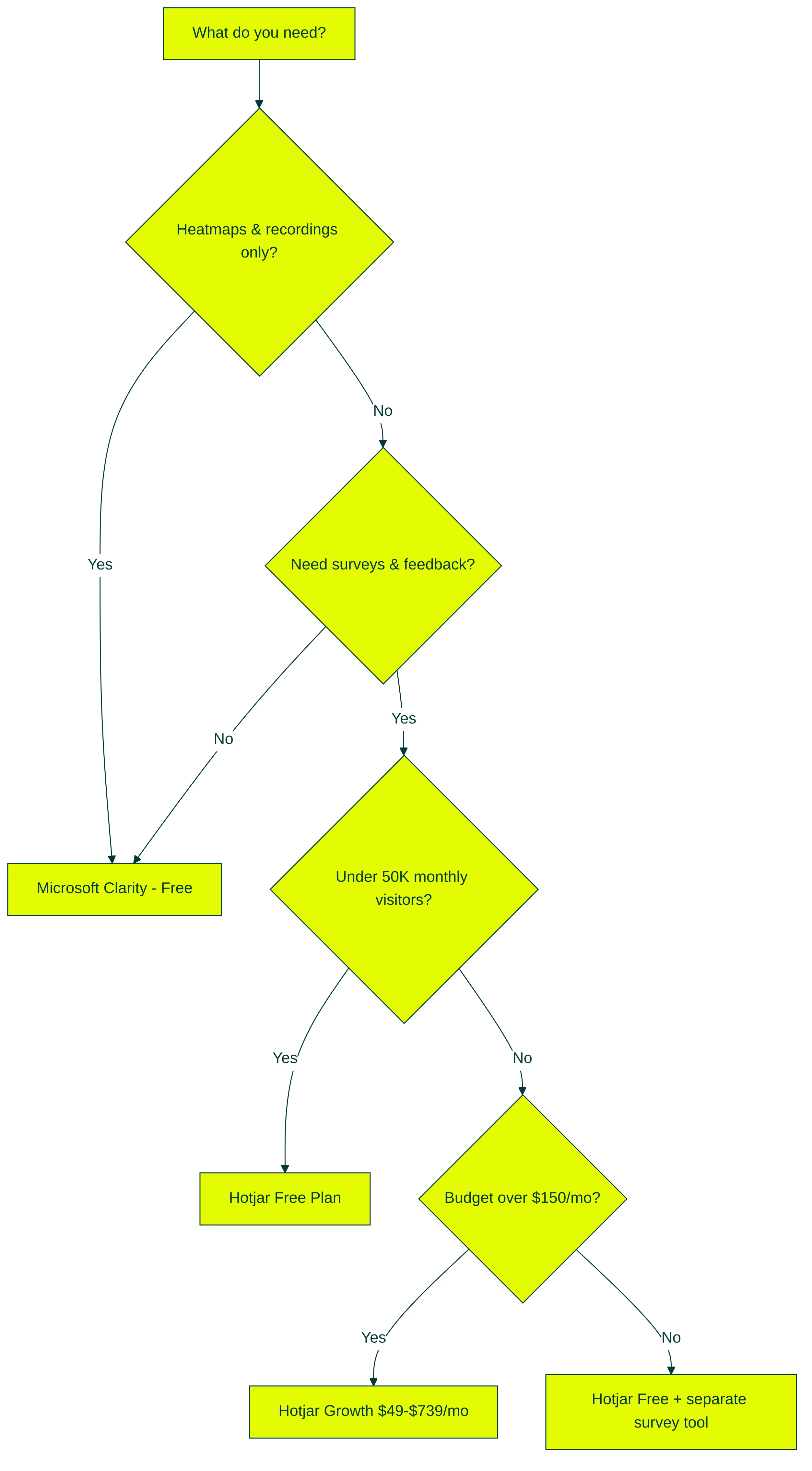
Just starting out or under 50K monthly visitors? The free plan covers you. Pair it with a free tool like Clarity for unlimited recordings, and you’ve got solid observation coverage at zero cost.
Need surveys and customer feedback? This is Hotjar’s actual moat. Clarity can’t do surveys. PostHog’s survey feature is newer and less mature. Qualitative feedback means actual words from real customers, not just click data. If that matters to you, Hotjar’s free plan gives you 100 responses per month.
Growing team, need AI insights and funnel analysis? Growth at $49/month gets you Sense AI, journey analysis, and 13 months of data. Worth it if you’re using Hotjar daily and need historical trends.
Multiple websites? You need Growth (3 projects) or Pro (6 projects). There’s no way around this on the free plan.
Red flag: If you’re paying $200+ per month for Hotjar alone, audit whether you’re getting proportional value. At that price, you could have Hotjar’s free tier plus a dedicated testing tool plus money left over.
One question worth sitting with: are you paying for observation without action? Heatmaps show you problems. Recordings confirm them. Surveys explain them. But none of those things improve your conversion rate by themselves.
You need to test the fixes. If your CRO budget goes entirely to watching visitors without testing changes, you’re collecting expensive evidence that nothing happens with. Pair your observation tools with something that lets you test what you find.
FAQ
How much does Hotjar cost per month?
Hotjar’s Experience Analytics (heatmaps and recordings) ranges from $0 to $739/month. The price depends on your session tier. Voice of Customer (surveys) is a separate product starting at $99/month. Product Analytics starts at free with custom pricing for Growth. The total cost depends on which products you use and how much traffic you get.
Is Hotjar free?
Yes. Hotjar has a permanent free plan (not a trial) that includes 200,000 analytics sessions, 10,000 session recordings, heatmaps, basic funnel tracking, and 100 survey responses per month. The main limits are 1-month data retention and 1 project.
What’s included in Hotjar’s free plan?
Heatmaps (click, scroll, and move maps), 10,000 session recordings per month, basic conversion funnels, 100 survey responses, 3 active feedback widgets, and access to 1 project. You don’t get AI Sense, journey analysis, advanced filtering, or more than 1 month of stored data.
Is Hotjar worth the price?
It depends on what you need. For heatmaps and recordings only, Microsoft Clarity offers more for free (unlimited sessions, 13 months retention). Hotjar’s unique value is its survey and feedback tools, which no free alternative matches. For conversion rate improvement, remember that Hotjar shows problems but doesn’t test solutions. Budget for testing tools alongside observation tools.
What changed with the Contentsquare acquisition?
Contentsquare acquired Hotjar in 2021 and merged the products in July 2025. One product became three (Experience Analytics, Voice of Customer, Product Analytics), each billed separately. Surveys that were included in the old plans now cost $99/month minimum as a separate product. The hotjar.com/pricing page redirects to Contentsquare. Existing customers are being migrated through 2026.
What were Hotjar’s old Observe, Ask, and Engage products?
Before the Contentsquare rebrand, Hotjar had three products: Observe (heatmaps, recordings, funnels), Ask (surveys, feedback), and Engage (user interviews). These have been renamed to Experience Analytics, Voice of Customer, and the interview features are folding into the Pro tier. The pricing structure changed with the rebrand, so quotes from the Observe/Ask era may not match current costs.

Randy Wattilete
CRO expert and founder with nearly a decade running conversion experiments for companies from early-stage startups to global brands. Built programs for Nestlé, felyx, and Storytel. Founder of Kirro (A/B testing).
View all author posts